Showing posts with label zombies. Show all posts

V/H/S/2, Occult, and Special Effects in Found Footage Movies

0 comments


One of the things that I love about the horror genre is its unique relationship with low-budget filmmaking. Cheaply-made terror trashfests have been a dime a dozen for decades, but on the other hand I cannot imagine where horror films would be today without low-budget classics such as Night of the Living Dead and Texas Chainsaw Massacre. Thus, it makes sense that the subgenre of found footage films, films that deliberately look rough and amateurish, has made its home in horror. There are exceptions to the rule (such as Cloverfield, which relied on high-quality CGI effects and green screen composite shots), but the found footage subgenre has largely been populated by filmmakers of limited resources.

With that in mind, what happens when a filmmaker decides to make a found footage film due to budgetary limitations but also wants to include special effects? This post will look at that question through the approaches taken by two found footage titles, V/H/S/2 (2013) and Occult (2009). Both incorporated special effects outside of the usual blood-and-guts stuff, each with varying levels of success. Read on for my analysis, with minor spoilers for both films.

Like the original V/H/S film, V/H/S/2 is a combination of found footage and anthology storytelling; also like its predecessor, it demonstrates that found footage and anthologies don’t really mix. None of the stories presented in V/H/S/2 are enhanced by the found footage visual style, and they might have been scarier had they not been found footage films at all. (This especially applies the story titled "Phase I Clinical Trials", where the protagonist receives an ocular implant that records his everyday life. Because the protagonist has no choice to record everything he sees, this story should have worked as a found footage short. It doesn't.) Even the best story of the bunch, an unexpectedly poignant zombie tale called “A Ride in the Park”, doesn't feel like it had to be shot in a found footage style in order to be effective.


The eco-friendly, mountain biking zombies from "A Ride in the Park" in V/H/S/2.


For as gory as it is--and believe me, it is very gory in some areas--V/H/S/2 features two stories that attempt to include monsters as part of the narratives. "Safe Haven" involves a goat-headed demon, while "Slumber Party Alien Abduction" involves a group of gray-skinned space invaders; unfortunately, both types of monsters look like actors in monster suits. Furthermore, the directors of both stories felt compelled to shoot their parts in a gonzo, over-the-top style, as if the visual overload will compensate for the unconvincing monsters.

"Safe Haven" layers on as much violence and gore as possible and even though the demon has a single line a dialog that ends the story on a morbid, twisted note, the demon’s bouncing goat head on top of a human-proportioned body emphasizes just how hokey the whole story actually is. In contrast, "Slumber Party Alien Abduction" tries to compensate for its low-budget monsters by becoming much shakier than most found footage films. If the idea of shaking a camera as hard as possible to compensate for low-budget creature effects sounds like a bad idea to you, then you know what to expect in "Slumber Party Alien Abduction".


The uninvited guests from "Slumber Party Alien Abduction" in V/H/S/2.


Then again, V/H/S/2 doesn't completely fail when it comes to special effects. The zombie effects in "A Ride in the Park" are convincing, and there’s an eerie creature that appears towards the end of "Tape 49", the main story that ties all the other stories together. The creature skitters along the floor by doing a contorted form of spider walk, and it's one of the most convincing and chilling effect shots in the film. Of course, it also helps that the footage of the creature are fleeting, unfocused and poorly lit--enough to engage the imagination, but not enough to see through the effect.

In contrast to V/H/S/2, Occult (a.k.a. Okaruto) is a single-story found footage film that begins with a documentary team’s investigation of a sudden killing spree at a tourist resort a few years earlier. Their research takes them to one of the attack’s survivors, a homeless drifter who wanders from temp job to temp job. The crew’s interaction with the drifter becomes plagued by a series of increasingly strange events, and the drifter slowly reveals his belief that the attack was a sign from a supernatural force that he has been chosen to perform a special "ceremony" that will allow him to ascend to another dimension.

The director of Occult, Koji Shiraishi, is known for other found footage horror films, including the excellent Noroi (2005). In Occult, Shiraishi incorporates special effects into several of the scenes, including strange, nebulous shapes that appear in the sky whenever the drifter is present and a final shot that shows the fate of the drifter. Unfortunately, none of these effects are convincing, so why Shiraishi used them both during the film and in the film's final frames seems like a serious misstep on his part. After all, he did use special effects in Noroi but those were simple effects that succeeded in conveying an eerie, ghostly mood, so I don’t understand his difference in approach for Occult. Yet in spite of weak special effects, Occult works because of the strength of the story, its convincing characters, and its mood of dread that gradually increases throughout the movie.


Occult: Sky worms from another dimension?


It may sound like a cliché that good acting, direction and writing can save a film with weak special effects, but Occult shows that this rule also applies to found footage films. This also explains why an anthology format doesn't work for found footage: With so little time to build a narrative, characters and mood, it’s no wonder that most of the stories in V/H/S/2 went straight for explicit visual shocks even though the low-budget effects used to provide the shocks fail to deliver. Ultimately, found footage works best with stories that emphasize mystery, suspense, and the unknown, while visual effects are better left to filmmakers with bigger budgets.


Zombie Babies Infect Spirit Halloween Product Lines

0 comments

Being a horror fan, I naturally consider myself to be an aficionado of the Halloween holiday season. Nevertheless, my recent visit to a Spirit Halloween store revealed to me how far I am behind the times in recognizing Halloween awesomeness, an awesomeness that's so awesomely awesome that it's criminal for it to be limited to just one season. The awesomeness that I'm talking about is Spirit Halloween's line of "Zombie Baby" props and costumes.


Watch your back, Anne Geddes--they're coming to get you!


Sure, the fusion of horrific imagery and themes with children and things aimed at children has long been a staple of horror art, merchandising and storytelling. What Spirit Halloween has done is take this to a new level by providing a wide selection of props and costumes (some motorized, some not) that make little bundles of joy look like newborn nightmares. When I say "wide selection", I mean just that--it felt like all that was missing from Spirit Halloween's insane zombie infant inventory were replicas of the Crawler and Lurker Necromorphs from the Dead Space video game series. Click below to see a selection of Spirit Halloween Zombie Baby items that will add an extra layer of delirium to your Halloween festivities.

I suppose I could provide descriptions of each of these products, but I think that the products' pictures and names speak quite well for themselves. Obviously, Spirit Halloween put a lot of thought and effort into these, so much so that I'm surprised that they aren't being released as some kind of monster baby collectible figure line. They're like the spiritual successors to the Garbage Pail Kids card series from Topps, only gorier; you can even get "adoption certificates" for them. Here's a selection of the props:


 Snack Time Zombie Baby

Baby Fat Zombie Baby 

Stabby Zombie Baby (with battery-powered stabbing action)

Jugular Jimmy Zombie Baby

Evil Rag Doll (with bloody needle-gnawing action)

Hugh R. Tasty Zombie Baby

Thumb Sucker Zombie Baby (extra thumbs not included)


Brain Eata Zombie Baby

Isabella Zombie Baby

Agony Ann Shoulder Baby


For those of you who would prefer to get more interactive with the terrifying tykes, here are some of the "Baby Harness Spinner" costumes:


Go to the Spirit Halloween site to check out the full selection of Zombie Baby items. Some of the products have already sold out, so place your orders now while supplies last.


Dawn of the Dead Cupcakes

0 comments

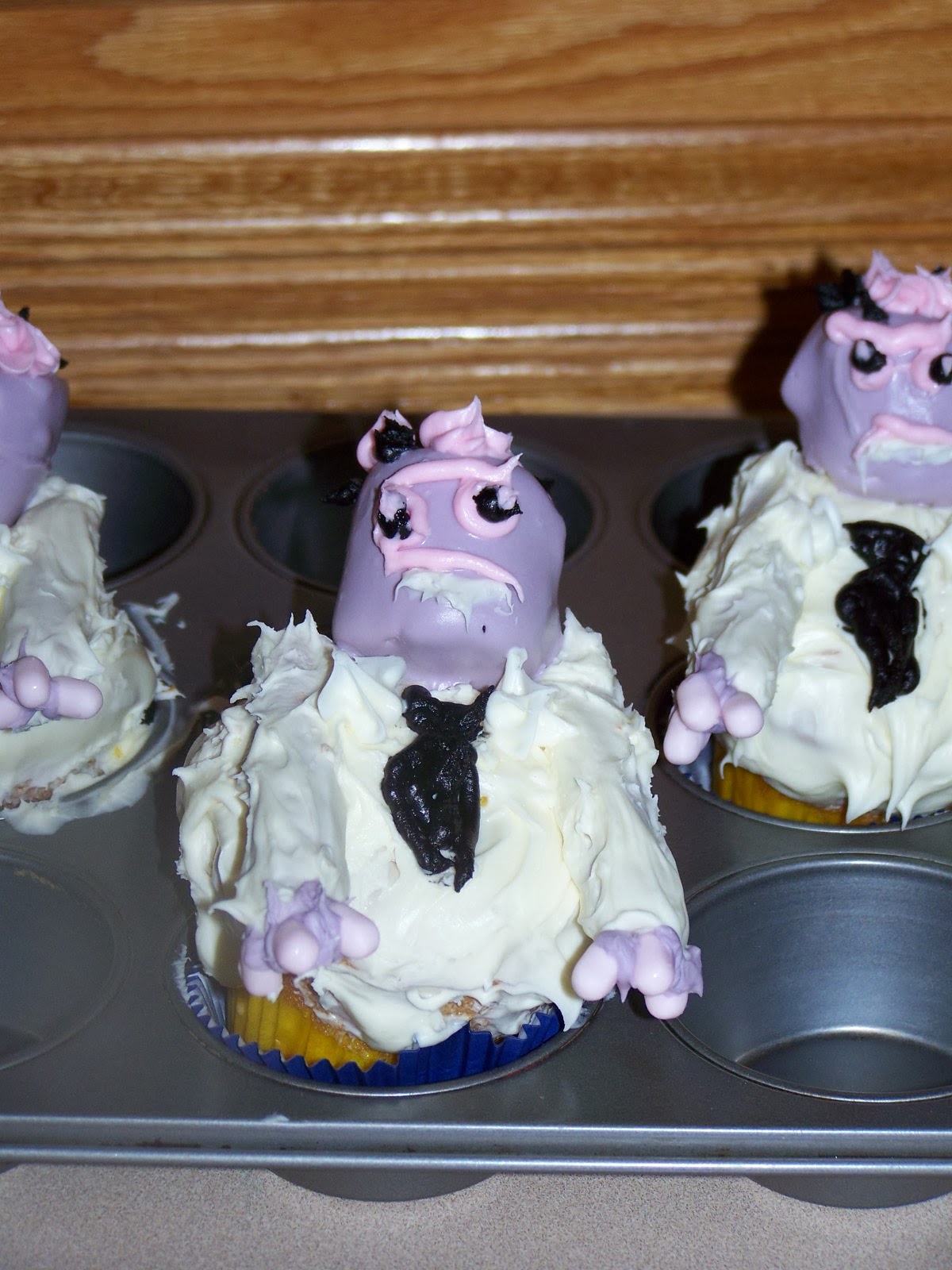
The Mrs. and I were visiting family over the weekend when one of the young geeks-in-training surprised us with a terrific Halloween treat: zombie cupcakes.


It's rare that a food item combines two things that I really love--zombies and pastry--but these cupcakes had it all. With pretzel sticks for arms, Tic Tacs for fingers, marshmallows for heads, and thick icing for skin, eyes, mouths and hair, these desserts of the damned can cause an epic sugar high that any horror fan would love. All that was missing were a few hapless gingerbread men (with sweet gumdrop brains) for these carnivorous confectionaries to terrorize.

Click below to see more pictures of this horde of undead delights.


V/H/S (2012) Movie Review

0 comments


With V/H/S/2 set for national release this weekend, I figured that I should finally see the first movie in this fledgling found footage anthology franchise. I enjoy the horror subgenre of found footage, but anthology movies never appealed to me so I wasn't particularly interested in seeing V/H/S in spite of the buzz that it has generated in the horror fan community.

Regardless, I'll give V/H/S credit: It's the first film that attempted to combine the visual style of found footage with the anthology approach to horror. While the end result isn't a success, it has enough interesting ideas to whet the appetite of found footage fans for what a better film could do with the same approach. Read on for my complete review.

Anthology movies are usually hit-and-miss in terms of quality (some more "miss" than others), and V/H/S is no exception. V/H/S is divided into six stories:

* "Tape 56", directed by Adam Wingard. A group of criminals that record their crimes and sell the footage online take a job that requires them to break into a house to find and retrieve a particular video tape. When they arrive at the house, they find a corpse sitting in front of a stack of TV sets and VHS players. "Tape 56" is the framing narrative for the rest of V/H/S, with the other stories being represented by tapes the criminals watch during their search.

* "Amateur Night", directed by David Bruckner. Three friends set up a motel room and a hidden camera with the intent of making amateur porn video with the women they plan to pick up during a night of bar-hopping. Their plan goes horribly awry when one of their intended sex partners reveals that she isn't what she appears to be.

* "Second Honeymoon", directed by Ti West. A married couple's second honeymoon is disrupted by a series of increasingly strange events.

* "Tuesday the 17th", directed by Glenn McQuaid. Four friends go on a camping trip to an isolated location that was the site of several brutal murders the year before.

* "The Sick Thing That Happened to Emily When She Was Younger", directed by Joe Swanberg. A girlfriend tells her boyfriend via video chat about odd noises she hears in her apartment during the night. She uses her laptop's built-in camera to show her boyfriend what happens when she decides to investigate the noises, and in doing so she learns that she's not alone.

* "10/31/98", directed by Radio Silence. A group of college students get together to go to a Halloween party, but wind up somewhere that is farthest thing from a party.


As with other entries in the found footage subgenre, the crucial detail is whether the movie benefits from using the found footage aesthetic. If you're going to shoot a movie as found footage, then the movie has to integrate that detail as a primary part of its narrative; otherwise, the movie might as well be shot as fiction films usually are and not as found footage. Unfortunately, the found footage style does not add much to the stories in V/H/S. Each of the protagonists use consumer-grade video cameras to document key moments of their lives in some way, but the cameras and the act of using cameras do not feel integral to the telling of the stories.

Further hindering the quality of V/H/S are the stories themselves, which are neither original nor engaging. I’m particularly disappointed that the film did not take advantage of one of its own recurring plot points--the idea of a collector who amasses a sizable inventory of footage of people in final days, hours and minutes of their lives.

Even though V/H/S won't bring any new fans to the found footage subgenre, it does have a few noteworthy moments:

* There's a chilling scene in "Second Honeymoon" involving video footage shot in a hotel room in the middle of the night. While this doesn't sound exceptional on the surface, director West sets it up to be the most memorable sequence in the movie.

* "Tuesday the 17th" is like an abbreviated slasher movie, but with two unique details: its "final girl" has a very disturbing idea about how to stop the killer, and it uses static and digital distortions in the footage to indicate the direct presence of a malevolent force. The distortion effect is unnerving to see--it's sort of like the Predator's cloaking device, only much more surreal--and it's a shame that the story didn't make better usage of it.


* "Tape 56" and "Amateur Night" play with the idea of sleazy digital voyeurism, although both use it as a plot device to set up the protagonists for their grisly yet predictable fates. Yet when I watched these characters plan and execute abusive, violent and exploitative activities for the sake of recording them for profit, I couldn't help but to think of recent all-too-real controversies surrounding high schools in Steubenville, OH and Saratoga, CA, where teenage rapists used digital media to document and brag about their crimes. With that in mind, I'm guessing that a found footage variation on I Spit on Your Grave is only a matter of time.

From what I've heard so far, V/H/S/2 is a better movie than its predecessor. In contrast, V/H/S is an intriguing but unsuccessful experiment with the found footage subgenre, and it thus would only be of interest of the subgenre's most devoted fans.


Must-See BBC TV: In the Flesh

0 comments


With so many zombie-themed movies, TV shows and video games on the market these days, it's hard to find a zombie story that's genuinely unique. Most follow the apocalyptic bloodbath plot that was pioneered by George Romero in his zombie films. In contrast, the BBC has broadcast In the Flesh, a three-part miniseries that has roots in Romero's work but takes it into provocative new territory.

Created and written by Dominic Mitchell, In the Flesh is about a British teenager named Kieren (Luke Newberry) who is being treated for "Partially Deceased Syndrome", or PDS. PDS is the term given to the phenomenon that reanimated the dead in a zombie outbreak that happened four years earlier. In the time since then, a large number of zombies--or "rotters" as they are called in the miniseries--have been rehabilitated through medical treatments and are being integrated back into society. The series follows Kieren as he returns to his family in the rural village of Roarton and how he and the world around him are adjusting to existence of the partially dead among the living.

While there are some brief flashes of gore in In the Flesh, it is not your typical zombie story. It takes the imagery, concepts and symbolism associated with zombies and uses them to examine modern issues such as drug abuse, mental health, Post-Traumatic Stress Disorder (PTSD), and widely-publicized diseases such as cancer and AIDS. In the series' post-outbreak world, PDS sufferers receive daily injections of a medication called Neurotriptyline and therapy to help them move on with their (after)lives, while family members of PDS sufferers can attend support groups to discuss the difficulties of caring for loved ones who are neither completely alive nor dead. Government-published posters and literature about PDS make cameo appearances throughout the series, while some survivors of the zombie outbreak are appalled at having to accept PDS sufferers--including ones they knew and cared for before the outbreak--as equal members of their community. In a sense, In the Flesh is the equal but opposite of Bob Clark's Deathdream (1972).

The plot device of rehabilitating zombies has been played for laughs many times before, such as in Shaun of the Dead, Fido, Ugly Americans and Warm Bodies. Yet In the Flesh plays it mostly straight and it works, largely due to Mitchell populating his story with so many interesting ideas, vivid details and nuanced characters. Monsters have been used as metaphors for diseases and social problems many, many times before, but it's rare to see a story like In the Flesh that takes the perspective of people who have to care for loved ones who have become "monsters" and how the newly monster-ized cope with their not-quite-human status. (For another good example of this, see my essay on the original The Fly and its sequels.) Between the strength of the script and wonderful performances by the cast, this series succeeds as a horror drama, a rare accomplishment in horror television. My only complaint is that the series runs for just three hour-long episodes; Mitchell provides so many details and subplots within his story that I'd love to see where it goes next after the third episode comes to an end.

If you're looking for hordes of zombies having a blood-drenched, entrails-splattered feeding frenzy on the living, this miniseries is not for you. Yet if you're looking for a unique, rewarding and thoughtful story about the living dead, In the Flesh is something you need to see. With the topics such as mental health, PTSD and suicide making frequent appearances in current discussions over gun violence and veterans returning from extended tours in the Middle East, In the Flesh really is a zombie tale for our time.

For more details about In the Flesh, including an annotated shooting script for the "Understanding PDS" public service video, check out the official series page over at the BBC site.


The Walking Dead and the Challenges of Cross-Media Adaptations

0 comments


When it comes to movies that are adaptations of novels, everyone knows the drill by now: the book is usually better than the movie. It's a fair criticism, since the printed page is a very different medium than the moving image. But what happens when a TV show attempts to adapt a serialized--and unfinished--comic book series? With AMC's The Walking Dead, we're watching such an attempt play out now on prime time.

I've read through the first 70 issues of the Walking Dead comic book, which was created and written by Robert Kirkman, so I have ample amounts of source information to draw from when comparing it to its televised counterpart. I enjoy the TV show's ample amounts of zombie gore, and I thought that it got off to a great start in its first six-episode season. But after watching the meandering second season and seeing the third season end so poorly last week, I'm beginning to wonder how much longer this show can go with its rapidly rotting legs in spite of its high ratings. Read on for my analysis of the show, and why adapting an ongoing comic book series into a different medium requires much more planning and foresight than adapting a single novel.

NOTE: This post makes many references to events in both versions of The Walking Dead. Thus, if you aren't familiar with either of them but want to read/see them later, you might want to skip this post to avoid spoilers.

When The Walking Dead first appeared in comic book stores back in 2003, I was impressed at how it took an idea that's been around since George Romero's Night of the Living Dead--a global zombie epidemic--and turned it into a serialized narrative. Essentially, The Walking Dead is Night of the Living Dead: The Series; why nobody through to do this before Kirkman still astonishes me. Unlike Living Dead's sequels, which jumped to different sets of characters at different locations during the epidemic, The Walking Dead stuck with a group of characters during society's collapse in the wake of the epidemic and how they try to bring stability back into their lives while stuck in a world overrun by reanimated, flesh-eating corpses. Because the story was told through the pages of a comic book, the narrative possibilities were limited only by the imagination and talent of the comic's writer and artist.


The TV version of Walking Dead started in 2010 and it has tried to recreate the comic in many aspects. Most of the central characters and story arcs that appear in the comic are also in the TV show, with varying degrees of accuracy. However, due to the complications that come with TV production (in this case, AMC cutting the show's production budget and then ordering a larger number of episodes per season, as well as a seasonal succession of showrunners), the TV Walking Dead runs at a much different pace than the comic, which has resulted in some peculiar and counter-intuitive creative choices.

I've read many complaints (many of which I think are spot-on) about the Walking Dead TV show in how it handles its female and non-white characters. Here are some of the complaints that I have:

* The farmhouse story arc that only lasted for six issues in the comic was stretched for the entirety of season two, which ran for thirteen episodes. To me, it felt like a five-episode arc that was padded into a thirteen-episode season.

* The prison vs. Woodbury story in the comic was very simple: Rick, Michonne and Glenn are held prisoner by the Governor in Woodsbury, they escape back to the prison, and then there's a fight between Rick's group and the Governor's personal army at the prison, which results in massive casualties. This same story arc was the basis of season three and it felt like many details and subplots were added to simply to meet the sixteen episode requirement for the season, not to push the show in an interesting new direction. In the TV show, not only did the Governor survive the final confrontation at the prison, he also survived several other instances throughout the season where he should have logically died.


In spite of the differences between the details and pacing of the story arcs between the comic book and the TV show, it seems that the show's producers want the TV characters to develop the same way as their comic book counterparts do and when they don’t, another character is swapped in to take his/her place. When Dale was killed in season two at the farmhouse because the actor who played him quit, Herschel takes his place in season three (complete with losing a leg due to a zombie bite in the prison, just like Dale) even though he was the one who died at the farmhouse in the comic. I've also noticed that when the narrative trajectories of the TV characters stray very far from their comic book counterparts (specifically Andrea and Carol) the TV show doesn't know what to do with them. In contrast, I can see why Daryl is the most popular character in the show: Because he appeared briefly in the comic early in its run, the TV writers had many more opportunities to develop Daryl without having to meet any narrative requirement from the comic or use him as a replacement for a prematurely dispatched character.

When adapting a novel into a movie, the filmmakers naturally have to choose what can be translated from the printed page to film, and what cannot be translated due to budgetary and/or running time restrictions. In the case of The Walking Dead, the demands of AMC and TV production in production in general prohibit the series from being a faithful adaptation of the comic, yet it nevertheless remains dedicated to keeping the same characters and stories from the comic even past the point of its own internal logic.

Looking back, it may have been better for AMC to produce a Walking Dead TV series as a spinoff to the comic book that takes place in the same universe. That would've given the show's creative team more freedom to develop characters, settings and story arcs that are much more complementary with the show's budget and production schedule. In fact, a spinoff might have even been better than The Walking Dead comic itself. Despite the freedoms that the print medium allows, the comic hasn't moved past the main theme of every George Romero zombie movie: no matter how grotesque and dangerous the reanimated dead are, the living can and will be much, much worse. It's a compelling theme, but at over 100 issues and counting you'd think that a zombie comic book would have something else to say by now.

The Governor (David Morrissey) and Rick Grimes (Andrew Lincoln):
Gunfight at the Zombie Corral?

This wouldn't be the first time that a TV network would impose difficult and counterproductive demands on a genre TV show. The original Battlestar Galactica was supposed to be a series of made-for-TV movies, but ABC demanded that it be made into a TV series instead--a series that was later cancelled because the declining ratings weren't enough to justify the series’ large production budget, a problem that probably wouldn't have happened if ABC hadn't rejected the original plan of TV movies. Likewise, the original 1983 miniseries V was made on a very small budget, but that didn't keep NBC from deciding to continue the V story as a weekly TV series the following year. It too was cancelled after one season, and for the same reasons as Galactica's cancellation.

The Walking Dead doesn't appear to have the same problems as Galactica or V because it keeps setting ratings records and has been renewed for a fourth season. Yet if it doesn't do something to set itself apart as a TV series with its own dramatic momentum apart from the source comic, this zombie show could wind up dropping dead in the ratings before it sees a fifth season.


Using Zombies in Hardware Store Ad Campaign = Success; Using Hardware Store in Zombie Mockumentary = Unemployment

1 comments


During the Halloween season of 2011, I posted a story about how the Westlake Ace Hardware chain of stores in Nebraska used zombies as part of a new advertising campaign. This zombie-themed campaign, which included a witty Web site and in-store "Zombie Preparedness Centers", was a big success. Unfortunately, someone in Georgia didn't get the memo.

According to reports from news sites around the Internet, a group of college students in Georgia produced a documentary short film called When The Zombies Come that won a prize at the recent Sundance Film Festival. The film was shot an Ace Hardware store in Lawrenceville, GA, and it featured real-life Ace employee Alex Warner explaining why a hardware store would be a perfect place to be during a sudden zombie outbreak. One would think that this high-profile, prize-winning mockumentary--a mockumentary that was made without a dime from Ace itself--is an ideal extension of the aforementioned Ace advertising campaign, right? Apparently, Ace Hardware management in Georgia feels otherwise. Ace posted a cease and desist letter on YouTube, claiming that the short can potentially damage Ace's reputation and trademark infringement, and have cut the working hours of Warner to zero.

Here's a screen capture of Ace's expression of displeasure of the film that was posted on Facebook:


Here’s the offending video, courtesy of YouTube:


So far, no complaints have been filed on behalf of the zombie community over the short's supposedly offensive nature. I guess we'll have to wait for the pending zombie apocalypse to know for sure.


Three Wii Horror Games That Were Never Released

0 comments


With the official release of the Nintendo Wii U console just a few days away, I thought I would take the time to look back at three promising horror titles for the Wii that never made it to the store shelves. Mind you, I'm not talking about horror games that were released for the Wii overseas but not in the U.S. (although there are a few of those, such as Japan's Night of the Sacrifice), nor am I talking about horror games that were released for the PS3 and Xbox 360 and not the Wii. No, these are games that spent plenty of time in production and development but for whatever reason were not released--ever. Click below to read more about these unseen Wii games (listed in alphabetical order), games that may still have a chance on the Wii U.

Title: The Grinder

Developer: High Voltage Software


Plot: The Grinder takes place in an alternate world where vampires, werewolves and zombies are very real problems for humans. Players can choose to play one of four monster hunters--Hector, Doc, Miko and AJ--who are hired by a secretive organization called Book to exterminate hordes of these monsters and to discover their origins.

Background: From what I know about this game, The Grinder looks and feels like what Hunter: The Reckoning would have been like if it had been designed as a first-person shooter. And what a first-person shooter The Grinder would be: Players would spend level after level gunning down rows of gargoyle-like vampires, hulking werewolves, and hard-to-kill zombies. The game is also supposed to feature a "dual wield" option for the weapons, as well as online cooperative play that could accommodate up to four players simultaneously. See the videos below for the teaser ad and a game play preview.


Wii U Release?: There's no word on whether The Grinder will appear on the Wii U. The last I read about it, this game was put on IGN's "Games in Danger" list back in 2011 and I couldn't find anything else about this game since that article was posted. Still, with plans to broaden its player base by porting this game over to the PlayStation 3 and Xbox 360 consoles as a top-down, third person shooter--while still remaining a first-person shooter for Nintendo--I'm hoping that The Grinder will have some kind of afterlife through the Wii U. Click here to see IGN's page about The Grinder.


Title: Last Flight

Developer: Bloober Team


Plot: Last Flight takes place on a gigantic passenger airplane during its maiden flight. A mysterious virus spreads through the plane that turns many of the passengers into vampires. Players can either play as Larry, a portly American food critic, or Anna, a Romanian vampire, to fight off the new army of bloodsuckers and find a solution that can stop the virus before the plane lands.

Background: Even though its fate has yet to be decided, I'm still excited about Last Flight. It features some very bloody hack and slash action, and it puts the survival horror format into a very confined and claustrophobic environment: an airplane. The plot device of a passenger airplane that carries a virulent pathogen has been used before in movies like Flight of the Living Dead (2007) and Quarantine 2 (2011), but Last Flight would be the first video game that I know of to exploit such a premise to challenge and scare gamers. Furthermore, the game was intended to be released as an ongoing WiiWare title with new episodes released every few months, thus bringing serialized storytelling to horror gaming. See the videos below for the teaser ad and a game play preview.


Wii U Release?: News about Last Flight has been circulating since 2008, so I would like to believe that at least the first episode of this game is ready and waiting for release. However, I have no idea if it will be released for the Wii U or if it is, if it will need to be updated to add features for the Wii U's touch screen controller. Click here to see IGN's page about Last Flight.


Title:Winter

Developer: n-Space


Plot: Winter puts gamers in the role of Mia, a young woman who awakens within a wrecked ambulance and cannot remember anything about herself or the events leading up to the wreckage. The town she finds herself in is experiencing an unusually powerful snowstorm, which is causing the temperature to drop to dangerous, frostbite-inducing levels. As players keep Mia alive and search for clues regarding her past, they encounter strange creatures that seem connected to the snowstorm ... and to Mia herself.

Background: It's hard to read about Winter and not compare it to another Wii title, Silent Hill: Shattered Memories. Nevertheless, the development team behind Winter wanted to emphasize the "survival" aspect of survival horror within their game, and that's a creative goal that I'm willing to support. It also helps that the pictures I've seen so far of the game's creatures are as intriguing as they are disturbing, so I'm itching to find out what they have to do with a temperature-plunging snowstorm that never seems to end. See the video below for a game play preview.


Wii U Release?: Of the games listed in this post, I think that Winter has the greatest likelihood to make it to the Wii U. Gamers have shown their interest through a few fan petitions, and a representative from n-Space had this to say in an interview that was posted on the Nintendo Everything site last August: "There's an intense amount of love among the team for the game. And the more we've seen the survival horror genre switch its focus from surviving to reloading, the more we feel the market is hungry for a game like Winter. So what's the bottom line? The bad news is that we haven't yet found the right opportunity. The good news is that Winter is just like any good horror movie monster. It's not dead." Click here to see IGN's page about Winter.


REC 3: Genesis (2011) Movie Review: 'Til Demonic Possession Do You Part

0 comments


After watching all of the films in the REC franchise so far, I've come to this conclusion: The ending for the first movie in 2007 was that film's "twist" ending. Period. I don't think that the film's creators had any plans to explore that ending in any greater detail, let alone build a franchise around it. Yet a franchise is what REC started and as of the latest entry, REC 3: Genesis, fans are no closer to learning anything more about the larger significance of the ending of the first film within the REC universe.

To be sure, REC 3 is not a bad horror film; its director Paco Plaza has a lot of talent and it shows in many sequences of this sequel. But even though REC 3 is a more polished movie than its predecessor REC 2 (2009), it still is a weak sequel in terms of advancing the plot that was started in the first movie. Read on for my complete review. Note: If you haven't seen REC yet but would like to, skip this review now and come back later because this review will spoil the ending of that movie for you.

REC 3 is takes place on the wedding day of a young couple, Koldo (Diego Martin) and Clara (Leticia Dolera). Everything appears to be perfect on this day of holy matrimony, except for one of the guests who arrives with a peculiar injury that he sustained just before the ceremony. As the wedding ends and the reception festivities begin, the guest's injury erupts into a vicious epidemic that threatens to engulf everyone in its path.


As a sequel, so much goes wrong here--even its title is a misnomer. The term "REC" suggests "record", which calls attention to the found footage style of the first two movies, but REC 3 only features found footage-style cinematography for the first third of the movie and the rest is shot like a regular feature. The subtitle "Genesis" suggests to REC fans that the second sequel might reveal something significant about Niña Medeiros, patient zero of the demonic possession epidemic first seen in REC. It doesn't, and the real meaning of the word "Genesis" within the narrative of REC 3 will leave fans disappointed. The connections between REC 3 and the other two movies are negligible, so much so that it almost feels like REC 3 is a sequel-in-name-only. Indeed, REC 3 does not live up to the description provided on IMDB, which states: "In a clever twist that draws together the plots of the first two movies, this third part of the saga also works as a decoder to uncover information hidden in the first two films and leaves the door open for the final installment, the future REC 4: Apocalypse."

So, with REC 3 failing as a sequel, how does it fare as a horror movie? Better than you'd expect, but still it falls short where it counts. Using a wedding reception as the site of a gory outbreak leads to some unique scenes and situations. Plaza sets up a few good scares and keeps the pace running smoothly; he also throws in plenty of gory gags that will remind horror buffs of splatstick classics such as Evil Dead 2 (1987) and Dead Alive (1992). Yet Plaza's turn towards humor after the previous two films, which were very serious in their portrayal of horror, indicates a reluctance of sorts on his part. Such reluctance dovetails with the ongoing problem of the REC franchise's portrayal of victims of the demonic possession, victims who behave more like zombies than anything else. Sure, the reflection of the victims in mirrors and other reflective surfaces show their true demonic nature, they refuse to set foot in churches and they stop dead in their tracks whenever someone quotes Bible verses, but otherwise the victims are indistinguishable from most movie zombies. If the victims acted more like they were possessed by demons and less like zombies, they'd probably be much scarier.


The demonic possession/zombie outbreak quandary in the REC franchise brings me back to the beginning of this review. Plaza and his co-director Jaume Balagueró set up the situation in REC to seem like a zombie outbreak (particularly a zombie outbreak similar to the one seen in 2002's 28 Days Later) but then threw in a twist ending that revealed the cause of the outbreak to be a communicable form of demonic possession. Yet with this narrative rule established in the first movie, REC 3 doesn't get much mileage out of it. After all, if someone is possessed by a demon, a non-corporeal embodiment of pure evil, then the victim should torment, torture and do other evil, vile things while under the control of the demon. A demonic outbreak on their wedding day should be an unrelenting nightmare for Koldo and Clara, since demons possess their family and friends--people who are the closest to the couple and could thus psychologically abuse them in grizzly, twisted ways. That doesn't happen, so instead we get the usual zombie high jinks: blood-gushing cannibalism, dismemberment, disemboweling and decapitation. Ho-hum.

There was a lot that I didn't like about the first sequel, REC 2 (read my review of that film here). One of the worst things that it did was to bring up a very interesting and revealing plot point early in story--that the priest who was assigned by the Vatican to treat Medeiros also infected children with the demonic possession while searching for a cure--and then ignoring it for the rest of the film. That thread alone could have been expanded for the plot for REC 3, tracking the Medeiros case from its beginnings in Portugal to its arrival in Spain and its subsequent involvement of child test subjects. This plot could also have be used by Plaza and Balagueró to provide metaphorical commentary about the ongoing child abuse scandal within the Catholic Church and/or the Vatican's reinstatement of the dubious practice of exorcism in contemporary society. It could be that Plaza and Balagueró never considered such possibilities for their franchise, or they did but decided against doing so to avoid courting controversy. Nevertheless, the refusal to take the REC franchise to darker, uglier places makes its sequels feel like increasingly bashful continuations of the bold REC. With that in mind, I'm guessing that the upcoming REC 4: Apocalypse will not be nearly as apocalyptic as its title wants you to believe.


Between its splatstick sense of humor and well executed but otherwise unexceptional demon/zombie gore, REC 3 feels less like a sequel to REC and more like a sequel to Lamberto Bava's Demons (1985). In fact, with some minor edits and some bad English dubbing, REC 3 could be re-titled as Demons: Rebirth and put into a DVD box set with Demons and Demons 2 (1986) and few would be the wiser for it. If you view REC 3 with that in mind, you might enjoy it; if not, expect to be disappointed.


It's a Beastly Bare-Skinned Bloodbath in Wii's Onechanbara: Bikini Zombie Slayers

0 comments


As of this post, I have come to the end of the horror video games that I'll be reviewing for the Wii, at least for the time being. With Wii U's release set for later this month, I figured that I'd ease off the video game reviews for a while until the new Nintendo console has a chance to settle in and demonstrate how its new selection of touch screen controls complements the pre-existing motion controls. Thankfully, the Wii U is reverse compatible with Wii games, so feel free to come back to this site for reviews of low-priced Wii games that you can play to tide you over until you can afford the more expensive Wii U games.

This review is of Onechanbara: Bikini Zombie Slayers, which was released for the Wii back in 2009 by Tamsoft. In case you couldn't tell by the title, Onechanbara is a big, heaping serving of campy Japanese gore cheesecake, a video game counterpart to films such as Tokyo Gore Police (2008) and Vampire Girl vs. Frankenstein Girl (2009). As a game, it feels like an oversimplified version of Hunter: The Reckoning, but the main appeal of Onechanbara is found in its endless supply of blood and dismemberment. Read on for my complete review.

Onechanbara allows you to control up to four different characters: Aya and Saki, two sisters who have inherited something known as "Baneful Blood", and Reiko No. 9 and Misery, the game's villains who seek to understand and control the Baneful Blood for their own purposes. Each of the four characters has her own set of skills, strengths and weaknesses, but all of them have the Baneful Blood. The Baneful Blood causes the characters to go into a nearly unstoppable rampage after coming into direct skin contact with enormous amounts zombie blood; thus, Aya wears only a bikini when fighting zombies so that she can maximize her power. (Yes, really.) Where the Baneful Blood becomes a liability within the game is that the longer a character is under the influence of the Baneful Blood, the more that character's life will drain. If a character stays under the spell of the Baneful Blood for too long, she will die and the game will end.


The level environments you play through for each character in Onechanbara are the same: a graveyard, a church, a hospital, a series of streets in a city, a subway station, a forest, and an underground research facility. The sequences in which levels are provided and the kinds of zombies and monsters that inhabit them differ somewhat depending on the character, but there are no additional environments outside of this set. Such simplicity makes Onechanbara feel more like an arcade game than a home console title, since fast-paced action takes a much higher priority than diversity and complexity of game play. There are very few cut scenes, and many of those scenes are just internal monologues that provide expository information about the Baneful Blood, the latest zombie outbreak, and the characters themselves. The game does feature a multi-player option, but that is only available in levels that have been completed in single-player story mode. Curiously, for as simple as the game is, it includes four different stories that have four different endings, one for each character.

I normally don't like hack and slash and brawler games, largely because they become repetitive and eventually bore me. Even the visually impressive and hyper-violent game MadWorld lost my interest after a few levels. Yet in spite of its rote game play, Onechanbara stands apart from other hack and slash games for one major reason: its massive amounts of gore. I would even say that Onechanbara is as gory as (if not gorier than) House of the Dead: Overkill. Such violence may not appeal to some gamers, but gamers who are fans of movies such as Night of the Living Dead, Evil Dead and Dead Alive--and/or fans of the Japanese gore titles I mentioned above--will be thoroughly entertained.


In each level, you'll hack and slash through many hordes of zombies, as well as slay a few other kinds of monsters that appear to keep things interesting. (Of particular note is a monster called the Exorcist, a spider-like creature that's made from the torso of a partially dismembered corpse.) The zombies in the Onechanbara universe are not the kind that can be stopped with an injury to the brain; these zombies must be completely dismembered in order for them to stop moving. As you use your sword to cut the zombies to pieces, blood gushes in all directions from the limbs, heads and torsos as they spin through the air, and a few droplets of blood splatter even hit the screen from time to time. There's so much zombie blood in Onechanbara that you frequently have to clean off your blade with the flick of the Wiimote so that your sword won't get stuck in a zombie.

It should also be mentioned that Onechanbara is the only non-fitness game for the Wii that made my arms sore. The control scheme requires you to keep the Wiimote and nunchuk moving almost all of the time, so playing this game through multiple levels in a single sitting will make you sweat.


Other than its limited set of levels, the only other complaint I have about Onechanbara is that the story behind the game is more interesting than the game itself. After doing some online research, I found out that Bikini Zombie Slayers is just one of ten games set in the Onechanbara series. Of these games, only two were released in the US: Bikini Zombie Slayers for the Wii and Bikini Samurai Squad for the Xbox 360. (Note: Bikini Samurai Squad features the first appearance of Misery, and her subsequent resurrection is one of the story arcs in Bikini Zombie Slayers.) Thus, if you're like me and want to know more about the Onechanbara universe, you'll either have to buy the other games that were released overseas or just be content to watch the live-action Onechanbara movie that was released in 2008. Personally, I'd rather play the games.

In a nutshell, Onechanbara: Bikini Zombie Slayers delivers a game where scantily-clad women drench themselves with gallons of blood as they hack and slash through legions of zombies. If that sounds like your kind of entertainment, then you probably won't mind the game's repetitive game play and small selection of level environments.