Showing posts with label essay. Show all posts

Great Moments in Toy Robot History: Shogun Warriors

0 comments


The origins of popular and recurring trends in pop culture can sometimes be difficult to pinpoint, especially trends that have gone on for so long that they become an accepted fixture of everyday life. For this post, I'm talking about Japanese robot toys that are imported and sold in the U.S. I'm sure robot fans who are around my age will remember how Japanese robot toys dominated the shelves of toy stores during the 80s, but the trend of U.S. toy companies securing the rights to sell Japanese robot toys in North America actually began in the 70s with Mattel's Shogun Warriors. While the Shogun Warriors line didn't last long, its influence would impact the toy industry for decades to come. Read on for my retrospective of this trend-setting toy line.

The idea of importing toys from one country and then selling them in another is not a new idea unto itself. However, what made the Shogun Warriors different was that included merchandise from many different points of origin but was sold under a single brand name. Mattel marketed the robot toys as if they all inhabited the same shared universe but they actually originated from over a dozen different Japanese "Super Robot" anime series, series such as Brave Raideen, Gaiking and Voltes V.


To encourage the perception of a unified product line, Mattel gave the licensing rights to Marvel Comics to create a Shogun Warriors comic book series, where the robots coexisted as a single force for good against an evil alien force. There was also a syndicated cartoon series called Force Five that was set up to show five of the anime series upon which the Shogun Warrior toys were based. Unfortunately, the Shogun Warriors line was winding down by the time Force Five made it to the air and only a handful of TV markets carried the series for the brief time that it ran.


Not to limit itself to Super Robot anime, Mattel also secured the rights to Godzilla and Rodan, two monsters from famous Japanese Atomic Age kaiju movies, so that they could be added to the Shogun Warriors line as monsters for the giant robots to fight. As far as I know, Shogun Warriors is the only toy line that has combined Super Robot anime with live-action kaiju films; from that perspective, Guillermo del Toro's Pacific Rim (2013) could also have been named Shogun Warriors: The Movie.


A Godzilla figure from the Shogun Warriors line, complete with 
launching spring-loaded claw and extendable tongue of fire.


Shogun Warrior robots came in three different sizes: 24 inches, 5 inches, and 3.5 inches. Even though the 24-inch robots are what most people remember about the Shogun Warriors line, you could see some items from the robot toys' original anime series in the Shogun Warriors' "Action Vehicle" toys. For example, the Rydoto Action Vehicle was actually from the Brave Raideen anime series and the Kargosaur Action Vehicle was from Gaiking.


Curiously, some of the Shogun Warrior Action Vehicle toys had nothing to do with any Super Robot anime series; they were just toys that Mattel apparently decided to include in the line anyway because they looked similar enough to the robots. After all, none of the anime series upon which the Shogun Warriors toy line was based aired on U.S. television during most of the line's release, so it wasn't as if the kids who were buying the toys would know the difference.


The Shogun Warriors' Heli-Capter Action Vehicle 
(Japanese TV show of origin unknown).


The Shogun Warriors line didn't last long and completely disappeared from toy stores within a few years of its launch. Regardless, its approach to licensing Japanese robot toys in bulk was also used by other toy and model kit lines that were released in the U.S. during the 80s:

* Hasbro's Transformers line was a combination of Takara Tomy's Diaclone and Microman lines, and the Transformers marketing campaign depicted the robots and sentient beings from another planet.

* Matchbox's Voltron line was a combination of robot toys from three anime series: Beast King GoLion, Armored Fleet Dairugger XV and Lightspeed Electroid Albegas. However, when the Voltron cartoon series was assembled to help promote the toy line, footage from Albegas was not included.

* Revell's line of Robotech model kits combined robot kits from three anime series as well: Fang of the Sun Dougram, Super Dimension Fortress Macross and Super Dimension Century Orguss. Yet when the Robotech cartoon was assembled, footage from Dougram and Orguss were not used and Macross was edited together with footage from Super Dimension Cavalry Southern Cross and Genesis Climber MOSPEADA.


One of Revell's Robotech model kits that's originally from 
the Fang of the Sun Dougram anime series.


Over time, the concept of mashing together Super Robot anime series into a single line of merchandise eventually made it back Japan itself with the arrival of Super Robot Wars in 1991. Super Robot Wars is a series of tactical role-playing video games where players can choose from a selection of Super Robots from various anime and manga series. This selection also includes the titular robots from Mazinger Z and Getter Robo, two of the robots that were also featured in the Shogun Warriors toy line. The Super Robot Wars game series continues to this day, and has since expanded to include anime and manga series of its own.

To learn more about the Shogun Warriors, check out the following fan sites:

* Wildtoy's Shogun Warriors Page

* Weird Science-Fantasy's Shogun Warriors Page

* Ted Terranova's Robot Page.


A Shogun Warriors Halloween Costume.


Remembering Return of the Jedi

0 comments


This last weekend marked the 30th anniversary of the theatrical release of Star Wars: Return of the Jedi, which was released on May 25, 1983. Being a life-long Star Wars fan, it would be wrong for me not to do some kind of retrospective about this moment in modern geek history.

At the time of its release, Return of the Jedi marked the end of an era for me. Star Wars wasn’t just my gateway drug into all things geeky; it was a rehab-worthy addiction that began with Star Wars in 1977 and ended in 1983 with Jedi. That’s six years of toys, books, comics, posters, bubblegum cards, board games, magazines, t-shirts, Underoos, pajamas, bed sheet sets, window curtains, towels, wallpaper, drinking glasses, vinyl records, and dozens of other licensed items that I cannot recall at the moment. That list doesn’t include the release of Empire Strikes Back in 1980 and the subsequent theatrical re-releases of both Star Wars and Empire before the arrival of Jedi; each of these trips to the movie theater helped to spur the anticipation for anything and everything connected to the Star Wars franchise.


What might have been: Revenge of the Jedi poster


After spending so many years being obsessed with one franchise--a lifetime in the eyes of a child--things just weren’t the same after Jedi. At the time, George Lucas and Lucasfilm didn’t seem interested in continuing the Star Wars franchise (at least on the scale of another movie trilogy), so a pervasive feeling of finality had set in quickly after Jedi left the theaters. Marvel kept publishing issues of their non-canonical Star Wars comic until 1986 and Star Wars would appear every now and then on TV with the Ewoks and Droids cartoons and the Ewok TV movies, but the fan enthusiasm that permeated the years of the original trilogy had evaporated. There were no new movies on the horizon, so kids my age sobered up and moved on to other things.

Looking back, I don’t recall anything else like what the original Star Wars trilogy brought to pop culture, or any other series that provided the kind of final act that Jedi was. There have been plenty of fantasy and sci-fi trilogies since then, as well as noteworthy third movie installments in other film franchises, but none of them could match the mood of Star Wars. Sure, Lord of the Rings was a popular movie trilogy, but you could always read the novels if you couldn’t wait for the next movie installment; in contrast, you couldn’t read ahead in the Star Wars trilogy, so you had to wait three years at a time with everybody else for the next movie. There were also other movie-only trilogies such as the Back to the Future and The Matrix trilogies, but their mediocre second installments and overall lack of kid appeal quelled whatever excitement those series could muster.


George Lucas and R2-D2, surrounded by the original Star Wars trilogy in miniature.


Between its overall quality and uniqueness, as well as its significance both within the original trilogy and to the prequel trilogy, I think that Jedi is a gem of a film that deserves much more respect than it gets. At its heart, the Star Wars series is sci-fi pulp serial along the lines of Flash Gordon and Buck Rogers and the visual sophistication of Jedi is a celebration of that kind of storytelling. It featured a huge selection of new aliens (Jabba the Hut, Admiral Ackbar, the Rancor monster, etc.) and action sequences that pushed the envelope of what practical special effects were capable of during the early 80s. While these dazzling visual treats flashed by on the silver screen, story arcs came to an end, an empire lost its emperor, the Jedi were beginning to return, and a cast of characters who matured over the course of three movies made their final curtain call. If another movie trilogy provided a better ending than Return of the Jedi, I can’t think of one.


Star Trek Boldly Goes Where Its Merchandising and Licensing Rights Say It Can Go

0 comments

Star Trek 2.1: The Wrath of CumberKhan


I've been a Star Trek fan for a significant portion of my life-spanning geekhood, although my overall enthusiasm for the franchise has waned considerably during the last decade. It's not that Star Trek is a bad franchise as a whole; I just think that its potential has been squandered time and time again due to the absence of a strong, central leadership figure at the helm to guide the franchise through its various incarnations and effectively capitalize on its successes. As a result of this lack of leadership, Trek has been subject to Paramount's whims, which has largely resulted in competently made yet frequently bland Trek content and products. Whether it was using Trek to prop up a fledgling TV network (as was the case of Voyager and then Enterprise for Paramount's now-defunct UPN) or pushing one of the more successful Trek spinoffs onto the big screen just to makes some extra dollars (the underwhelming and uninspired Next Generation movies), Paramount's decisions concerning Trek appear to be made mostly by its accounting department and no one else.

With that in mind, I've been paying attention to the media coverage of Star Trek Into Darkness, the second movie in Paramount's reboot of the franchise that debuts here in the U.S. this weekend. The reboot started back in 2009 with a movie directed by J.J. Abrams, who has returned to direct the sequel. Most of the coverage of the new movie has been routine promotional stuff: articles reviewing the long history of Trek, fans discussing which Trek iterations were their most and least favorite, interviews with the reboot movie cast, and so on. But with director Abrams recently being hired by Disney to direct the first film in the next Star Wars trilogy, speculation has run rampant about what will become of Trek in the near future and whether Abrams will stay on with Trek or, if he leaves, who will continue the Trek reboot effort when Abrams is gone.

After reading dozens of reviews, articles and discussion boards, I finally found one article that sheds a considerable amount of light on the future of Trek and why Abrams signed on to a rival sci-fi franchise even though his last Trek film was a box office smash and the sequel looks to be equally profitable. Read on to learn more about how this Star Trek reboot might not live long and prosper after all.

According to The Wrap, Abrams' vision for the Trek reboot were much grander than what the fans actually got. This may have led Abrams to abandon ship for Disney, which recently acquired ownership of Star Wars franchise from creator George Lucas. As stated in the article:

"Competing ambitions between Paramount, CBS and Abrams' production company Bad Robot over merchandising surrounding the first film in the rebooted "Star Trek" franchise led the director to curtail plans to turn the series into a multi-platform experience that spanned television, digital entertainment and comic books, according to an individual with knowledge of the dispute. ... "Star Trek's" licensing and merchandising rights are spread over two media conglomerates with competing goals. The rights to the original television series from the 1960s remained with CBS after it split off from Paramount’s corporate parent Viacom in 2006, while the studio retained the rights to the film series. CBS also held onto the ability to create future “Star Trek” TV shows. ... (CBS) was making roughly $20 million a year on that merchandise and had no incentive to play nice with its former corporate brother ... In response, (Bad Robot) scaled back its ambitions to have "Star Trek's" storylines play out with television shows, spin-off films and online components, something Abrams had been eager to accomplish." (Click here to read the full article.)


Q: How much are Kirk and Spock worth?
A: It depends upon which ones you're talking about.


The Wrap concludes that Abrams left Star Trek for Star Wars largely because Disney has much more control over the Star Wars franchise than Paramount does over Trek and is thus more likely to work with Abrams' grand ambitions, and I'm inclined to agree. A major difference between Star Trek and Star Wars is that Trek's creator Gene Roddenberry never had nearly as much control over his creation as Lucas did over his, and I think that this difference is going to work in the favor of Star Wars in the long run. I'm still miffed that Disney discontinued production of the animated Clone Wars series, but it is obviously much more organized than Paramount when it comes to nurturing franchises.

(For another comparative example of Disney's prowess with building franchises, just look at how Marvel is doing under Disney and compare it to how DC is doing under Time-Warner. As of now, Marvel is starting on "Phase Two" of its movie adaptation plan and is set to release two new cartoons and a live-action TV show, while DC is still struggling with what to do with its characters that aren't named Batman.)

With the ongoing conflict of interest between CBS and Paramount and Abrams's frustration over it, I suspect that this particular Trek reboot will sputter to an end within a few years regardless of what Into Darkness does at the box office. I've said it before and I'll say it again: The worst thing that has ever happened to Star Trek was Paramount. That's been true for a long time and the fact that it's still true doesn't bode well for the franchise no matter how loyal its fan base is.


The Walking Dead and the Challenges of Cross-Media Adaptations

0 comments


When it comes to movies that are adaptations of novels, everyone knows the drill by now: the book is usually better than the movie. It's a fair criticism, since the printed page is a very different medium than the moving image. But what happens when a TV show attempts to adapt a serialized--and unfinished--comic book series? With AMC's The Walking Dead, we're watching such an attempt play out now on prime time.

I've read through the first 70 issues of the Walking Dead comic book, which was created and written by Robert Kirkman, so I have ample amounts of source information to draw from when comparing it to its televised counterpart. I enjoy the TV show's ample amounts of zombie gore, and I thought that it got off to a great start in its first six-episode season. But after watching the meandering second season and seeing the third season end so poorly last week, I'm beginning to wonder how much longer this show can go with its rapidly rotting legs in spite of its high ratings. Read on for my analysis of the show, and why adapting an ongoing comic book series into a different medium requires much more planning and foresight than adapting a single novel.

NOTE: This post makes many references to events in both versions of The Walking Dead. Thus, if you aren't familiar with either of them but want to read/see them later, you might want to skip this post to avoid spoilers.

When The Walking Dead first appeared in comic book stores back in 2003, I was impressed at how it took an idea that's been around since George Romero's Night of the Living Dead--a global zombie epidemic--and turned it into a serialized narrative. Essentially, The Walking Dead is Night of the Living Dead: The Series; why nobody through to do this before Kirkman still astonishes me. Unlike Living Dead's sequels, which jumped to different sets of characters at different locations during the epidemic, The Walking Dead stuck with a group of characters during society's collapse in the wake of the epidemic and how they try to bring stability back into their lives while stuck in a world overrun by reanimated, flesh-eating corpses. Because the story was told through the pages of a comic book, the narrative possibilities were limited only by the imagination and talent of the comic's writer and artist.


The TV version of Walking Dead started in 2010 and it has tried to recreate the comic in many aspects. Most of the central characters and story arcs that appear in the comic are also in the TV show, with varying degrees of accuracy. However, due to the complications that come with TV production (in this case, AMC cutting the show's production budget and then ordering a larger number of episodes per season, as well as a seasonal succession of showrunners), the TV Walking Dead runs at a much different pace than the comic, which has resulted in some peculiar and counter-intuitive creative choices.

I've read many complaints (many of which I think are spot-on) about the Walking Dead TV show in how it handles its female and non-white characters. Here are some of the complaints that I have:

* The farmhouse story arc that only lasted for six issues in the comic was stretched for the entirety of season two, which ran for thirteen episodes. To me, it felt like a five-episode arc that was padded into a thirteen-episode season.

* The prison vs. Woodbury story in the comic was very simple: Rick, Michonne and Glenn are held prisoner by the Governor in Woodsbury, they escape back to the prison, and then there's a fight between Rick's group and the Governor's personal army at the prison, which results in massive casualties. This same story arc was the basis of season three and it felt like many details and subplots were added to simply to meet the sixteen episode requirement for the season, not to push the show in an interesting new direction. In the TV show, not only did the Governor survive the final confrontation at the prison, he also survived several other instances throughout the season where he should have logically died.


In spite of the differences between the details and pacing of the story arcs between the comic book and the TV show, it seems that the show's producers want the TV characters to develop the same way as their comic book counterparts do and when they don’t, another character is swapped in to take his/her place. When Dale was killed in season two at the farmhouse because the actor who played him quit, Herschel takes his place in season three (complete with losing a leg due to a zombie bite in the prison, just like Dale) even though he was the one who died at the farmhouse in the comic. I've also noticed that when the narrative trajectories of the TV characters stray very far from their comic book counterparts (specifically Andrea and Carol) the TV show doesn't know what to do with them. In contrast, I can see why Daryl is the most popular character in the show: Because he appeared briefly in the comic early in its run, the TV writers had many more opportunities to develop Daryl without having to meet any narrative requirement from the comic or use him as a replacement for a prematurely dispatched character.

When adapting a novel into a movie, the filmmakers naturally have to choose what can be translated from the printed page to film, and what cannot be translated due to budgetary and/or running time restrictions. In the case of The Walking Dead, the demands of AMC and TV production in production in general prohibit the series from being a faithful adaptation of the comic, yet it nevertheless remains dedicated to keeping the same characters and stories from the comic even past the point of its own internal logic.

Looking back, it may have been better for AMC to produce a Walking Dead TV series as a spinoff to the comic book that takes place in the same universe. That would've given the show's creative team more freedom to develop characters, settings and story arcs that are much more complementary with the show's budget and production schedule. In fact, a spinoff might have even been better than The Walking Dead comic itself. Despite the freedoms that the print medium allows, the comic hasn't moved past the main theme of every George Romero zombie movie: no matter how grotesque and dangerous the reanimated dead are, the living can and will be much, much worse. It's a compelling theme, but at over 100 issues and counting you'd think that a zombie comic book would have something else to say by now.

The Governor (David Morrissey) and Rick Grimes (Andrew Lincoln):
Gunfight at the Zombie Corral?

This wouldn't be the first time that a TV network would impose difficult and counterproductive demands on a genre TV show. The original Battlestar Galactica was supposed to be a series of made-for-TV movies, but ABC demanded that it be made into a TV series instead--a series that was later cancelled because the declining ratings weren't enough to justify the series’ large production budget, a problem that probably wouldn't have happened if ABC hadn't rejected the original plan of TV movies. Likewise, the original 1983 miniseries V was made on a very small budget, but that didn't keep NBC from deciding to continue the V story as a weekly TV series the following year. It too was cancelled after one season, and for the same reasons as Galactica's cancellation.

The Walking Dead doesn't appear to have the same problems as Galactica or V because it keeps setting ratings records and has been renewed for a fourth season. Yet if it doesn't do something to set itself apart as a TV series with its own dramatic momentum apart from the source comic, this zombie show could wind up dropping dead in the ratings before it sees a fifth season.


Great Moments in Creature Feature Special Effects History: The Monster That Challenged the World (1957)

0 comments


It's almost impossible these days to read online discussions about new and upcoming creature features without encountering some debate over the effectiveness of practical effects versus CGI. I personally think that a combination of both is the best option, although I've been told by someone who works in the industry that the major studios will often dump practical effects for CGI for the sake of cost-cutting and expediency. That's a disappointing development, but unfortunately that is how Hollywood seems to work these days.

Regardless, for those of you who appreciate practical special effects in your monster movies, you should check out the 50s-era "big bug" movie, The Monster That Challenged the World (1957). There are a few things that are misleading about the title--in particular, there is more than one monster in the movie, and the monsters never actually get around to challenging the entire world. Also, this film is technically not a big bug movie because the monsters are actually giant prehistoric mollusks; nevertheless, the film's plot uses conventions that are very similar to the big bug movies from that decade, particularly Them! (1954) and Black Scorpion (1957).

Where this film earns its place in the history of monster movies is in its special effects, where early animatronics technology was used to bring the titular monster to life. Before there was a mechanical shark in Jaws (1975) or a life-sized Alien Queen puppet in Aliens (1986), there was a giant mechanical mollusk in The Monster That Challenged the World. Read on for more details about this early attempt at using animatronics to put giant monsters in the same sets as their human co-stars.

For a film that was shot in 16 days for a budget of $200,000, the 10 foot tall fiberglass mollusk puppet that was featured in The Monster That Challenged the World is still very impressive to watch. It was designed by Augie Lohman so that the head could tilt in various directions and its mandible pincers could twitch menacingly. According to producer Arthur Gardner, the monster's movements were controlled by Lohman and two assistants through a series of air pressure valves. Gardner estimated that the monster cost around $15,000 to build, and that it weighed around 1,500 pounds. After production, the monster was sold to the Ocean Park Pier in Santa Monica, CA, where it was incorporated into one of the attractions. (Fun horror trivia: Ocean Park Pier was the setting of the 1961 cult classic thriller, Night Tide.)


The film never shows a monster in its entirety. At first, you only see its head and neck, which look like some kind of fanged caterpillar; in other shots, large shells are shown, suggesting that the mollusk monsters looked as a whole like giant snails. I suspect that the giant snail design choice was made for budgetary reasons: As you watch the movie, it becomes clear that only one mollusk puppet was made even though the script says that there are dozens of mollusk monsters lurking in the waters of the Salton Sea, waiting to escape to the Pacific Ocean through a series of water canals. Thus, the filmmakers used the single puppet for attack scenes, and then used several giant shell props (in which the mollusks retreat to rest when they are not on the move) to indicate that there is more than one monster present.

Unfortunately, such a production decision drains the narrative of much of its tension. Even though the mollusk puppet is more impressive than the puppets from Them!, the giant ant film has two things going for it that the giant mollusk movie did not: Them! had 1) a better script and direction and 2) it had more than one puppet. A film is more likely to scare audiences with the threat of a pending giant monster invasion when more than one moving monster appears on the screen. With only one mollusk puppet available, you can't get past the feeling that you're watching the same monster in every attack scene--because you are. In that sense, the movie's title is a Freudian slip: there was only one monster to challenge the world because there was only one monster on the set, no matter what the characters say. Then again, many of the scenes feel like they were scripted in a manner so that characters could talk around the fact that the audience would never see more than one attacking mollusk at a time.


Another shortcoming of the movie that didn't help the mechanical puppet was the monsters' aquatic origin. Even though several scenes in and around the Salton Sea will remind horror fans of Jaws, the mollusk puppet wasn't designed to function in the water. Thus, the water attack scenes were either shot on a set with a rear projection of the Salton Sea or on a set that was supposed to look like the bottom of the Salton Sea. Neither approach is very convincing and they ultimately detract from the puppet's effectiveness.

Don't let my criticisms keep you from watching The Monster That Challenged the World; it may not be an influential classic, but it actually is one of the better creature features from its decade. Watching this film will give you an idea of what it was like to include complex practical special effects in a movie with a low budget, particularly during a certain era of Hollywood history. If you need a break from CGI effects in your horror and sci-fi movies, then you might want to spend some time with The Monster That Challenged the World.

A resin model kit of The Monster That Challenged the World


Nerd Rant: Darth Vader Goes to Disneyland, while Terminator Remains Lost in Time

0 comments


Everyone knows by now that George Lucas has sold Lucasfilm and all of its creative properties, such as the Star Wars and Indiana Jones franchises, to Disney for over $4 billion. This is big news for both Star Wars fans and sci-fi and fantasy fans in general, so I thought that I would contribute a few of my own thoughts as to what this means for the future of Star Wars and sci-fi/fantasy film franchises in general, as well as how it compares to the current status of the floundering Terminator franchise. Read on ...

I'm kind of torn about Lucas selling Star Wars to Disney. It's not much of a surprise that he would do this, since he's worked closely with Disney before on other Star Wars projects. In fact, the last time I visited Disney back in 2007, it was during one of the "Star Wars Celebration" weekends at the park (events that were held to celebrate the 30th anniversary of the first Star Wars) and people were getting their photos taken with actors dressed as various characters from the Star Wars universe. This was before the recent renovation of the Star Tours ride at the Disney parks, a renovation that completed in 2011.


The rationale I've heard Lucas provide in interviews is that Disney will provide a safe environment for the future of his creative properties. I can't argue with that logic, because I think that Star Wars will do better under the ownership of Disney than, say, Star Trek has done under the ownership of Paramount. The same could be said about the relationship between Marvel and Disney in comparison to the relationship between DC Comics and Time Warner; in other words, given its creative roots in fantasy storytelling, Disney will be a safer, more supportive environment for fantasy franchises such as Marvel and Star Wars than a less niche-focused media company such as Paramount or Time Warner.

For example: Two of the four Star Trek spin-offs, Voyager and Enterprise, were put into production for the sake of attracting the Trek fan base to provide a steady supply of ratings for Paramount's fledgling--and later cancelled--United Paramount Network (UPN). This was a revival of Paramount's original plan to launch its own TV network back in the 70s and use a new Trek TV series, Star Trek: Phase II, as the new network's flagship show. That plan fell through and the Phase II pilot script later became the script for Star Trek: The Motion Picture, but that didn't stop Paramount from using the Trek franchise (twice, no less) to help establish and sustain the non-Trek project that was UPN. Given Disney's long-established system of media production and distribution, I doubt that Disney will put the Star Wars franchise into the same kind of awkward and ill-conceived situations.

All that has been determined so far for the immediate future of Star Wars under Disney is that a new trilogy is in the works, the long-rumored Episodes 7, 8 and 9 of the saga. Episode 7 is currently in pre-production and is scheduled for release in 2015, with the sequels following every two or three subsequent years. The Star Wars: 1313 video game is still scheduled for completion and release. As far as I can tell, everything else about the franchise has yet to be determined. I still don't know how many more episodes of The Clone Wars series will be produced and how long it will remain on Cartoon Network, a network that's owned by Time Warner. I suspect that Cartoon Network's recent rescheduling of The Clone Wars from its successful Friday night slot to a Saturday morning slot was probably based on the pending sale of Lucasfilm to Disney--in other words, Cartoon Network's relocation of The Clone Wars to a less successful time slot could be a signal of its near cancellation--but this is only speculation on my part.


Where I feel uncertain about Disney's acquisition of Lucasfilm is in light of how much else Disney owns right now--it's currently the largest media conglomerate in the US--and how much more it will go on to own after the profits from Star Wars are added to its collective revenue. In addition to Lucasfilm, Disney also owns Pixar, Marvel, and The Muppets Studio; the combination of these companies' creative licenses amounts to an enormous piece of pop culture real estate, along with all of the creative licenses that Disney already has by itself. This doesn't even include the other assets that Disney owns, such as ESPN, ABC, Touchstone Pictures and Hyperion Books. Sure, the creative side of the Disney media empire may do wonderful things for the Star Wars franchise, but I'm not very comfortable with the corporate side of the Disney media empire using Star Wars revenue to gobble up even more chunks of domestic and international media--something that is inevitably going to happen, unfortunately. How future sci-fi and fantasy film franchises can achieve success in a media landscape that's dominated by Disney remains to be seen.

Bringing things back to a more geek-centric level, I'm also hoping that Disney's ownership of the Star Wars franchise will not prompt it to abandon its own Tron franchise. The Tron Uprising series is a fantastic show and the franchise as a whole has a lot of potential, so I would hate to see Disney completely ditch their cult fan favorite in exchange for the more well-known and much more lucrative property.


Concerns aside, the transition of Star Wars from Lucas to Disney is a good example of a well-maintained franchise that will see more success under new and proven ownership. Say what you will about what Lucas has done with his franchise since its inception, at least he made sure that there was always someone at the helm to manage the Star Wars universe. The same cannot be said for the Terminator franchise, which is currently struggling to break free of its current state of limbo. For as much as I love the Terminator franchise, I'm still shocked that it has made it as far as it has without a consistent leadership figure such as James Cameron--or anyone else.

As of now, the Terminator franchise is currently owned by Megan Ellison and her production company Annapurna Films, but the rights to the franchise will revert back to Cameron if a new movie is not made by 2018. Some rumors suggest another sequel, while others hint at a complete reboot. Personally, I think that the franchise made its worst mistake when it associated its success with the bankability of Arnold Schwarzenegger, a mistake from which the franchise may never recover.

Terminator 2 was a big hit in 1991 and the most profitable film in the franchise, but I think that most of its success was due to Schwarzenegger's peaking popularity during the late 80s and early 90s. (Then again, T2 is the most positive and optimistic movie in the series, which might also have something to do with its appeal to a larger, blockbuster-sized audience. As film critic Sean French observed, the violence and anti-social nature of The Terminator were sanitized by Cameron himself in T2, essentially transforming the franchise that started as a gritty, violent, grindhouse-style low-budget sci-fi movie into a sleek, high-tech summer blockbuster movie with a then-popular leading actor.) Utilizing Schwarzenegger to produce a successful sequel was a shrewd decision on Cameron's part, since T2 salvaged his own career after The Abyss tanked at the box office in 1989 (without T2, there never would have been True Lies, Dark Angel, Titanic or Avatar), even though this decision would ultimately cripple the Terminator franchise.

T2 led many to regard the Terminator franchise as strictly a Schwarzenegger vehicle, even though his creative input to the movies is negligible and his character was the most disposable one in terms of the franchise's overarching narrative logic. The Schwarzenegger connection was further reinforced by the T2 3-D: Battle Across Time ride in the Universal Studio theme parks--in a story which depicts Schwarzenegger's T-800 character as the triumphant vanquisher of Skynet and recasts humanity's post-nuclear savior, John Connor, in a secondary and superfluous role--and by Terminator 3: Rise of the Machines in 2003. Schwarzenegger appeared in T3 under the direction of Jonathan Mostow, after years of saying that he'd only do another Terminator movie if Cameron directed it. Schwarzenegger hoped that T3 would do for his career what T2 did for Cameron's; it didn't, and I don't think a Terminator 5 would either.

As any devoted Terminator fan knows, there are plenty of Schwarzenegger-free, universe-expanding Terminator stories to be told through the narrative rules established in the movies. For example, the Terminator: Sarah Connor Chronicles TV series explored the Terminator universe in entertaining and character-driven ways that the movies never had time to do, all without involving a cyborg that looked and sounded like an Austrian bodybuilder.


I enjoy Terminator 3 and Terminator Salvation for what they are (as well as the Terminator novels connected to those sequels), but I think that Josh Friedman's involvement in the franchise through his creation of the Sarah Connor Chronicles series was the last real chance to get the franchise back on stable creative ground. This chance was lost between the writer's strike during the show's first season and the Fox network's dwindling support of the series during the second. Alas, the association with a faded campy action star, the lack of behind-the-scenes leadership, shifting ownership of creative rights, and an unstable production schedule and distribution venue for its TV series have all combined to terminate the Terminator's chances of significant continuation into the future.

The Schwarzenegger-Terminator link is inescapable by now, and how his future, post-political film career fares will determine what the Terminator franchise will do next. If the poor sales of his recent tell-all book and his god-awful Governator cartoon series proposal are any indication, Schwarzenegger's blockbuster days are long over and the Terminator franchise will move on without him--that is, if it ever moves again at all.


Jack Arnold Builds a Better Big Bug in Tarantula (1955)

0 comments


I like big bugs and I cannot lie. From Them! to the Mimic trilogy, these giant creepy-crawlers always fascinated me with their M.C. Escher-esque distortions of scale. On the other hand, finding big bug movies that are actually worth watching can be a challenge, since the overwhelming majority of them are low-budget, low-talent rip-offs of better movies.

Jack Arnold's Tarantula is one of the better big bug movies from the 50s, the second best movie of its type after Them!. I can't add much more to what has already been said about the quality of Tarantula as a movie, but I've decided to post about it anyway to look back at its impressive effects work. In our modern era where Hollywood's overreliance CGI technology has drained the creative spark out of many horror and sci-fi titles, Tarantula stands as a textbook example of how talented people can make a simple optical illusion yield amazing results. Read on for my complete retrospective, which includes video clips.

The big bug movies of the 50s brought their macro-monsters to life by using one of three methods: scale-sized puppets, stop-motion animation, and/or shooting real bugs with miniature sets and then compositing that footage with human actors and human-sized sets through techniques such as rear-screen projections and traveling mattes. Them! and The Deadly Mantis used the first method, and The Black Scorpion used the second method. Arnold used the third method in Tarantula--as did another filmmaker, Bert I. Gordon, during the same decade for the giant monster movies he shot. The end results from both filmmakers couldn't be more different, as you can see in the clips below.

Arnold's Tarantula:


Gordon's Beginning of the End and Earth vs. The Spider:


Arnold would later build upon his experience with distorting the size of a spider in The Incredible Shrinking Man, where he had to reduce actor Grant Williams from human-sized to microscopic:


On the other hand, Gordon shot so many giant monster movies during his career that earned the nickname "Mr. Big", but his creative output strongly suggests that he never learned to refine his trick photography techniques. For example, the giant ants in his Empire of the Ants look just as hokey as his grasshoppers in The Beginning of the End, even though the films were shot two decades apart:


Not all of the spider shots in Tarantula are perfect. A spider's leg simply vanishes into thin air in one shot, while the spider appears to be walking over--and not on--the desert's surface in another shot. The spider's exact size also shifts between shots, and it never casts a shadow on the desert no matter how big it gets. In spite of these drawbacks, the overall effect works much better than you think it should.

I believe that a lot of the film's success is due to how well the spider is placed within the shot and how the spider remains opaque, even in daylight desert shots. By keeping the details of the spider's body concealed, it forces the viewer to concentrate on the spider's body motion instead of the smaller details that could give away the spider's true scale. Then again, the spider's slow, creeping motions suggest a creature of a large size and weight; these motions build a sense of impending doom whenever it closes in on a victim. Compare that to Gordon's bugs, whose twitchy, jerky motions betray their actual sizes. Furthermore, compare Arnold's work in Tarantula to other movies where the "giant" insects, spiders, and lizards--and even rabbits--are shown in complete detail and in full lighting in composite shots with actors, and the difference in quality becomes apparent:


For a special effects technique that is comparative simple in terms of both concept and execution, it's still amazing that Arnold remains one of the few directors to actually get it right. (Of course, having a solid script also helps, since Tarantula is also better written than most of its counterparts.) Tarantula may not be the best creature feature ever made, but it's a welcome respite for horror fans who have reached their limit of CGI effects and want to see an example of when a filmmaker's knowledge of photography, scale and illusion could produce amazing results on a modest budget.


Monster on the Campus (1958): The Hulk's Missing Link?

0 comments


I don't know what it is about creature features from the 1950s. Even when they descend into the depths of accidental camp, there's still something quite charming about them. Maybe it's because creature features were still finding their aesthetic legs, or that the still-new Atomic Age had generated so many larger-than-life anxieties that only creature features could do them justice on the big screen. Regardless, I just re-watched Monster on the Campus, one of Jack Arnold's lesser sci-fi flicks from the 50s. I first saw it a long time ago when running this kind of movie on syndicated TV during the weekend was a common practice, and I was looking forward to seeing it again. Read on for my retrospective of this cult classic, which includes some thoughts as to how it’s connected to Marvel Comics’ not-so-jolly green giant, the Hulk.

For those of you who don't know anything about this film, Monster on the Campus is about a college biology professor named Donald Blake (Arthur Franz) who cuts his hand on teeth of a coelacanth, a prehistoric fish that his department just received from Madagascar. As he begins to suffer blackouts during attacks made against him by an unknown assailant, the professor notices how animals that are exposed to the coelacanth suddenly take on attributes of their prehistoric ancestors (larger fangs, bigger body sizes, etc.). After making this discovery, Blake realizes that his attacker could be a visitor from humanity's distant past, a visitor who is much closer to Blake than he ever could imagine.

While the plot is similar in many respects to Dr. Jekyll and Mr. Hyde, Monster on the Campus is actually a rip-off of an earlier creature feature called The Neanderthal Man (1953). (You can watch The Neanderthal Man on YouTube here.) It's also worthy to note that the same ideas from The Neanderthal Man and Monster on the Campus would be re-used in Altered States (1980), a hallucinatory body horror film that was directed by Ken Russell and based on a novel by Paddy Chayefsky.


Monster on the Campus doesn't meet the same standard of quality as Arnold's other sci-fi films, such as Creature From the Black Lagoon and The Incredible Shrinking Man. Arnold himself has voiced his displeasure with the film in interviews, saying that he agreed to direct it as a favor to someone at Universal. Nevertheless, I have a soft spot for this film because Arnold was able to add some polish and charm to an absurd script and poor special effects. Adding to the film's appeal is the enthusiasm of the cast, particularly Franz's performance as Blake. During the movie, Blake does several things with the dead coelacanth that anyone else would know never to do with raw, rotting meat; thus, Blake shouldn't be allowed to cook food let alone teach a biology class. Yet Franz keeps you believing in the sincerity of Blake's motives and actions, no matter how unintentionally funny they get.

I think that the most intriguing aspect about Monster on the Campus is how at times it feels like the missing link between Dr. Jekyll and Mr. Hyde and Marvel Comics' superhero Hulk. Stan Lee has cited Dr. Jekyll and Mr. Hyde as one of the key influences in the creation of the Hulk, but there are enough details in Monster on the Campus to suggest that Lee and Steve Kirby probably saw Arnold's film and drew a lot from it when they developed their monstrous hero.


For example, the Hulk is the alter ego of Dr. Bruce Banner, who became the Hulk after being bombarded by gamma radiation. In Monster on the Campus, Blake finds out that the coelacanth itself is not causing the evolutionary regressions (including Blake's own regressions into a Neanderthal) but that the fish was exposed to gamma radiation to preserve it and thus gave its blood a regressive property. The Hulk hates his human half, and Banner feels lingering remorse over the destruction wreaked by the Hulk. Likewise, the Neanderthal that Blake transforms into harbors a raging anger against him--to the point where local police even think that someone is stalking Blake--and Blake becomes overwhelmed with guilt when he realizes that it is he who is the murderous beast that has been stalking his campus. Furthermore, the relationship dynamics between Banner, his love interest Betty Ross and her father General Thaddeus "Thunderbolt" Ross is similar to Blake's relationship with his fiancée Madeline Howard (Joanna Moore) and her father Professor Gilbert Howard (Alexander Lockwood). Another bit of Jack Arnold/Marvel trivia: "Donald Blake" was also the name used for the former alter ego of Thor, another superhero character created by Lee and Kirby.

Monster on the Campus isn't the only example of a commonality between creature features from the 40s and 50s and Marvel Comics characters that were first published in the 60s. I've posted before about how the Fantastic Four bears some similarities to other space radiation films, and two of Spider-Man's archenemies, Electro and the Lizard, have backgrounds are similar to the respective titular monsters in Man-Made Monster (1941) and The Alligator People (1959). I can see why Lee would prefer to mention a literary classic by Robert Louis Stevenson over a b-movie as a source of inspiration for the Hulk, if for no other reason than to suggest an air of artistic sophistication to the creation of a superhero. Nevertheless, movies like Monster on the Campus serve as a reminder to fans of the close conceptual kinship between b-grade creature features and pulpy superhero adventures. The way I see it, that's a beautiful thing.


Happy (Belated) Father's Day to Geek Dads and Dads of Geeks Everywhere

0 comments


Like the good geek that I am, I spent this last weekend with my dad celebrating Father's Day. My dad's a bit of a geek too; while our respective areas of geekery have never been quite on the same wavelength, Dad always made it a point to encourage my budding geekiness even if he didn't always approve of where it was going.

This year's Father's Day gave me the chance to reflect upon how crucial my dad was to one of the most precocious, demanding times of my life: my obsessive-compulsive infatuation with Star Wars during the late 70s and early 80s. Sure, my folks spent tons of money to placate my addiction to all things from a certain galaxy far, far away, but my dad when the extra mile by putting together a few Star Wars model kits that my impatient and unskilled pre-pubescent personality couldn't assemble but coveted nevertheless. Read on for more about my dad's heroic feats of modeling glue manipulation and modeling paint application that he performed to keep his oddball offspring satiated.

As any normal person knows, toys and model kits are not the same thing. Toys are usually designed with durability in mind so that they can withstand the rigors of play, while model kits are much more fragile and are intended for hobbyists to use their skills to bring out scale-accurate details in miniature versions of much larger objects, objects such as cars, airplanes, boats and so on. This difference was lost on me back after Star Wars was released, because I noticed how the Kenner Star Wars toys were lacking details that the MPC Star Wars model kits had in spades. The fact that I couldn't play with the model kits meant nothing to me; all I knew is that the kits had something that the toys didn't, so naturally I HAD TO HAVE THEM.

My father, bless his heart, could've told me to be happy with the Kenner toys as they were--he certainly spend enough of his hard-earned money on them for me. Yet he was willing to put up with my kid-sized demands (and probably at the behest of my grandmother) and he put together some of the Star Wars models for me, starting with C-3PO and R2-D2 in 1977.


Back then, I couldn't understand was how the Kenner action figures of the droids were missing such important movie-accurate features, such as C-3PO's exposed wired mid-section and R2-D2's third leg and retractable utility arms--even the large-sized figures that Kenner produced lacked these details. I also couldn't understand how Kenner could produce regular TIE fighter toys and put Darth Vader in them in the toy ads, when everybody knew that Darth Vader had his own special TIE fighter. So, when MPC released a Darth Vader TIE fighter model kit in 1978, Dad put that kit together for me too.


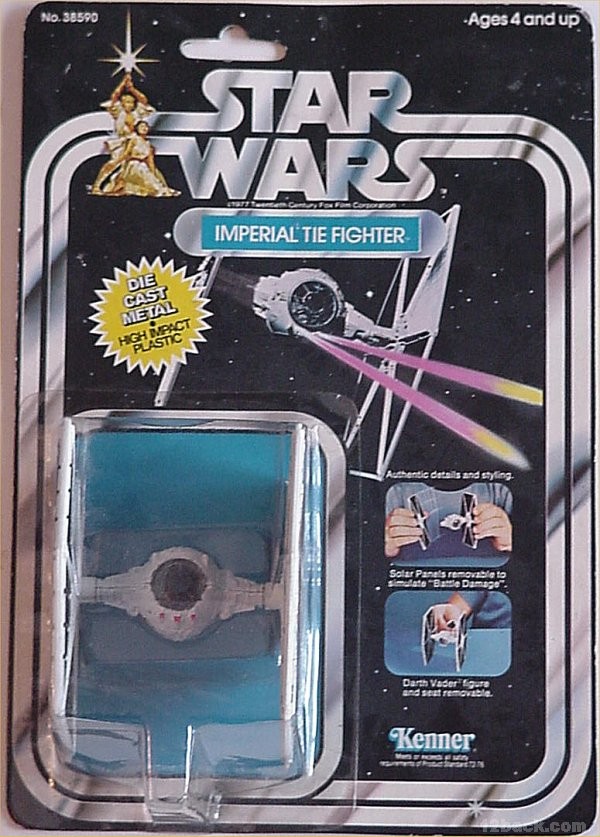
(Kenner did release Darth Vader TIE fighter toys in 1979--one for the action figures and one as a smaller, die-cast metal replica--but both of those lacked the elongated rear deck that was in the movie version. How dare they!)

You'd think that after my dad put together three models that I would finally get the hint that models weren't toys and that I would stop pestering Dad to put this stuff together for me, but no. Much to my dad's chagrin, I just couldn't make the connection. So, after Empire Strikes Back hit the theaters in 1980 and to assuage my disappointment over the birthday gift I received that was Kenner's cheapjack Hoth Ice Planet Adventure Set (which included a small, bisected cardboard AT-AT walker mounted to a 2D cardboard background), Dad broke down and put together the Battle of Hoth Action Scene diorama (which included two complete AT-ATs and one AT-AT that was "battle damaged").


Wouldn't you know it, Kenner released a complete AT-AT vehicle for the action figures in 1981. My parents gave me that toy too, although I'm still surprised to this day that my dad didn't tell me to be satisfied with the AT-ATs from the diorama, that maybe I should have the action figures ride them like ponies to get my money's worth.

There was a fifth Star Wars model for which I didn't ask but a relative got for me anyway and my dad tried to assemble: the Darth Vader Action Model. This model was a bust of Vader that included parts that were supposed to make the eyes glow and a plastic tube with a bristled disk that was supposed to re-create Vader's "rasping breathing sound". Dad couldn't get the extra stuff to work, but the Vader bust itself came together very well.


The kits listed above weren't the only models from my early years; there would be more Star Wars models later on, as well as some Robotech models during the mid-80s. In those cases, my dad in his wisdom left me to my own devices for those kits, so I could learn on my own what model making really involves and how poorly I'm suited for that particular hobby.

I still don't know how Dad maintained the patience to put the Star Wars models together for me, but I'm impressed with how he pulled it off and that he did it more than once. For that, I salute my dad's devotion to my geek quirks, and I extend that salute to all of the fathers out there who made the extra effort to gratify their children's budding interests in robots, monsters, spaceships, superheroes, and all other things geeky.

Can you spot the error on this blister card?