Showing posts with label toys. Show all posts

Funko and Super 7 Go Retro with New ReAction Action Figures

1 comments


The power of nostalgia strikes again! Back in 2012, toy companies Funko and Super 7 teamed up to finish what Kenner started back in the '70s by producing a line of 3 and 3/4-inch action figures based on the movie Alien. This partnership marked the beginning of the ReAction line of action figures, one that later expanded to include similar-sized action figures based on the Six Million Dollar Man TV series.

I'm guessing that these ReAction figures must have been a success, because that would explain the recent announcement by Funko and Super 7 to produce even more ReAction figures based on characters from Back to the Future, Buffy the Vampire Slayer, Escape From New York, Firefly, Goonies, Nightmare Before Christmas, Predator, Pulp Fiction, The Terminator and other popular films and TV shows from the '80s and '90s. These figures are currently available for pre-order over at Entertainment Earth.

I find it amusing that even after the arrival of highly detailed yet reasonably priced action figures from companies such as McFarlane Toys and NECA, fans and collectors are still willing to spend money on even less detailed action figures that have a design aesthetic similar to Kenner's during the late '70s and early '80s. On the other hand, I have no room to judge--after all, the expanding ReAction line will also include figures based on classic Universal Studios monsters, figures that I'm assuming will appear similar to the 3 and 3/4-inch Universal Studio monster figures that Remco released during the early '80s.


Remco's Universal Monster action figures.


Even though I never collected any of Remco's Universal Monster figures, I eyed them with great curiosity and fascination back in the day when I was just discovering classic monster movies. Remco's line had Dracula, Frankenstein's Monster, the Wolfman, the Mummy, the Phantom of the Opera and the Creature from the Black Lagoon; the ReAction line will have the same set of characters along with the Invisible Man. Thus, while I prefer to collect figures that have greater detail, such as Diamond Select's line of classic monster figures, there's a part of me that wants to spend a chunk of change on ReAction figures so that I can have classic Universal Monsters rub elbows with more contemporary horror icons such as the Alien, Predator, a T-800 endoskeleton, and slashers such as Micheal Meyers and Freddy Krueger.

Check out the ReAction Figures and More blog for updates about additions to the ReAction line of figures.


Lego Update: Ghostbusters and Star Wars

0 comments


With its first theatrically released movie debuting in a few days and more licensed merchandise on its way, Lego is doing extremely well for itself. Here’s an update on two geek-centric licenses that Lego has in its ample portfolio:

Ghostbusters: While a third Ghostbusters movie remains stuck in development hell, Lego is moving ahead with its first Ghostbusters Ectomobile kit in honor of the first movie’s 30th anniversary. The kit was designed by Brent Waller as part of Lego’s CUUSOO project, a project that allows fans to submit their own designs to Lego for possible release. The kit will include minifigs of all four Ghostbusters and the ghost Slimer. Waller’s original design included flashing lights and working sirens, although it hasn’t been determined if these features will be part of the official kit. The kit will be released later this year.

Another Lego fan, Alex Jones (a.k.a. Orion Pax), also designed a playset based on the Ghostbusters’ firehouse headquarters. Although this playset is not scheduled at this time be a Lego-licensed Ghostbusters kit, you can click here to see the incredible amount of detail that Jones put into his brick-based recreation of Ghostbusters HQ.


Busting ghosts, Lego style.


Star Wars: As part of its ever-expanding line of Star Wars kits, Lego has been providing previews for its summer 2014 line of new licensed kits. While most of these kits are based on vehicles and locations from the original trilogy, two are based on vehicles from the upcoming Star Wars: Rebels animated series: The Ghost and Phantom. According to details that have been released about Rebels, the Ghost is a ship that will serve a similar purpose in the series as the Millennium Falcon did in the original trilogy--namely, as the ship the heroes use to go on missions and transport cargo that’s crucial to the Rebel Alliance.


The Phantom looks to be a smaller vehicle than the Ghost, with a smaller crew and lesser transportation capabilities. It looks like a Y-Wing fighter that has been stripped down and repurposed to function as a shuttle.


Paper Airplanes Become Remote Controlled Toys with Power Up RC Conversion Kits

0 comments


When I was growing up, the most reliable toys were the ones you could make yourself: paper airplanes. It didn't matter how much money you had in your pocket, because all you needed was a sheet of paper to have a few minutes of amateur flying fun. There were books you could buy that featured sleek, complex designs from engineers who wanted to take the paper plane to higher levels, but anyone who had basic paper-folding skills could produce at least one type of paper plane to throw around until it became to damaged to go anywhere. Of course, if you wanted a battery-powered flying toy, paper planes just couldn't compete ... until now.

Meet Power Up Toys. A while back, Power Up was selling "Electric Paper Airplane Conversion Kits" that consisted of a durable, lightweight and rechargeable propeller that you could attach to a paper plane to make it fly for longer distances. I've seen the first two versions of this kit for sale on a number of sites, and I've also seen video footage of Power Up modified paper planes posted on YouTube. However, with the success of the previous conversion kits, Power Up Toys is taking it to the next level with the Power Up 3.0 kit, the kit that will allow you to convert a paper plane that can be controlled remotely through a smartphone.


The Power Up 3.0 kit started as a Kickstarter campaign that reached its initial funding goal of $50,000 within hours of its initial launch. With its baseline goal met, the Kickstarter campaign continues to this day to fund more options that can be added to Power Up 3.0's main remote control feature. These options include:
  • Remote controller software for multiple smartphone platforms;
  • Multi-control 3.0 kits that will allow you to mount more than one 3.0 kit to a paper plane but control all of them simultaneously with just one smartphone controller;
  • A "dogfight" feature that will allow users to have a mid-air battle between two 3.0 modified planes; and
  • A pin camera attached to the 3.0 battery/Bluetooth receiver that can record footage of flights.

As someone who spent his youth wishing for paper planes that could fly greater distances, I think that Power Up 3.0 looks like hours of fun. Go to the official Power Up Toys site and the Power Up 3.0 Kickstarter page for more information about putting more power into your paper planes. See the Power Up 3.0 kit promo video in the window below.


Four Fun Robot Toys from Mego’s Micronauts Line

1 comments


In this last installment of my year-end series about cool robot toys from Japan, I've decided to look back at one of the classics: Takara’s Microman line, which was released in the U.S. in the late '70s by Mego under the name Micronauts. Micronauts was a contemporary of another line of imported Japanese robot toys, Mattel’s Shogun Warriors, and both lines even had comic book series published by Marvel. While Shogun Warriors featured Super Robots from several anime series that had pilots and combination configurations, that toy line didn’t have any pilot figures or robot figures with combination capabilities; in contrast, Micronauts provided the first examples of mech and combiner robot toys to kids in the U.S. Read on for a look at four of Micronauts’ groundbreaking toys.

Before getting into the list of noteworthy Micronauts toys, it should be noted that Takara’s Microman line was a spin-off of another innovative robot toy line, Henshin Cyborg. Henshin Cyborg figures were modeled after Hasbro’s line of 12-inch G.I. Joe action figures from the '60s and '70s, but they differed from Hasbro’s figures in two significant ways: They were made with transparent plastic so kids could see the figures’ mechanical insides, and they had magnetic joints that allowed for greater flexibility and disassembly/reassembly.


A Henshin Cyborg figure.


The Microman toy line was a miniaturized version of the Henshin Cyborg line, and the modularity of the Henshin Cyborg figures carried over to the modularity of the Microman/Micronauts vehicles, robots and playsets. Even though the Micronauts line ended during the early ’80s, Takara continued the Microman line in Japan for many more years. Some of the later Microman toys would also become part of Hasbro’s Transformers toy line. While Takara’s Microman line features plenty of great robot toys, I am only including on this list the toys that were released in U.S. under the Micronauts line.


Biotron


Biotron is an early example of a combiner mech toy. It can be “piloted” by a smaller 3 ¾-inch Micronaut figure, and it can be disassembled into a tank and a rocket sled. It also required two C batteries, which allowed Biotron to roll in tank mode and walk in robot mode.


Microtron


Microtron is like Biotron in that it is also battery-power and can be re-arranged from a robot configuration to a vehicle configuration. Microtron’s head opens to form as seat for a Mirconaut pilot in both robot and vehicle configurations.


Giant Acroyear


Giant Acroyear was an amazing combiner robot toy: It consisted of two humanoid robots, a missile-launching rocket plane and a missile-launching land vehicle that combined into a single large robot. Years before kids heard of Voltron, they had the Micronauts’ Giant Acroyear.


Hornetroid


Hornetroid was one of the later releases in the Micronauts line. It was designed by Mego and not Takara, so it had no Microman counterpart. Even though it looks like a vehicle toy, Hornetroid is basically a giant flying robot that looks like an insect, complete with flapping transparent wings, six retractable legs, and figure-gripping pinchers.


For more information about the Micronauts and Microman toy lines, check out Innerspace Online and the Microman Forever site.


Getting it Right with Getter Robo Toys

0 comments


Because I live in the U.S. and not Japan, my first introduction to combiner robots came through Japanese toy lines that were imported into the U.S. during the '80s: Gobots, Transformers and Voltron. Since each of these toy lines had its own cartoon series, it was generally assumed that if you saw a group of vehicles or robots combining together to form a gigantic robot in the cartoon, there was also a toy available that could do the same thing. After all, who would taunt potential toy buyers with a cartoon that showed vehicles and robots doing something that their toy versions couldn't do, right?

What I didn't know at the time and only found out recently was that the concept of a combiner robot actually began in the '70 with a manga and anime series called Getter Robo. In Getter Robo, three combat jets would combine together to form a giant robot; depending on the sequence of the jets' combination, a different giant robot would be formed. Getter Robo was very popular and it spawned plenty of merchandise and numerous anime and manga sequels; in fact, these toys were also included in Mattel's Shogun Warriors line.

However, there's a drawback to the first Getter Robo that's peculiar for a Japanese combiner robot: For as ground-breaking as the combiner robot idea was at the time, no one seemed to know exactly how the combat jets could come together to form anything, let alone a giant robot. As you can see from the video clip below, even the animators behind the original anime series had to take significant shortcuts during the jet combination sequences.


From what I can gather, the dominant attitude towards the first Getter Robo toys and model kits is that companies would produce the jets and the giant robots, but they wouldn't produce jets that could combine to form a giant robot. Apparently, this approach worked, but it seems very strange when compared to the countless combiner robots toys that Getter Robo influenced. Subsequent jet and robot designs for most of the sequels were much more detailed and provided clear views of how the jets combine, but the early designs for Getter Robo are astonishingly vague in their combination mechanics.

Of course, if you really, really want to collect toy replicas of the original Getter Robo jets that can combine into various robot configurations, you can--but it will cost you. The Perfect Change Getter Robo set, the most detailed and scale-accurate combining toy based on the original Getter Robo design, costs hundreds of dollars. The cheapest set, Dynamic Change Getter Robo, is a chibi-scale interpretation of the original design and it costs over $100.


The Perfect Change Getter Robo set.


The Dynamic Change Getter Robo set.


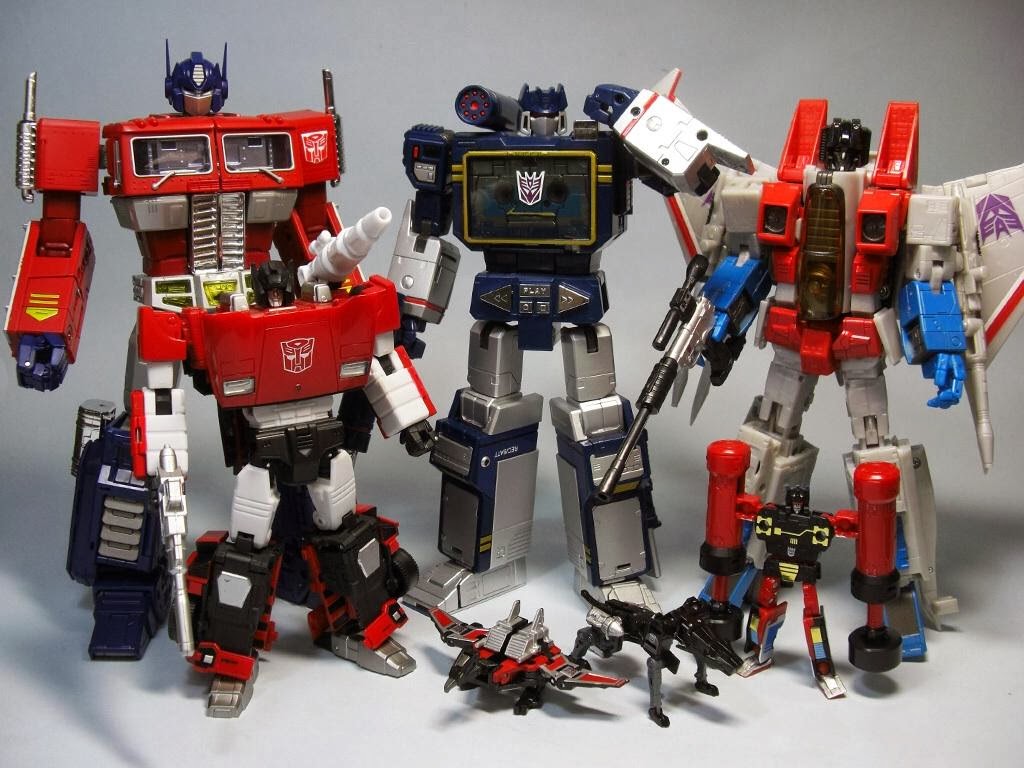
The problem with Getter Robo toys sort of reminds me of the Transformers Masterpiece collection. The animators who worked on the first Transformers cartoon took many liberties with the toy robot designs in order to create robot characters, all of the purpose of selling the toys. Now, decades later, Transformers fans can by transforming toy robots that look exactly like they did from the original cartoon from the '80s, but each Masterpiece figure costs several times the amount of a regular transforming toy robot.


Figures from the Transformers Masterpiece collection.


The Mighty Miniature Robots of Machine Robo

1 comments

Sometimes, I don't know what I would do without the Internet, particularly when I look up things that were well-known at one time but have since faded into obscurity. In the ancient times when print media ruled the information landscape, it could take up to days, weeks, and even months to track down publications that mention trends or products that are no longer considered popular by mainstream culture. With the Internet, the same kind of search can only take a few hours or even minutes, especially because amateur writers can publish whatever they want online without being solely driven or restricted by profit.


This intro brings me to the topic of this post, Bandai's Machine Robo toy line. Machine Robo started in 1982 and it was one of the earliest toy lines based on robots that can transform into vehicles. Bandai started exporting these toys to other countries in 1983, and Tonka distributed them in the United States under its Gobots line. As anyone who grew up in the '80s knows, Tonka's Gobots quickly faded when they competed against Hasbro's more popular Transformers line, another group of transforming robot toys imported from Japan. Yet while the Gobots vanished from American pop culture during 80s, I discovered via the Internet that Bandai's original Machine Robo line kept going in Japan throughout the following decades. Read on for more thoughts on Machine Robo and what makes it so resilient in the face of other more popular toy robot lines.

Honestly, you could write a master's level thesis paper on how badly Tonka handled the import and marketing of Machine Robo toys. From its poor coordination with Bandai to its partnership with Hanna-Barbera in creating a lackluster cartoon to help sell the toys, Tonka's Gobots line was inevitably doomed against Hasbro, which partnered with Toei Animation and Marvel Comics (which had previous experience with Japanese robot toys through Mattel's Shogun Warriors line) in creating the marketing campaign for the Transformers line. In the end, many American toy buyers from that time remember Gobots as the simpler, inferior version of the Transformers. While that may be true to some extent (Tonka's incompetent marketing certainly didn't help), that's not a completely fair assessment of Machine Robo toys. While the Transformers had a better marketing campaign and more sophisticated designs, I think that Machine Robo/Gobots were the superior toys for three important reasons: price, durability and scale.

Price: Because the Gobots were sold at cheaper prices than Transformers, many concluded that a cheaper price must have meant a lower-quality product. Yet by selling most of the Gobot figures at $3.00, kids could quickly build an army of transforming robots for the same price it would cost to get a handful of the main characters from the Transformers line. It's like comparing Hasbro's G.I. Joe toy line to generic army men toys: The army men might not have marketing support of Hasbro or the G.I. Joe brand name, but their cheaper price makes it easier to build huge armies and wage epic, imaginary battles.


Fun trivia fact: The original line of small Machine Robo figures were 
called the "600 Series", because each figure cost 600 yen.


Durability: Most of the robot figures in the Gobots line were simple in their design and had a significant portion of die-cast metal in them, which made them perfect for rigorous play. Much like the die-cast Matchbox and Hot Wheels vehicle toys, kids could "wreck" the Gobots in all sorts of ways and they'd still remain viable as play items. In contrast, the Transformers toys relied more on plastic than die-cast metal; while the high usage of plastic probably kept their production costs down, it also made them much more fragile. I owned one of the more complicated Autobot car toys when I was a kid and for as cool as it looked, all it took was one unfortunate tumble off of a table to break one of its weaker yet transformation-essential parts. This kind of problem didn't happen with the handful of Gobot figures that I had, since they were just as durable as the die-cast metal toy cars I collected.

Scale: Of all their advantages, scale was the most important for Machine Robo/Gobots. Their small size kept their prices low and added to their durability, and keeping them at a fairly uniform scale presented more opportunities for play. Some larger-sized Machine Robo/Gobots were released as part of the line, but most of the figures were between three to four inches tall. Not only did their small size make them easier to store and transport, but it also allowed for cool playsets. Furthermore, because the smaller figures were roughly the same scale as Matchbox and Hot Wheels toys, kids could use the playsets, track sets and vehicle launchers from those lines for their Gobots figures--say, imagining the robots battling each other near a multi-level parking garage or on an aircraft carrier.


A vintage Machine Robo playset.


Tonka's failed Gobots line is part of Machine Robo's history, but that's hardly the end of it. Even as Tonka was desperately trying to keep space on toy store shelves for it Gobots, Bandai released new kinds of Machine Robo toys and launched the 47 episode anime series, Machine Robo: Revenge of Cronos. Chronos gave Bandai the opportunity to rerelease older figures and significantly redesign previous figures.


The MR-03 Jet Robo from the Machine Robo 600 series ...


... and its Chronos-inspired redesign.


The Chronos anime series also introduced new Machine Robo figures, such as an evil transforming combiner robot called Devil Satan 6. (Yes, a robot with a name that includes the words "devil" and "Satan"--how cool is that?).


Devil Satan 6--six evil robots in one!


Chronos was followed by other anime series based on the Machine Robo line--including Machine Robo: Battle Hackers and Machine Robo Rescue--each with varying degrees of success. Nevertheless, the anime series kept Machine Robo going in Japan, even though it had disappeared everywhere else. In particular, Machine Robo Rescue added some interesting new combiner designs to the Machine Robo line.


Left to right: TMR-01WL Wing Liner and TMR-02SG Siren Garry,
two deluxe transport/combiner robots from Machine Robo Rescue.


One of the key selling points for the Machine Robo Rescue line was its series of five-robot combiner sets. These sets featured one transforming robot and four look-alike transforming drones that combined into a single larger robot; however, the components from each of the five-robot combiner sets could be connected to each other, which allowed kids to assemble the robots into a wide variety of larger machines.


Transforming robots and drones from three Machine Robo Rescue combiner sets ...


... and one of their many possible forms of combination.


Taking a cue from its previous Rescue series, Bandai's most recent success was with the Machine Robo Mugenbine line, a line that placed a heavier emphasis on combination than transformation. As described on the Machine Robo Mugenbine Wikipedia page, "The majority of the series consists of figures called Mugenroids, basic block-proportioned figures that can contort and fold into various shapes, most notably a perfect cube, to form the core of its various modes. ... Rather than the traditional shape changing method of previous figures, Mugenbine uses numerous interlocking pegs and sockets to attach and remove components and relocate them in order to form different modes. While all figures have at least two official alternate modes and most have official combinations with one to three other figures, the concept of the line is to allow you to assemble your own animal and machine creations and build your own robots of various size and numbers of sets, an activity encouraged by Bandai to the point where figures with no official combiner modes come with larger head parts to help create your own."


A Machine Robo Mugenbine set of combiner robots.


Think of a robot-centric system of Lego bricks, and that's the Machine Robo Mugenbine line in a nutshell. The first Mugenbine toys appeared in 2003 and they were such a hit for Bandai that it released several additional Mugenbine series in the years since. The flexibility of the Mugenbine toys has encouraged fans to build increasingly ambitious super combiner robots, as seen in the pictures below.


The Counter-X site features a very comprehensive section devoted to Machine Robo/Gobots, including a historical review of the toys, robot figure reviews, and scans from catalog pages. Additional Machine Robo/Gobots toy reviews can be found at Collection DX, Random Toy Reviews, and Hisparobot.


Great Moments in Toy Robot History: Shogun Warriors

0 comments


The origins of popular and recurring trends in pop culture can sometimes be difficult to pinpoint, especially trends that have gone on for so long that they become an accepted fixture of everyday life. For this post, I'm talking about Japanese robot toys that are imported and sold in the U.S. I'm sure robot fans who are around my age will remember how Japanese robot toys dominated the shelves of toy stores during the 80s, but the trend of U.S. toy companies securing the rights to sell Japanese robot toys in North America actually began in the 70s with Mattel's Shogun Warriors. While the Shogun Warriors line didn't last long, its influence would impact the toy industry for decades to come. Read on for my retrospective of this trend-setting toy line.

The idea of importing toys from one country and then selling them in another is not a new idea unto itself. However, what made the Shogun Warriors different was that included merchandise from many different points of origin but was sold under a single brand name. Mattel marketed the robot toys as if they all inhabited the same shared universe but they actually originated from over a dozen different Japanese "Super Robot" anime series, series such as Brave Raideen, Gaiking and Voltes V.


To encourage the perception of a unified product line, Mattel gave the licensing rights to Marvel Comics to create a Shogun Warriors comic book series, where the robots coexisted as a single force for good against an evil alien force. There was also a syndicated cartoon series called Force Five that was set up to show five of the anime series upon which the Shogun Warrior toys were based. Unfortunately, the Shogun Warriors line was winding down by the time Force Five made it to the air and only a handful of TV markets carried the series for the brief time that it ran.


Not to limit itself to Super Robot anime, Mattel also secured the rights to Godzilla and Rodan, two monsters from famous Japanese Atomic Age kaiju movies, so that they could be added to the Shogun Warriors line as monsters for the giant robots to fight. As far as I know, Shogun Warriors is the only toy line that has combined Super Robot anime with live-action kaiju films; from that perspective, Guillermo del Toro's Pacific Rim (2013) could also have been named Shogun Warriors: The Movie.


A Godzilla figure from the Shogun Warriors line, complete with 
launching spring-loaded claw and extendable tongue of fire.


Shogun Warrior robots came in three different sizes: 24 inches, 5 inches, and 3.5 inches. Even though the 24-inch robots are what most people remember about the Shogun Warriors line, you could see some items from the robot toys' original anime series in the Shogun Warriors' "Action Vehicle" toys. For example, the Rydoto Action Vehicle was actually from the Brave Raideen anime series and the Kargosaur Action Vehicle was from Gaiking.


Curiously, some of the Shogun Warrior Action Vehicle toys had nothing to do with any Super Robot anime series; they were just toys that Mattel apparently decided to include in the line anyway because they looked similar enough to the robots. After all, none of the anime series upon which the Shogun Warriors toy line was based aired on U.S. television during most of the line's release, so it wasn't as if the kids who were buying the toys would know the difference.


The Shogun Warriors' Heli-Capter Action Vehicle 
(Japanese TV show of origin unknown).


The Shogun Warriors line didn't last long and completely disappeared from toy stores within a few years of its launch. Regardless, its approach to licensing Japanese robot toys in bulk was also used by other toy and model kit lines that were released in the U.S. during the 80s:

* Hasbro's Transformers line was a combination of Takara Tomy's Diaclone and Microman lines, and the Transformers marketing campaign depicted the robots and sentient beings from another planet.

* Matchbox's Voltron line was a combination of robot toys from three anime series: Beast King GoLion, Armored Fleet Dairugger XV and Lightspeed Electroid Albegas. However, when the Voltron cartoon series was assembled to help promote the toy line, footage from Albegas was not included.

* Revell's line of Robotech model kits combined robot kits from three anime series as well: Fang of the Sun Dougram, Super Dimension Fortress Macross and Super Dimension Century Orguss. Yet when the Robotech cartoon was assembled, footage from Dougram and Orguss were not used and Macross was edited together with footage from Super Dimension Cavalry Southern Cross and Genesis Climber MOSPEADA.


One of Revell's Robotech model kits that's originally from 
the Fang of the Sun Dougram anime series.


Over time, the concept of mashing together Super Robot anime series into a single line of merchandise eventually made it back Japan itself with the arrival of Super Robot Wars in 1991. Super Robot Wars is a series of tactical role-playing video games where players can choose from a selection of Super Robots from various anime and manga series. This selection also includes the titular robots from Mazinger Z and Getter Robo, two of the robots that were also featured in the Shogun Warriors toy line. The Super Robot Wars game series continues to this day, and has since expanded to include anime and manga series of its own.

To learn more about the Shogun Warriors, check out the following fan sites:

* Wildtoy's Shogun Warriors Page

* Weird Science-Fantasy's Shogun Warriors Page

* Ted Terranova's Robot Page.


A Shogun Warriors Halloween Costume.


Crayola Encourages Budding Kaiju Fans Through Its Create 2 Destroy Toy Line

0 comments

Imagine this holiday shopping scenario: You're a life-long fan of giant monster movies and want to foster an appreciation of such entertainment in the next generation of geeks--your kids, your nieces and nephews, or both. However, you think that they're too young to grasp the finer points of such giant monster mashes such as Godzilla, Gamera: Guardian of the Universe and Pacific Rim, so you have no idea what to get them for Christmas. Well, never fear because Crayola has got your back this year with its Create 2 Destroy line of playsets.


The Create 2 Destroy playsets aren't strictly kaiju merchandise, but they might as well be because half of the playsets involve giant monsters trashing a city, a shopping mall, and a suburban community. These playsets make up the Dino Destruction sub-series, where kids use Morphix (Crayola's answer to Play-Doh) to mold cars, buildings and trees that the included dinosaurs can stomp with their feet and crush with their jaws. Some of the dinosaurs have spring-loaded tails that kids can use as catapults to launch Morphix-molded boulders into nearby targets.

The other Create 2 Destroy sub-series, Fortress Invasion, are designed to have kids build fortresses, castles and walls with the goal of knocking them down by using the included catapults. While these playsets don't include any monsters, adult fans of King Kong can buy their kids a Dino Destruction playset and a Fortress Invasion playset that so they can imagine dinosaurs tearing through the enormous protective wall on Skull Island. This is the kind of stuff that brings geek families closer together during the holiday season!


Shogun Warrior-Sized Bender Challenges You to Bite His Colossal Metal Ass

0 comments


Good news, everyone! Futurama may be officially cancelled (for now), but its merchandising license lives on in a variety of collectibles. This month, Toynami is releasing a limited edition Shogun Warrior version of Bender that's 24-inches tall and includes spring-loaded arms for fist-firing action. I'm not sure if this version of Bender has any other features, so I don't know if this chest panel opens or how many points of articulation he has. Nevertheless, if you're willing to pay the $150 price for this collectible item, you can have Bender pick fights with other Shogun Warrior robots and terrorize 6-inch scale Futurama action figures.


Kenner's Imperial Troop Transporter Gets Lego-ized

0 comments

As I mentioned in a previous post, the upcoming Star Wars: Rebels animated series will incorporate some of Kenner's classic Star Wars toy designs as part of the series' selection of vehicles and weaponry, such as Kenner's Imperial Troop Transporter toy. Thus, it makes sense for avid Lego hobbyist BaronSat (a.k.a. Eric Druon) to make a Lego version of the Troop Transporter that's in scale with official Lego Star Wars minifigs. Check it out:


BaronSat's Lego Imperial Troop Transporter (above) and Kenner's original toy (below). 


Click below to see more pictures of BaronSat's Lego version of the Imperial Troop Transporter, along with a new Lego Hoth playset that he recently produced that draw inspiration from Kenner's short-lived Star Wars Micro Collection line.

BaronSat does incredible work with Legos and his interpretation of the Imperial Troop Transporter is no exception. As you can see in the photos below, his Troop Transporter includes almost all of the features as the original toy, such as opening front and rear panels and six side compartments that can hold minifigs.


BaronSat has also produced another minifig-scaled Star Wars playset that represents the Rebel base on Hoth, as seen in Empire Strikes Back.


If you look closely at the Lego Hoth playset, which includes the Rebels' ion cannon, blast door and shield generator, you'll notice that it bears some similarities to two play sets from Kenner's Star Wars Micro Collection line: the Hoth Ion Cannon and the Hoth Generator Attack playsets. (Photos below provided courtesy of RebelScum.com.)


While BaronSat's new Lego Hoth playset isn't a scale-accurate replica of the Micro Collection Hoth playsets, it nevertheless includes some of the features of the original playsets (such as an observation tower and an opening blast door) and it is complementary to BaronSat's previous Lego re-creation of Kenner's Imperial Attack Base playset.

Check out BarsonSat’s official site and Flickr pages for more examples of his work. You can also order custom Lego kits and custom kit instructions from him on his site.