Showing posts with label Robotech. Show all posts

Great Moments in Toy Robot History: Shogun Warriors

0 comments


The origins of popular and recurring trends in pop culture can sometimes be difficult to pinpoint, especially trends that have gone on for so long that they become an accepted fixture of everyday life. For this post, I'm talking about Japanese robot toys that are imported and sold in the U.S. I'm sure robot fans who are around my age will remember how Japanese robot toys dominated the shelves of toy stores during the 80s, but the trend of U.S. toy companies securing the rights to sell Japanese robot toys in North America actually began in the 70s with Mattel's Shogun Warriors. While the Shogun Warriors line didn't last long, its influence would impact the toy industry for decades to come. Read on for my retrospective of this trend-setting toy line.

The idea of importing toys from one country and then selling them in another is not a new idea unto itself. However, what made the Shogun Warriors different was that included merchandise from many different points of origin but was sold under a single brand name. Mattel marketed the robot toys as if they all inhabited the same shared universe but they actually originated from over a dozen different Japanese "Super Robot" anime series, series such as Brave Raideen, Gaiking and Voltes V.


To encourage the perception of a unified product line, Mattel gave the licensing rights to Marvel Comics to create a Shogun Warriors comic book series, where the robots coexisted as a single force for good against an evil alien force. There was also a syndicated cartoon series called Force Five that was set up to show five of the anime series upon which the Shogun Warrior toys were based. Unfortunately, the Shogun Warriors line was winding down by the time Force Five made it to the air and only a handful of TV markets carried the series for the brief time that it ran.


Not to limit itself to Super Robot anime, Mattel also secured the rights to Godzilla and Rodan, two monsters from famous Japanese Atomic Age kaiju movies, so that they could be added to the Shogun Warriors line as monsters for the giant robots to fight. As far as I know, Shogun Warriors is the only toy line that has combined Super Robot anime with live-action kaiju films; from that perspective, Guillermo del Toro's Pacific Rim (2013) could also have been named Shogun Warriors: The Movie.


A Godzilla figure from the Shogun Warriors line, complete with 
launching spring-loaded claw and extendable tongue of fire.


Shogun Warrior robots came in three different sizes: 24 inches, 5 inches, and 3.5 inches. Even though the 24-inch robots are what most people remember about the Shogun Warriors line, you could see some items from the robot toys' original anime series in the Shogun Warriors' "Action Vehicle" toys. For example, the Rydoto Action Vehicle was actually from the Brave Raideen anime series and the Kargosaur Action Vehicle was from Gaiking.


Curiously, some of the Shogun Warrior Action Vehicle toys had nothing to do with any Super Robot anime series; they were just toys that Mattel apparently decided to include in the line anyway because they looked similar enough to the robots. After all, none of the anime series upon which the Shogun Warriors toy line was based aired on U.S. television during most of the line's release, so it wasn't as if the kids who were buying the toys would know the difference.


The Shogun Warriors' Heli-Capter Action Vehicle 
(Japanese TV show of origin unknown).


The Shogun Warriors line didn't last long and completely disappeared from toy stores within a few years of its launch. Regardless, its approach to licensing Japanese robot toys in bulk was also used by other toy and model kit lines that were released in the U.S. during the 80s:

* Hasbro's Transformers line was a combination of Takara Tomy's Diaclone and Microman lines, and the Transformers marketing campaign depicted the robots and sentient beings from another planet.

* Matchbox's Voltron line was a combination of robot toys from three anime series: Beast King GoLion, Armored Fleet Dairugger XV and Lightspeed Electroid Albegas. However, when the Voltron cartoon series was assembled to help promote the toy line, footage from Albegas was not included.

* Revell's line of Robotech model kits combined robot kits from three anime series as well: Fang of the Sun Dougram, Super Dimension Fortress Macross and Super Dimension Century Orguss. Yet when the Robotech cartoon was assembled, footage from Dougram and Orguss were not used and Macross was edited together with footage from Super Dimension Cavalry Southern Cross and Genesis Climber MOSPEADA.


One of Revell's Robotech model kits that's originally from 
the Fang of the Sun Dougram anime series.


Over time, the concept of mashing together Super Robot anime series into a single line of merchandise eventually made it back Japan itself with the arrival of Super Robot Wars in 1991. Super Robot Wars is a series of tactical role-playing video games where players can choose from a selection of Super Robots from various anime and manga series. This selection also includes the titular robots from Mazinger Z and Getter Robo, two of the robots that were also featured in the Shogun Warriors toy line. The Super Robot Wars game series continues to this day, and has since expanded to include anime and manga series of its own.

To learn more about the Shogun Warriors, check out the following fan sites:

* Wildtoy's Shogun Warriors Page

* Weird Science-Fantasy's Shogun Warriors Page

* Ted Terranova's Robot Page.


A Shogun Warriors Halloween Costume.


Painting Giant Robot Model Kits Anime Style

0 comments

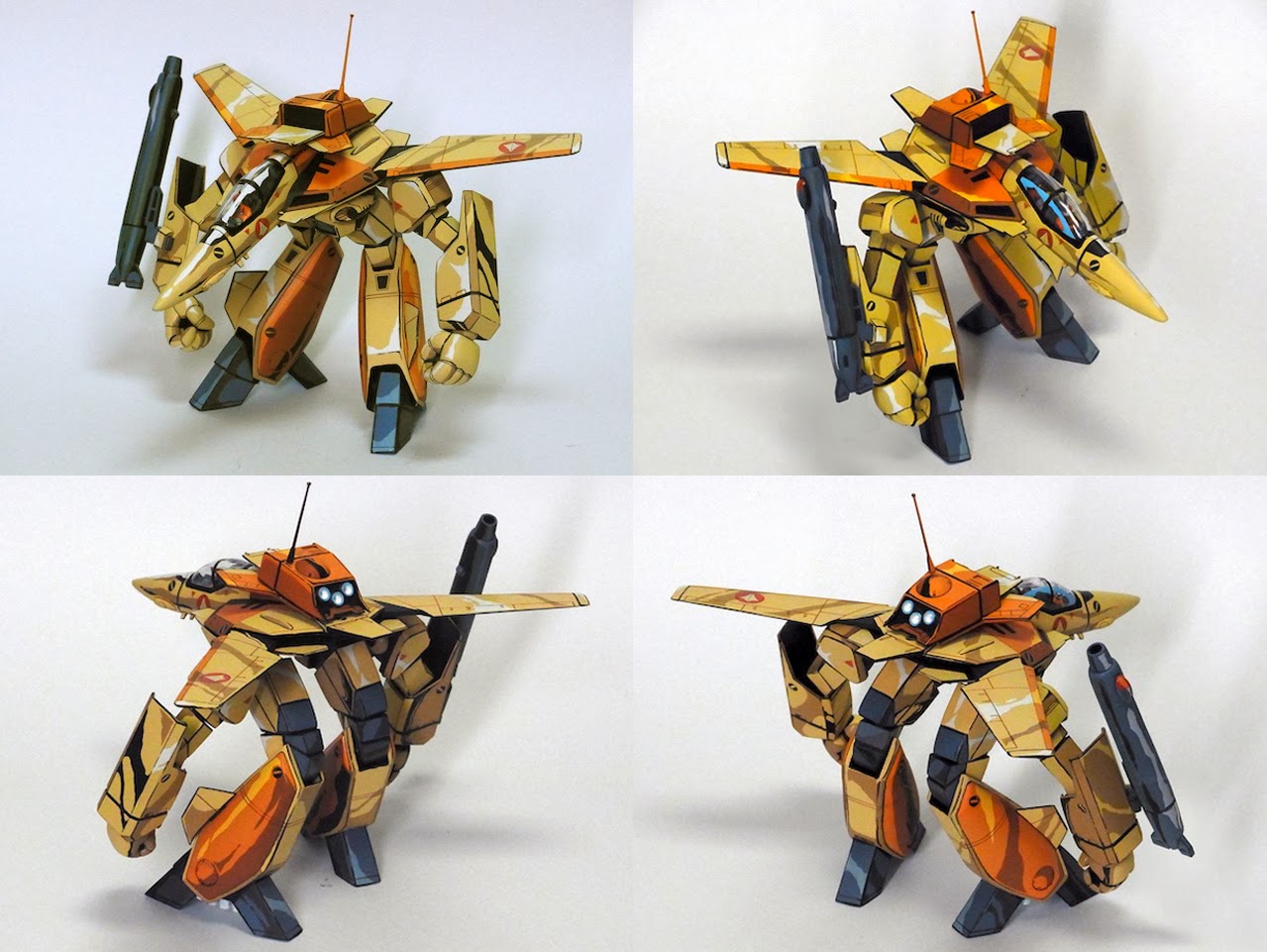
I love detailed miniature replicas of monsters, robots and spaceships from my favorite horror and sci-fi franchises, but the ability to competently assemble model kits of such replicas has always eluded me. I particularly admire those who can paint kits of robots, spaceships and other machines in a way that makes them look used (exposed to the elements, battle damage, etc.). In fact, I frequently regarded this kind of modeling skill as a remarkable achievement ... and then I saw this:


Yes, this really is a photo of a plastic model kit.


From what I read on Kotaku, a talented model builder in Japan has painted a Valkyrie kit from the Super Dimension Fortress Macross anime series (which is known to some as Robotech) in a cel shading style that makes the model appear as if it was pulled directly out of the Macross cartoon.


This makes sense, actually--since the Valkyrie design was originally intended for animation, why not paint a Valkyrie model kit like it was part of a cartoon? The picture below provides an overview of how each piece of the kit was painted to achieve the comprehensive anime look.


Click here to see the article about this kit on Kotaku. Click here to see the original Japanese post of this kit, which features many more pictures of the finished product.


Robotech Double Shot: Love, Live, Alive DVD Arrives this Week, Robotech/Voltron Comic Book Crossover in the Development

0 comments


Some franchises can be very, very difficult to love. Take Robotech, for example. For an anime series from 1985 that many fans love, it can't seem to catch a break. The sequel series The Sentinels never got off the ground, and Robotech: The Movie wound up being a forgettable mess. The last major entry in the series' canon was Robotech: The Shadow Chronicles, which was released on home video back in 2006. That particular release arrived with a bit of fanfare: It was preceded by a series of Robotech comic book miniseries by Wildstorm (a publishing imprint of DC Comics) that retconned a few key points in the saga to prepare for the new Shadow Chronicles addition. Adding to the hype was Toynami's release of a few expensive Shadow Chronicles vehicle and robot collectibles.

Shadow Chronicles finally arrived in the midst of the hype, promising a new series of adventures in the Robotech universe, and then ... nothing. No new animation, no new comic books, nothing. There were some releases for the Robotech role-playing game since 2006, but that meant nothing for fans who don't play RPGs. Now, after seven years, more Robotech stuff is on its way, although not all of it can be considered 'new'. Read on for a rundown on Robotech items that are scheduled for release for this week and beyond.

Robotech: Love, Live, Alive is going to be released this week on DVD. Love, Live, Alive will involve the New Generation cast of characters from the series, and it will focus mostly on Lancer Belmont (a.k.a. Yellow Dancer) and his memories of the Invid invasion of Earth, from the Invid's arrival to their later departure. Early reports about this release also hinted that the Southern Cross character Dana Sterling will appear in Love, Live, Alive; I'm assuming that, based on what was seen of Sterling in Wildstorm's Robotech: Love and War comic book miniseries, her departure from Earth will coincide with the early days of the Invid invasion.

I have mixed feelings about Love, Live, Alive. Even though it's billed as a new release, only one-third of the animation is actually new. The remaining two-thirds consist of recycled animation from the original Robotech series and animation from the 1985 Genesis Climber Mospeada home video release that was also titled Love, Live, Alive. I can only speculate how the animation from 1985 will match the more recent animation, but I doubt it will look good. Furthermore, Love, Live, Alive will not be available in the Blu-ray format, nor is it being released as its own feature. It's only being released on DVD as part of a two-movie set that includes a re-release of Shadow Chronicles. Thus, Robotech fans who already bought Shadow Chronicles will have to buy it again to see Love, Live, Alive. Ugh.

Nevertheless, I'll still give Love, Live, Alive a go because its producers went to the trouble of reuniting the original voice cast for the New Generation to record dialogue for the new release. It should also be noted that this American version of Love, Live, Alive was directed by Gregory Snegoff, who provided the voice of New Generation character Scott Bernard. In real life, Snegoff was married to Lisa Michelson, the actress who provided the voice of Dana Sterling; Michelson died in a car accident in 1991, so it feels fitting for Snegoff to be directing Sterling's swan song in the Robotech series.


While Love, Live, Alive isn't getting the same hype as Shadow Chronicles, a news release from last week indicated that new Robotech comics will be on their way sometime in the future. Dynamite Entertainment has picked up the Robotech license and it plans to begin releasing new Robotech comics soon. (I'm guessing the new comics will appear in 2014, since no publication date was provided in the news release I saw.) Dynamite's Robotech comics will launch with a crossover miniseries involving Voltron, another hit anime franchise from the mid-'80s. Click here to read MTV's exclusive interview with Tommy Yune, the current creative director for all things Robotech, about the crossover.

I don't have much of an opinion about the Robotech/Voltron crossover. I realize that this is probably Dynamite's way to stir interest in its readership about Robotech through Voltron, since Voltron comics are selling quite well for Dynamite. However, what I'm really concerned about is where Robotech will go once it gets its own comic book series again. Will the comic give fans interesting new chapters in the saga (which is what happened when Eternity Comics had the license from 1988 to 1994), or will we be getting more retcons that go nowhere, like the Robotech comics from Wildstorm?


Robotech Returns (Sort of) with the Genesis Pits Role-Playing Game Sourcebook

0 comments

2013 will see the return of several beloved horror and sci-fi titles, including Iron Man (as a sequel), Evil Dead (as a remake), and Aliens (as a video game). Yet one that I didn't expect to return was Robotech, the popular anime series from 1985 that has yet to see a successful and consistent continuation in the decades since. From I've read on various anime sites, another straight-to-video film titled Robotech: Love, Live, Alive is scheduled for release sometime this year, although its exact release date has yet to be determined. This post isn't about that. Instead, I'm focusing my attention on a role-playing game (RPG) sourcebook that was published less than a month before the end of 2012: the Robotech Genesis Pits Sourcebook.


The Robotech RPG has been around for a while and new modules of the game usually mirror what is considered to be "canon" (i.e., the animated episodes, as opposed to the comic books or novels). In contrast, the Genesis Pits Sourcebook takes some of the most interesting ideas from the Robotech saga and goes absolutely berserk with them, in a way that makes it sounds like the most promising Robotech release I've seen in years.

According to Palladium Books, the Genesis Pits Sourcebook "takes an in-depth look at the Invid Genesis Pits, their purpose, function, the mutants and monsters they unleash and the dangers they pose for non-Invid. It is jam-packed with never before seen source material, mutations, mutation tables (so you can generate your own Genesis Pit monsters and characters) and more." Here are a few of the things that are included in the sourcebook:

* Inorganics and other war machines of the Invid Regent
* Gura-Invid: Monstrous mutant Invid that do not leave when the Regess and her Invid legions depart a planet
* Evolutionary experiments gone wrong, like giant insects and extinct creatures from Earth's past
* Genesis Pits on alien worlds filled with strange monsters
* Frankenmechs: Monstrous machine hybrids created from the remains of older mecha
* The last surviving Robotech Masters and their clones
* Mutated Zentraedi
* The fate of the Alaska Grand Cannon

I don't even play RPGs outside of video games that include RPG-like scoring systems, but I might pick this book up anyway to see how it pushes Robotech into strange, freaky new directions. Armies of mecha, monsters and mutants, all in one game--what's not to love?


A Look Back at Four Fantastic Giant Robot Games for the SNES

0 comments


As a long-time fan of giant robot stuff like the Robotech anime series and the Zoids toy line, I'm frequently drawn like a bee to honey to giant robot video games. By "giant robot video games", I'm not talking about any of the Transformers games (where sentient robots fight other sentient robots) or games such as the Super Robot Wars series (where the robots are just pieces that players move around on the board as part of a strategy game). No, I'm talking about games that allow you to control robots that are piloted by people, something along the lines of a Japanese "real robot" anime series. For games of this variety, some of the best were made for the Super Nintendo Entertainment System (SNES) back in the 1990s. Click below for a list of four SNES games that allowed players to assume control of a big 'bot and lay waste to various digital landscapes and pummel the bejesus out of other robots.

Title: Cybernator
Release Date: 1993
Publisher: Konami


Even though the American title of this game sounds like some kind of low-budget, straight-to-video Terminator rip-off, Cybernator is actually a game that closely adheres to the logic of real robot anime series such as Mobile Suit Gundam and Armored Trooper Votoms. The original Japanese title is Assault Suits Valken and it is the second in a series of Assault Suits games that were released on a number of different game consoles, from the Sega Genesis and the SNES to the PlayStation 2, although only two of the games were released in the US.

An Assault Suits Valken model kit.

Cybernator is a combination of a 2D platformer and a "shoot 'em up" game. Players assume control of a "Federation Assault Suit", a humanoid robot that is armed with various weapons and has jets that allow for limited flight capabilities. The missions in the game take place in both space and land environments, and the mission objectives vary from level to level. Even though most of the enemy's forces consist of robots like yours, you will also encounter tiny human soldiers that shoot at you--soldiers that you can vaporize with your robot's weapons.


Title: Mazinger Z
Release Date: 1993
Publisher: Bandai


As the title explicitly indicates, Mazinger Z is a video game tie-in to the popular Mazinger Z anime series. This is also the only title on this list that falls into the "super robot" genre of anime, and the only title on this list that was exclusively released in Japan. The game is very faithful to the anime series, with cut scenes featuring the anime's characters and levels populated by enemy robots pulled from many of the anime's episodes.


Mazinger Z is a side-scrolling "beat 'em up" game, much like other licensed tie-in video games from that era. What makes Mazinger Z worthy of inclusion on this list is that it gives players access to many of the titular robot's weapons, including its signature "Rocket Punches". If you're a child of the 70s who waxes nostalgic for the Shogun Warriors toy line, Mazinger Z is the video game for you. Also be sure to check out the Mazinger Z arcade game, which offers a hefty additional helping of super robot mayhem.


Title: MechWarrior 3050
Release Date: 1995
Publisher: Activision


MechWarrior 3050 is based on BattleTech, a popular sci-fi role-playing game that revolves around giant robot wars. Two licensed BattleTech games were made for SNES: MechWarrior in 1993 and later MechWarrior 3050. The first MechWarrior game approached giant robot combat from a first-person perspective, but the technological limitations of the SNES, no matter how innovative they were at the time, made the game feel like a tank simulator with a few extra features. It also didn't help that the depiction of giant robot combat in BattleTech games is very clunky and ponderous, as opposed to the sleek, fast-paced action seen in most giant robot animes--never mind the fact that a few of BattleTech's robot designs are pulled directly from various anime series.


MechWarrior 3050 switched the game play into an isometric, third person format, and it's much better off for it. Sure, the robots are still rigid and clunky, but they're easier to control and you can watch them blast enemy bases and robots to smithereens. Bliss!


Title: Metal Warriors
Release Date: 1995
Publisher: Konami


Metal Warriors is very similar to Cybernator in terms of game play, but there are a few significant differences that make Metal Warriors the better game. During the many of the missions, players have to leave their robot armor to access control panels that open key doors or deactivate security measures. (When outside of their robots, the pilots somewhat resemble the tiny pilot figures that came with the Zoids robot kits and the early pre-Transformers Diaclone toys.) Metal Warriors also includes up to six different kinds of robots--each with their own strengths and weaknesses--for players to control, some of which players can switch to during the course of a mission. Leaving the controls of your robot also opens the opportunity for an enemy soldier to steal your robot and use it against you, another challenge that I haven't seen before in other giant robot games.

Metal Warriors' inventory of combat robots.

Of course, Metal Warriors has a lot more going for it than just a selection of playable robot types and robot-less mission challenges. The environments include destructible floors, ceilings and walls that allow you to make your own entrances and exits; the missions vary widely in terms of complexity and objective; and the animated cut scenes will give fans flashbacks to their favorite robot anime series. Indeed, even though it is a 2D platform game, Metal Warriors features the kinds of missions that should have appeared in the Robotech: Battlecry game but unfortunately did not.

The SNES titles listed here can still be found for sale on eBay, for purchase as virtual console games for one of the current home gaming systems, or for download as SNES emulator ROM files.


A Review of Lancer's VFA-6I Alpha Fighter from Toynami's Robotech Masterpiece Collection

0 comments


A few weeks ago, I posted a review of a Veritech Fighter replica that Toynami produced as part of its Robotech Masterpiece Collection (click here to read that review). This post is a companion to that review, since this is a review of an Alpha Fighter from the same Robotech Masterpiece Collection line. When I purchased this Alpha Fighter, I did so because I felt that I should have an Alpha counterpart to the Veritech that I purchased for such a low price. Unfortunately, I had to pay the original, non-discounted price for the Alpha, and I'm still unsure if the price I paid was worth the product that I received. Read on for my complete review.

Even though the Veritech and Alpha mechas from Robotech originally came from two different anime series--Super Dimension Fortress Macross and Genesis Climber Mospeada, respectively--they shared similar patterns of distribution in the U.S. during the mid-80s. To reiterate what I posted in the Veritech review, "Robotech shared a commonality with Star Wars in the sense that if you wanted a vehicle replica to play with, you'd end up with a toy that mostly looked like the vehicle but was not completely accurate in detail; on the other hand, if you wanted an exact replica of the vehicle, you'd have to purchase and assemble the model kit version."

Both Veritechs and Alphas were released as model kits in the U.S., although somehow the Veritech was picked up as part of Revell's Robotech model kit line (which pre-dated the Robotech anime series) while the Alpha was repackaged and distributed as a Leader-1 kit for the models distributed by Monogram that were based on the GoBots toy line. Despite the new GoBots label, the Leader-1 model kit captured every detail of the Alpha fighter from the Mospeada/Robotech anime series. There were also some toy versions available of the Alpha fighter during the mid-80s if you were lucky enough to find them. Matchbox released a few transformable Alpha toys under the Robotech license, although I was able to purchase an Alpha toy that was still inside the original Japanese Mospeada packaging. Nevertheless, the toy versions of the Alpha lacked many of the details that the Monogram model kit version had.


An Alpha Fighter model kit from the 80s ... 

... and a transformable Alpha Fighter toy from the same decade.


Like Toynami's Veritech replica, Toynami's Alpha replica looks and feels as if someone built a model kit version of the mecha with more durable materials and then released it for sale as an assembled, painted product. I tried to assemble GoBots Leader-1 kit and even though my completed model barely held together, I'm familiar enough with the kit to know that the Toynami Alpha took most--if not all--of its details from the model kit.

The box that the Masterpiece Collection Alpha came in looks like a huge, hardcover book, complete with a volume number. The volume I purchased was the green Alpha Fighter flown by Robotech's resident drag queen diva, Lance "Lancer" Belmont (a.k.a. Yellow Dancer). To denote that the Alpha collection series is different than the Veritech collection series, the spine of the book features a picture of Lancer that can be lined up with the other Alpha volumes in sequence to look like a Mospeada cast photo. The box also included a signed certificate of authenticity, which tells you the official number of the item produced within the limited edition toy line.


Toynami did a great job at re-creating the dimensions and details of an Alpha Fighter in a plastic and die-cast metal form, thus making it a fantastic display piece for Robotech collectors. The Alpha includes a mountable gun pod and retractable landing gear, it transforms into three modes--Fighter, Guardian and Battloid--and the cockpit opens to reveal a removable armored pilot figure.


In addition to the main feature of transformation, the smaller details of the Alpha are captured as well. Hinged panels can be opened all over the Alpha to reveal hidden missile racks, and another panel can be opened to store a collapsed Cyclone vehicle. Of course, the Cyclone is too small to be transformed into either its motorcycle or battle armor modes, but I'm glad that Toynami included this detail for devoted Robotech fans.


One of the best things about Toynami's Alpha Fighter is the amount of die-cast metal that was used in its making. This replica feels solid, almost as if it could double as a paperweight. Yet where the Alpha impresses with its die-cast metal parts, it disappoints with its plastic parts--which is a serious problem, because the plastic parts are what facilitate the Alpha's transformation and pose-ability. It's difficult to perform complete transformations of the Alpha, because you don't want to press or pull too hard on the plastic pieces for fear that they might break; as a result, the Alpha looks a bit awkward and disjointed in each of its modes. The Alpha also includes hands with movable joints in the fingers so that the gun pod can be placed in either hand, but one of my Alpha's thumb joints broke while I was shooting the photos for this post. Hence, my Alpha is now officially left-handed.

If I had to buy an Alpha Fighter replica by itself, I would have searched for something that was cheaper and more durable than what Toynami had produced. I'm not sure if this option is possible because I don't know for sure if it even exists, yet I would've searched hard for that option if an Alpha was the only Robotech collectible that I wanted. Nevertheless, I don't completely regret the purchase of a Toynami Alpha Fighter because I have a Toynami Veritech Fighter, which was produced in the same scale as the Alpha; thus, I can compare the sizes of both of these mechas in their various modes and how their sizes differ to correspond to different alien enemies in the Robotech universe (e.g., the Zentraedi and the Invid). As someone who is infatuated with accuracies of scale in miniature replicas, I'm still a wee bit giddy that I can make such a hands-on comparison.


A Review of Jack Archer's YF-1R Veritech from Toynami's Robotech Masterpiece Collection

0 comments


What can I say? I'm a sucker for miniatures and replicas of characters and vehicles from my favorite TV shows and movies. So when Toynami started releasing Robotech mecha as part of their "Masterpiece Collection", beginning with mecha from the Macross Saga, I knew I had to pick up at least one of these items regardless of their high prices. Fortunately, I caught a break when I saw on sale the only vehicle in Toynami's Robotech line that came straight from a video game and not the original anime series--namely, Jack Archer's YF-1R Veritech from the 2002 Robotech: Battlecry game. Read on for my complete review of this unique bit of Robotech merchandise.

Before I get to my review, here's some background on my experience with Robotech merchandise. Robotech first appeared in the U.S. not as an anime series, but as a series of model kits distributed by Revell. The transforming robots that would later become known as Veritechs were part of this kit series, which I'm assuming is one of the reasons why "Robotech" was chosen for the U.S. anime series. Production history aside, Robotech shared a commonality with Star Wars in the sense that if you wanted a vehicle replica to play with, you'd end up with a toy that mostly looked like the vehicle but was not completely accurate in detail; on the other hand, if you wanted an exact replica of the vehicle, you'd have to purchase and assemble the model kit version.

In the case of Robotech, if you wanted to play with a fully transformable Veritech during the mid-80s, you'd have to pick up the Jetfire figure from the Transformers toy line. (How a Veritech ended up in the Transformers line is a long, convoluted story.) Jetfire was the most accurate toy replica of a Veritech at that time--much more accurate than the squat, "super deformed" Veritech toys that Matchbox distributed under its official Robotech line--but even that lacked many details that were seen in the anime TV show. In contrast, the Revell model kit versions of the Veritech captured every detail from the anime series, with an even greater range of articulation than the Jetfire toy.


The Transformers Jetfire toy ...


... a Revell Robotech model kit ...


... and a Matchbox Veritech toy.


Toynami's Masterpiece Collection Veritech replicas began to appear almost fifteen years after Robotech went off the air. If I had to summarize the Veritech replica that I purchased in a nutshell, it would be as if someone built a Veritech model kit with more durable materials and then released it for sale as an assembled, painted product. I tried to assemble Revell's Veritech kits twice and while my efforts were far less than average, I'm familiar enough with the kits to know that the Toynami Veritech took most--if not all--of its details from the model kits.

The box that the Masterpiece Collection Veritech came in looks like a huge, hardcover book, complete with a volume number; the Jack Archer Veritech is Volume 6. I suppose that this box design was chosen to add an aura of style and sophistication to the "Masterpiece Collection" name, even though all the box contains is just an expensive toy. The spine of the "book" features a picture of Jack Archer, a picture that when lined up with the other five volumes in sequence will look like a Macross cast photo (note the elbow sticking out in front of Archer in the picture below). The box also included a signed certificate of authenticity, which tells you the official number of the item produced within the limited edition toy line.


Out of the box, the Veritech is an impressive thing to behold. As you can see from the pictures of the Veritech in Fighter mode below, everything is proportionate to everything else: the length of the wings, the shape and length of the nose cone and the overall length of the fighter all match how a Veritech is supposed to appear. (Just looking at this toy in Fighter mode makes the Robotech opening theme song start playing in my head!) The Veritech also came with missile clusters to attach to the wings, retractable landing gear, an opening cockpit and a pilot ladder for extra details. Even the Veritech's gun pod fits neatly to the underside of the Veritech when it is in fighter mode.


The same level of detail holds up when transforming the Veritech into Guardian and Battloid modes. Toynami placed a few hinges within the Veritech's hands, so that it can grip the gun pod in either hand. The toy also comes with a heat shield to place over the cockpit for when it is in Battloid mode.


Finally, the Veritech comes with batteries and a small switch located on the underside the nose cone. When you flip the switch, the Battloid's eye lights up. This is a nifty extra feature that I didn't expect and it is included in all of their Masterpiece Collection Veritech replicas, although Toynami didn't think to add this to their subsequent series of Masterpiece Collection Alpha Fighter replicas.


As a display piece, I'm very satisfied with this Veritech--it looks great in any mode. The only drawback is that the joints of the toy are very loose. While it will remain upright in Guardian and Battloid modes, you have to position the legs very carefully so it will remain standing. For this reason, I hesitate to transform my Veritech often, lest the joints become too loose.

I've heard that better quality Veritech replicas of similar size and detail can be purchased straight from Japan, but from what I've seen so far those are usually more expensive than the Toynami Veritechs. Then again, the price of this particular Veritech replica wasn't an issue for me--I found it on sale for $29.99. Whether this discounted price is due to Jack Archer's obscurity even among Robotech fans, I cannot say.


If you haven't played Robotech: Battlecry, Jack Archer's one and only appearance in the Robotech franchise, you might want to give it a try if you can find a copy. You play as Archer, one of the pilots who was on Macross Island when the Zentraedi first attack, but he is left behind when the SDF-1 performs the notorious spacefold that sends it to Pluto. Hence, there are only three parts of the game--the Macross Island attack, the disastrous battle in the skies over Toronto, and the Zentraedis' orbital assault against Earth--that overlap with the Macross Saga; the rest of the game's missions take place on Earth during what is known as the "Malcontent Uprisings", a series of smaller conflicts that took place before the launch of the SDF-3 and the Second Robotech War.


Some Robotech fans may be disappointed by the game's lack of direct connection to most of the Macross episodes; you don't get to play any missions that take place during the SDF-1's voyage back to Earth and you don't get to explore the SDF-1 at all, either on the inside or the outside. Yet the game retains the feel of Robotech by playing clips from the series' memorable soundtrack during each of the missions, and several original voice cast members return to reprise their Macross Saga roles--as well as to portray some new roles, both human and Zentraedi alike. Furthermore, the game's unlockable extras include video clips of enjoyable and insightful interviews with the returning cast members about their time with the Robotech series. Overall, Robotech: Battlecry is a decent game where you get to fly a transforming Veritech--what's not to like?