Showing posts with label emulators. Show all posts

Nerd Rant: Is it the Beginning of the End for Home Video Game Consoles?

0 comments


While I consider myself to be a gamer, I only play video games that fit within my disposable income budget, a budget that has been quite modest as of late. Thus, I have only been gaming within my financial means, playing discount or used games on a Nintendo Wii console that I bought a few years ago and playing older games on my PC. I've tried to play newer PC games, but my computer has an integrated graphics card that causes newer games to stutter; thus, I can’t play new PC titles until I can afford a new PC, and that won’t be for a while.

With my current financial limitations, I can only watch what’s currently happening in the video game industry from the sidelines. Nintendo’s latest system, the Wii U, isn't selling nearly as well as its predecessor, and the upcoming next generation consoles from Sony and Microsoft are causing concern among the gaming community due to their new restrictive features. For example, Microsoft’s upcoming Xbox One will require an Internet connection and a user account to play games--even single player games--which will limit the opportunities for gamers to share titles with their friends.

Another tidbit I've read is that the development costs for high-end titles for the game consoles are skyrocketing, while development costs for video games that are available for cell phones and tablets are cheaper and in turn are earning more revenue. In fact, the reason I've heard as to why the Wii U offered so few launch titles is that Nintendo management underestimated the cost and resources involved to make games for its new system and thus had to focus what it had available on the production of a handful of titles just to meet the scheduled launch date. The general consensus among many writers who cover the game industry is that the newer consoles are aiming to offer more than just games (e.g., Blu-ray disc playback capabilities and high-def TV viewing features) in order to convince consumers to buy them; in other words, in order to keep up with the new digital entertainment landscape, gaming consoles have to be more than just gaming consoles.

Being a gamer whose first home console was an Atari 2600, this has been fascinating to watch. In previous console wars, competing console companies only had to worry about each other because no other devices could do what their consoles could. Now, consoles have competition coming from the Internet, cell phones and digital tablets, mediums that can provide entertaining and addictive games at a fraction of the cost for a home console game. If this trend continues, home consoles could disappear altogether and high-end video games that are based on expansive virtual worlds and complicated game play mechanics could become limited to PCs and PC-based gaming services such as Steam. This reminds me of what happened to home video rental businesses such as Blockbuster in recent years: What used to be brick-and-mortar businesses have been replaced by online services and vending machines, venues that are cheaper to provide and sustain.

It should also be noted that many of the video games that are being offered in the alternate venues of the Internet, cell phones and tablets are following the design aesthetic of video games that used to populate the video game arcades of the 80s: simple, colorful and addictive instead of complex, detailed and immersive. I remember a time when arcade video games provided the quality standard that the home consoles aimed to emulate; now, the home consoles are being beaten by games that would have fit perfectly in an 80s-era arcade.


While video games will never go away as long as digital entertainment remains a profitable industry, I am disappointed to see the gaming consoles disappear. I am very satisfied with the gaming experiences I've had with the Wii and its motion-based controls such as the Wiimote and the Balance Board. Sure, many Wii games failed to creatively utilize the console's unique controls and instead only provided the notoriously irritating “Wii waggle” as a control system, and Nintendo itself provided limited support for its upgraded MotionPlus feature. Nevertheless, when Wii titles did something genuinely innovative with the hardware provided--titles such as Wii Sports Resort and Red Steel 2--the experience was rewarding and memorable. The Wii’s unique control system breathed new life into older games such as Bully, Resident Evil 4 and Okami, and it provided opportunities for video gaming to enter the realm of physical fitness with titles such as Wii Fit.

I’m convinced that devising new and creative ways to play games are just as vital to the video gaming experience as the production of quality titles, and I don’t see how anything other than a dedicated game console can provide new systems of play. Likewise, I’m hoping that Nintendo can turn things around with the Wii U and turn it into something other than a larger version of its handheld 3DS system. Yet while I would hate to see console-based attempts to make video gaming something more than just sitting in front of a screen with a controller go by the wayside, I don’t know how this can be avoided until game production and sales costs go down.


8-Bit Music: When Techno Goes Retro

0 comments


Being a child of the late 70s and early 80s, I remember falling into a state of slack-jawed awe when video games began to play their own soundtracks. Not just music cues that would play every now and then, but actual soundtracks that would play a music track throughout a level and then switch to a different track on another level, and so on--almost like a movie or a TV show. Mind you, these early video soundtracks were very simple in their arrangement but back during the heyday of coin-op arcades and early home gaming consoles, the arrival of 8-bit music soundtracks hinted at the successive waves of increased technological sophistication that were inevitably on their way in video gaming entertainment. Thankfully, even though video game soundtracks have since moved on to include compositions played by full orchestras, 8-bit music has stayed alive to create an underground music genre of its own.

I recently discovered that 8-bit music, otherwise known as "chipmusic" or "chiptunes", is still being composed and distributed by artists who specialize in electronic dance music. According to Wikipedia, 8-bit music "is synthesized electronic music often produced with the sound chips of vintage computers, video game consoles, and arcade machines, as well as with other methods such as emulation. In the early 1980s, personal computers became less expensive and more accessible than they had previously been. This led to a proliferation of outdated personal computers and game consoles that had been abandoned by consumers as they upgraded to newer machines. They were in low demand by consumers as a whole, and not difficult to find, making them a highly accessible and affordable method of creating sound or art. ... (I)n its modern form, the terms 'chip music', and 'chiptune' refer to music made by the sound chips found within early gaming systems and microcomputers."

I've been listening to 8-bit music tracks on YouTube and even though some of the tracks sound like the simple compositions played on 80s-era coin-ops, the best 8-bit music utilizes the full range of sounds that the technology provides to create complex and unique music. Read on for a small selection of few tracks that I recommend for those who wish to hear the 8-bit musical sounds from decades past taken to a completely new level.

Naturally, there are many 8-bit covers of popular rock hits available on YouTube, but most of them sound like what these songs would've been like if they had been used as background tracks for a Nintendo Entertainment System game. The most impressive covers are the ones that apply an inspired selection of 8-bit sounds to the original composition in order to create something that sounds both fresh and familiar. Here are two examples of such creativity at work:


The Pixies, "Where is My Mind":


Weezer, "Just Like Buddy Holly":


Where 8-bit music maintains its ongoing livelihood is through musicians who continue to find new ways to apply 8-bit sounds to modern musical tastes, musicians such as 8-Bit Weapon and 4mat:


Anamanaguchi, "Blackout City"


8-Bit Weapon, "Bit and Run":


4mat, "Chipmusic is Dead":


The examples that I listed above are just a few of the chiptunes that I've found so far. There are plenty of other examples of 8-bit music and artists around the Web.


A Look Back at Four Fantastic Giant Robot Games for the SNES

0 comments


As a long-time fan of giant robot stuff like the Robotech anime series and the Zoids toy line, I'm frequently drawn like a bee to honey to giant robot video games. By "giant robot video games", I'm not talking about any of the Transformers games (where sentient robots fight other sentient robots) or games such as the Super Robot Wars series (where the robots are just pieces that players move around on the board as part of a strategy game). No, I'm talking about games that allow you to control robots that are piloted by people, something along the lines of a Japanese "real robot" anime series. For games of this variety, some of the best were made for the Super Nintendo Entertainment System (SNES) back in the 1990s. Click below for a list of four SNES games that allowed players to assume control of a big 'bot and lay waste to various digital landscapes and pummel the bejesus out of other robots.

Title: Cybernator
Release Date: 1993
Publisher: Konami


Even though the American title of this game sounds like some kind of low-budget, straight-to-video Terminator rip-off, Cybernator is actually a game that closely adheres to the logic of real robot anime series such as Mobile Suit Gundam and Armored Trooper Votoms. The original Japanese title is Assault Suits Valken and it is the second in a series of Assault Suits games that were released on a number of different game consoles, from the Sega Genesis and the SNES to the PlayStation 2, although only two of the games were released in the US.

An Assault Suits Valken model kit.

Cybernator is a combination of a 2D platformer and a "shoot 'em up" game. Players assume control of a "Federation Assault Suit", a humanoid robot that is armed with various weapons and has jets that allow for limited flight capabilities. The missions in the game take place in both space and land environments, and the mission objectives vary from level to level. Even though most of the enemy's forces consist of robots like yours, you will also encounter tiny human soldiers that shoot at you--soldiers that you can vaporize with your robot's weapons.


Title: Mazinger Z
Release Date: 1993
Publisher: Bandai


As the title explicitly indicates, Mazinger Z is a video game tie-in to the popular Mazinger Z anime series. This is also the only title on this list that falls into the "super robot" genre of anime, and the only title on this list that was exclusively released in Japan. The game is very faithful to the anime series, with cut scenes featuring the anime's characters and levels populated by enemy robots pulled from many of the anime's episodes.


Mazinger Z is a side-scrolling "beat 'em up" game, much like other licensed tie-in video games from that era. What makes Mazinger Z worthy of inclusion on this list is that it gives players access to many of the titular robot's weapons, including its signature "Rocket Punches". If you're a child of the 70s who waxes nostalgic for the Shogun Warriors toy line, Mazinger Z is the video game for you. Also be sure to check out the Mazinger Z arcade game, which offers a hefty additional helping of super robot mayhem.


Title: MechWarrior 3050
Release Date: 1995
Publisher: Activision


MechWarrior 3050 is based on BattleTech, a popular sci-fi role-playing game that revolves around giant robot wars. Two licensed BattleTech games were made for SNES: MechWarrior in 1993 and later MechWarrior 3050. The first MechWarrior game approached giant robot combat from a first-person perspective, but the technological limitations of the SNES, no matter how innovative they were at the time, made the game feel like a tank simulator with a few extra features. It also didn't help that the depiction of giant robot combat in BattleTech games is very clunky and ponderous, as opposed to the sleek, fast-paced action seen in most giant robot animes--never mind the fact that a few of BattleTech's robot designs are pulled directly from various anime series.


MechWarrior 3050 switched the game play into an isometric, third person format, and it's much better off for it. Sure, the robots are still rigid and clunky, but they're easier to control and you can watch them blast enemy bases and robots to smithereens. Bliss!


Title: Metal Warriors
Release Date: 1995
Publisher: Konami


Metal Warriors is very similar to Cybernator in terms of game play, but there are a few significant differences that make Metal Warriors the better game. During the many of the missions, players have to leave their robot armor to access control panels that open key doors or deactivate security measures. (When outside of their robots, the pilots somewhat resemble the tiny pilot figures that came with the Zoids robot kits and the early pre-Transformers Diaclone toys.) Metal Warriors also includes up to six different kinds of robots--each with their own strengths and weaknesses--for players to control, some of which players can switch to during the course of a mission. Leaving the controls of your robot also opens the opportunity for an enemy soldier to steal your robot and use it against you, another challenge that I haven't seen before in other giant robot games.

Metal Warriors' inventory of combat robots.

Of course, Metal Warriors has a lot more going for it than just a selection of playable robot types and robot-less mission challenges. The environments include destructible floors, ceilings and walls that allow you to make your own entrances and exits; the missions vary widely in terms of complexity and objective; and the animated cut scenes will give fans flashbacks to their favorite robot anime series. Indeed, even though it is a 2D platform game, Metal Warriors features the kinds of missions that should have appeared in the Robotech: Battlecry game but unfortunately did not.

The SNES titles listed here can still be found for sale on eBay, for purchase as virtual console games for one of the current home gaming systems, or for download as SNES emulator ROM files.


Star Wars Flashback: Early Star Wars Remote Control Toys and Model Rocket Kits

0 comments


This weekend marks the release of the Wii U, the new Nintendo gaming console. The big selling point for the Wii U is the touch screen control pad, which offers new ways of interacting with video games. With me being a sci-fi fan, hearing about a new kind of video game control scheme immediately leads me to wonder how the new scheme will allow me to better interact with and control the iconic vehicles from my favorite sci-fi franchises when they are ported into a video game environment.

Take Star Wars, for example. The earliest video games that put fans in the seats of Rebel and Imperial star fighters first appeared during the 90s, with titles such as X-Wing and TIE Fighter. (There were also the Star Wars and Empire Strikes Back arcade games in the 80s, but those were more like rail shooters than flight simulators.) Yet even before video games had enough sophistication to create a vehicle simulation fit for a galaxy far, far away, Lucasfilm tried to give fans the experience of controlling a Star Wars vehicle through remote control toys and model rocket kits (with varying degrees of success, of course). Click below to look back at these early attempts to put fans in the seat of their favorite Star Wars vehicles.

Lucasfilm has been consistently licensing remote control Star Wars toys and model rocket kits for almost two decades, ever since the mid-90s. Even now, you can purchase remote control Star Wars vehicles that can also seat action figures. Yet the very first Star Wars vehicle toys with remote controls and jet packs date way back to the 1970s, which is what I'm looking at in this post.

In the area of remote control toys, there was Kenner's "Sonic Controlled" Land Speeder, which was available as an exclusive from J.C. Penney between 1978 and 1980.


The good news about the Sonic Controlled Land Speeder was that you could put Star Wars action figures in it. The bad news is that the sonic control system rarely worked. Such shoddy controls made the toy prone to frequent malfunctions, which would explain why it wasn't widely distributed outside of J.C. Penney Christmas catalogs. So if you wanted a toy that would allow you to portray a young Luke Skywalker going on a drunken bender after chugging too much blue bantha milk and running over a few Stormtroopers, jawas, droids and Mos Eisley aliens with his Land Speeder, you were out of luck.

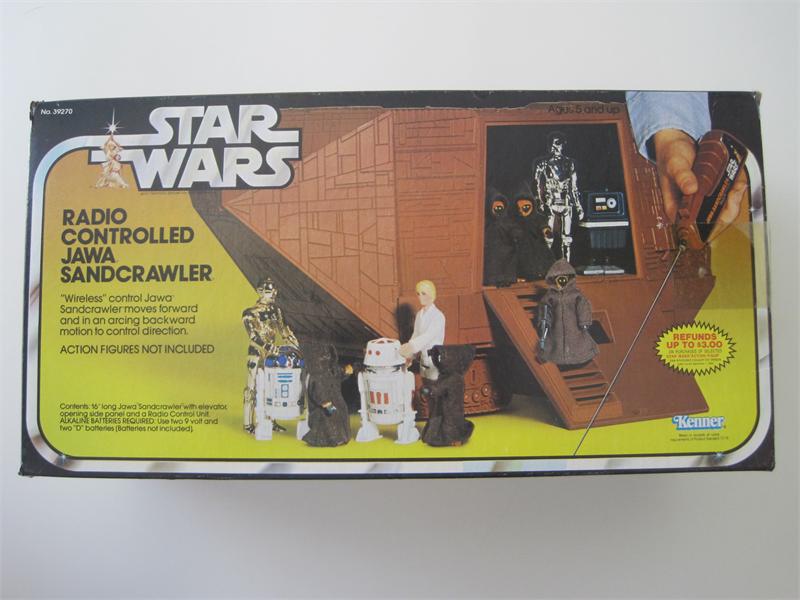
Then there was Kenner's Radio Controlled Jawa Sandcrawler, another J.C. Penney exclusive that appeared in the 1979 and 1980 Christmas catalogs.


From what I've read, the Sandcrawler worked better than the Land Speeder, but not by much. The price tag didn't help either--it was one of the most expensive Star Wars vehicle toys of its time at $30, a rather sizable cost for one of the movie's less popular vehicles. Regardless of its technical issues and price, it was still better than Kenner's other Sandcrawler, the Sandcrawler that was included in the Land of the Jawas playset. While the Remote Control Sandcrawler was made of plastic and could contain action figures, the Land of the Jawas Sandcrawler was a cheap cardboard backdrop that couldn't contain anything.

Kenner may have fumbled in the area of remote control toys, but Estes was able to deliver a few functional Star Wars model rocket kits. Basically, they were just regular model rocket kits in Star Wars drag and you couldn't make them duel each other in a dogfight, but at least they could fly. The two vehicles that Estes released as model rocket kits were the X-Wing Fighter and the TIE Fighter.


Curiously, Estes' TIE Fighter model rocket kit was the only model kit version of the standard TIE Fighter that could be found in the U.S. for the longest time. A TIE Fighter model kit didn't appear on American hobby store shelves until 1995, even though Darth Vader TIE Fighter model kits were sold after the release of Star Wars in 1977 and TIE Interceptor model kits were sold after the release of Return of the Jedi in 1983. Come to think of it, I'm sure that a few hobby enthusiasts bought the kit in the late 70s and early 80s with no intent of launching it just so they could have a TIE Fighter among their Star Wars model collection.

The other vehicles in Star Wars didn't lend themselves well to rocket model kit designs: the Millennium Falcon and Blockade Runner weren't aerodynamic enough, and kits based on the Y-Wing Fighter and the Star Destroyer wouldn't appear until 1995. So what else did Estes release in the 70s? An R2-D2 model rocket kit.


Attack of the Clones would later reveal that astromech droids could have rockets installed in them, but back in the 70s it seemed very odd to have a rocket kit based on a droid and not a vehicle. It was like something an exceptionally cruel droid owner would do to one of his hapless droids: strap a rocket to it and blast it into space. Just looking at the kit's packaging made me think of R2 loudly emitting one of his shrill electronic screams as he's launched into the air.

The R2-D2 rocket kit may have seemed like a stretch, but at least that looked like something from the Star Wars movie. The same could not be said for the Star Wars Photon Torpedo rocket kit.


Even though the Photon Torpedo kit was the most rocket-like and probably flew better than all of the other Star Wars kits, it really felt like Estes was scraping the bottom of the barrel with this one just to get another piece of Star Wars merchandise on the shelves. As you can see from the ad above, the Photon Torpedo kit was marketed as "the missile that destroyed the Imperial Death Star", even though the X-Wings in the movie never launched anything that looked like a missile. (The ad copy sounds like something a huckster would say on the streets of Coruscant to score some money from some unsuspecting dupe: "Why, of course this is the exact same missile that Luke Skywalker used to destroy the Death Star! Why would I lie to you about such an priceless piece of Rebel Alliance history?")

Star Wars wasn't the only sci-fi franchise that sold remote control toys and model rocket kits in the 70s. Battlestar Galactica produced a Colonial Viper model rocket kit and a remote control Cylon Raider (although it didn't fly--it just rolled around like a Roomba--and you couldn't put action figures in it), while Star Trek sold model rocket kits based on the USS Enterprise and a Klingon Battle Cruiser and a battery-powered "Star Trek CSF Controlled Space Flight" toy. Yet Lucasfilm was willing to go the extra mile to put Star Wars fans at the controls of their favorite futuristic vehicles, even if there were a few defects and malfunctions among its earliest attempts. Since that trend continues to this day among many sci-fi franchises, it's clear that such an effort really paid off in the long run for all sci-fi fans.


NEW--A Pocket-Sized Arcade Cabinet!

0 comments

Way back in 2010, I published a post about hand-held and tabletop video games from the 1970s and 80s. Part of that post discussed a series of tabletop games released by Coleco that emulated popular arcade games and looked like much smaller versions of arcade cabinets. At the time I joked, "Given the advancements in micro-computing and compact, high-definition video screens, a really devoted fan could probably gut one of the Coleco emulators and convert it into a tabletop unit--in other words, convert a plastic shell that was originally designed to house a VFD emulation of Donkey Kong into something that could house an actual, playable arcade version of Donkey Kong." Apparently, someone at ThinkGeek either read my post or thinks exactly the same way that I do:


Meet the "Arcadie iPhone and iPod Desktop Arcade". According to ThinkGeek, "The Arcadie Desktop Arcade is designed especially for iPhone and iPod Touch. Slide your device into the wee cabinet, pop it in the 30-pin connector dock, load up an Arcadie-supported app, and you're ready to play. More apps are being added every day, but for now there are games like Blasteroids, Alien Invaders, Ping, Stacker, and more. The 8-way joystick and two buttons will have you pew pew pew-ing the afternoon away, feeling like a jolly geek giant."


I don't have an iPhone or an iPod, but it amuses me to no end that someone remembers the video game arcade era so fondly that he/she is willing to make a teeny tiny version of an arcade cabinet interface for cell phones--even at the risk a causing some crippling new form of carpal tunnel syndrome--so that nostalgic geeks everywhere can relive the glory days of coin-op gaming. Now all they need to do is come out with Arcadie Desktop Arcade units that have marble-sized trackball controllers and action figure-sized light guns so that gamers can also play Centipede and House of the Dead knockoffs.


The Smithsonian Hosts The Art of Video Games

0 comments

As someone whose first video game console was an Atari 2600, I can tell you with great certainty and enthusiasm that video games have come a long way since their early Pong days in the 70s. But don't just take my word for it--it appears that the Smithsonian agrees with my opinion in their current exhibit, The Art of Video Games.


According to the exhibit's site, "The Art of Video Games is one of the first exhibitions to explore the forty-year evolution of video games as an artistic medium, with a focus on striking visual effects and the creative use of new technologies. ... The exhibition focuses on the interplay of graphics, technology and storytelling through some of the best games for twenty gaming systems ranging from the Atari VCS to the PlayStation 3. Eighty games, selected with the help of the public, demonstrate the evolution of the medium. The games are presented through still images and video footage. In addition, the galleries will include video interviews with twenty developers and artists, large prints of in-game screen shots, and historic game consoles."

I missed the opening GameFest weekend, which was held during March 16 - 18, but additional events are scheduled for April and May. After the exhibit closes in Washington DC at the end of September of this year, it will travel to 10 other locations throughout the US for those avid gamers who can't make it to our nation's capital. There's also a companion book for the exhibit, The Art of Video Games: From Pac-Man to Mass Effect by Chris Melissinos and Patrick O'Rourke, which you can learn more about here.


Wii Got Tron Evolution: Battle Grids

0 comments


I cannot tell a lie: A significant portion of this blog is devoted to my personal geek wish list, where I discuss collectible merchandise that I would like to own (or would've liked to have owned) and video games that I wish someone would make. Thus, it's nice to see that at least one of my wishes is coming true.

A few months ago, I kvetched about how there were no announced plans for a Wii Sports Resort-like video game to accompany the upcoming release of the Tron Legacy movie. Yet in a few days, a Tron Legacy game with game play similar to Wii Sports Resort will in fact be released for the Wii. It's called Tron Evolution: Battle Grids.

Battle Grids will have players fighting each other in various areas of the Tron world--Light Cycle Racing, Light Disc Battles, and so on. As far as I can see from the preview videos that are available online, Battle Grids seems a lot like the original Tron arcade game from 1982--as well as its 1983 arcade sequel, Discs of Tron--but with better graphics, head-to-head multiplayer competition, and more immersive game play. While it may not be the same thing as the Tron Evolution games that the other consoles are getting, it's still looking to be a worthy addition to the Wii collections of both casual gamers and Tron-o-philes alike. Wii is even getting its own neon blue Tron-themed Wiimotes; unfortunately, I don't think that you can Tron-ify your Mii as part of the Battle Grids experience.

Click here to see a preview video of Battle Grids by Game Spot from Comic-Con 2010, and click here to read additional information about the original Tron arcade game. If you still have a Nintendo Game Boy Advance, be sure to pick up Tron's other sequel, Tron 2.0: Killer App, which includes emulations of the previous Tron arcade games.


A Look Back at Portable Video Games

0 comments


If you're out on the northwest coast this weekend and have a thing for retro video gaming, you might want to head on over to Portland, OR. On September 18 and 19, Portland will be hosting the 5th annual Portland Retro Gaming Expo. It looks like it's going to be a big batch of fun, with events including Nintendo 64 and Atari 2600 gaming tournaments and a cosplay/costume contest.

I grew up during the rise of video game arcades, and the rise and fall and rise again of the home video game consoles. Yet one area of video game history that usually gets overlooked by even hard-core video game aficionados are the portable video games, particularly the pre-Nintendo GameBoy units from the 70s and 80s.

To be sure, the majority of these games weren't very compelling. While arcade games were still exploring their expanding graphical and game play capabilities and the home consoles were racing to keep up with the arcades, the portable video games had even less at their disposal to create a marketable game. Not only was their game play either very simple, annoyingly repetitive or sometimes incomprehensible, but their "graphics" consisted of either Light-Emitting Diodes (LED), Liquid Crystal Displays (LCD), or Vacuum Fluorescent Displays (VFD). LED games were just glowing dots (that's it--dots, dots, and nothing but dots), while LCD and VFD games used series of inanimate shapes or pictures that would light up in certain sequences to suggest motion.

Nevertheless, whenever my thumbs furiously race across my teeny, tiny Blackberry keyboard to answer work-related e-mail after e-mail, I can't help but to reminisce over those early funky, clunky attempts to put the joy of electronic gaming in the palm of your hand. Continue after the break to join me on my trip down insufficient memory lane and learn more about these early computerized toys.

The portable video games that I saw during the 70s and 80s fell into two basic, broad categories: the handhelds and the tabletops. The handhelds are self-explanatory, while the tabletops were games that were smaller than the home game consoles and didn't require a TV or computer screen to play them, yet you still needed something to put them on while playing them (such as a table) because they were too large to be played in your hand.


Of the tabletops, I had the Star Wars Electronic Battle Command, an LED game that was released in 1978. (Click here to see a video of the game in action.) The game was fun, even though you had to imagine that flashing red dots on a 4x4 grid were spaceships, planets and lasers, and that the screechy, scratchy noises emitted by the game unit were the sounds of space combat. Furthermore, the game required 6 AA batteries to run if you didn't have the outlet plug (which I didn't), so it wasn't cheap to play.


Of the handhelds, I had Escape from the Devil's Doom, one of the LCD solar powered games that Bandai released in 1982. Bandai released a bunch of solar powered handheld games that year, but Devil's Doom was marketed closely with Invaders of the Mummy's Tomb, as if the suggest that both were part of a single set. (You have to give Bandai quite a few geek chutzpah points for this: Not only did the titles sound like the names of long-forgotten B movies, but they also rhymed when you said them closely together.) Devil's Doom was a fun, simple time waster and it didn't require any batteries, but it was a far cry from even the most simple video games offered on the Atari 2600.

If anything, the early handhelds and tabletops represented the initial attempts to cram computing (albeit very, very simple computing) into increasingly smaller devices and yet maintain a commercial appeal. There were even some digital watches that included simple LCD games, long before anyone thought of putting games on cell phones. Believe it or not, Tomy released some "3D" handheld games, games that were packaged in ViewMaster-like units that you would hold up to your eyes while you played the game.


The series of tabletops that I remember the most fondly (but I didn't own a single one due to their high prices) are the VFD arcade emulators that were released by Coleco between 1981 and 1983. By that time, many other companies produced and sold their fair share of both handheld and tabletop arcade emulators, but what set Coleco's apart was that their emulator units were specifically designed to resemble tiny stand-up arcade cabinets. The packaging of the emulators and the commercials that advertised them heavily promoted this detail; to me, they looked like what would happen to arcade cabinets if you could shrink them in the laundry. Thanks to Coleco's emulators, all you needed was some background electronic and crowd noises (and perhaps the smell of beer and stale cigarettes) and you too could live out the arcade experience in the privacy of your own home.

The Coleco emulators included arcade hits such as Donkey Kong, Frogger, Galaxian, Pac-Man, Ms. Pac-Man, and Zaxxon. Coleco also released Donkey Kong Jr., but that was a LCD tabletop unit. The Smithsonian American History Museum has a copy of the Pac-Man emulator, but I didn't see it on display the last time I was there.

It should be noted that the Multiple Arcade Machine Emulator (MAME) software has spawned a subculture of classic arcade game enthusiasts who build arcade cabinets that are meant to provide the experience of an entire video arcade in a single full-sized unit. Given the advancements in micro-computing and compact, high-definition video screens, a really devoted MAME fan could probably gut one of the Coleco emulators and convert it into a tabletop unit--in other words, convert a plastic shell that was originally designed to house a VFD emulation of Donkey Kong into something that could house an actual, playable arcade version of Donkey Kong. Now that’s what I call progress!

The cartridge-less handhelds and tabletops didn't completely disappear after the Nintendo GameBoy arrived in 1989, but it was clear by then that their days on shelves of toy stores everywhere were numbered. To learn more about these revolutionary toys that paved the way for future generations of portable thumb-cramping computing devices, check out these sites:


The Economics of Video Game Geekery

0 comments

I've frequently heard over the last few years that in the realm of electronic entertainment, video games are flying circles around movies in terms of revenue. While I can understand why this is, what I have yet to comprehend is the economics behind product longevity when it comes to video games. Read on . . .  

For example: Because DVD sales are dropping, you can find a wide range of movie titles that are available for less than $20. (In other cases, less than $10.) In many cases, these movies are a few years--or even a few decades--old and, chances are that whenever the next big video format arrives, these same titles will be made available in this new format (complete with whatever bells and whistles that come with this new format). So you didn't get the 30th anniversary edition DVD of Jaws when it was first released? No problem--you can either get it brand new and for cheap at several DVD outlets, or you can wait for the 40th anniversary edition on a new video format that will probably include a whole new set of giant, man-eating shark-related ultra-super-high-definition goodies.

On the other hand, there are the video games. For as profitable as they are, they certainly can be hard to acquire once they've gone out of initial production because the prices seem to skyrocket after their initial distribution. For example, take Stubbs The Zombie in Rebel Without A Pulse (as seen above). I've heard nothing but good things about this game, which is not only a spot-on parody of zombie movies but it also gives you a chance to play as a zombie (quite a rare feature in the sub-genre of zombie video games) and start your own undead army of cannibalistic corpses. But when I recently tried to pick up a copy at Amazon.com, I found that new copies of this game run anywhere between $33 and $74, depending upon which vendor is chosen and how many new copies are left.

The same goes for Star Trek Elite Force 2. I played the first Star Trek Elite Force and it was an amazing game; it played almost exactly like an episode of Star Trek from a first-person perspective. (In fact, I would even go so far to say that while Elite Force is the older game, it probably captures the overall Trek experience better than the brand-new online Star Trek game. Go figure.) However, I missed the Elite Force sequel, which is now going for as high as $238. At prices like this, I can't see how long particular video games can maintain their appeal outside of a handful of hard-core fans.

Video games may have proven their worth economically, but it remains to be seen how well they can maintain their appeal over time. For example, even though stop-motion animation is not used often in the production of new movies, that doesn't prevent people from finding, watching and enjoying stop-motion classics such as the original King Kong and The Beast from 20,000 Fathoms. In contrast, enjoying some of the older video games appears to require a lot of money--not only to get the games themselves, but to get the necessary software and hardware to play them.

That said, there are video game emulators out there (such as Stella for the Atari 2600 and MAME for arcade games between the 1970s and the 1990s) that can be downloaded (either for free or for a fee) so that older games can be played on newer machines. However, how these emulators will factor into the ongoing history of video games remains to be seen, particularly since the emulators only cover certain game systems and formats. It could be that they could become essential to the future distribution of video games, for both old and new titles, particular since some have speculated that the future of video games may not belong to the dedicated consoles anyway. We'll just have to wait and see. Whatever happens, I just hope that I don't have to pay $238 just to play a single game.