ir a principal |
Ir a lateral
With 2014 just beginning, I'm going to kick off this year’s posts the only way a geek like me knows how: by talking about some of the swag I got for Christmas. For now, I’ll be taking about Star Wars Art: Concept which was recently published by Abrams Books. Read on for my complete review. Star Wars Art: Concept provides a historical cross section of Star Wars concept art, from the pre-production years of the first movie during the mid-70s up to the present day over three decades later. As such, it is not a comprehensive archive of concept art but a concept art sampler, providing glimpses into the conceptual work behind the movies, animated series and video games. To understand why this book was assembled and published in such a way, you have to consider that Concept is part of a larger series of Star Wars art books published by Abrams, a series that also includes Star Wars Art: Illustration, Star Wars Art: Comics, Star Wars Art: Visions and Star Wars: Frames. Each of these books covers different visual aspects of the franchise as a whole, instead of focusing on a single title within the franchise. If you want a complete set of concept art for a specific Star Wars movie, animated series, comic book series or video game, you’ll have to look elsewhere. The opening essays in Concept by Star Wars movie vets Joe Johnston, Ryan Church and Doug Chiang, as well as a concluding interview with Erik Tiemens, who worked on Revenge of the Sith, do a great deal to explain how essential visual art has been to the success of the franchise, so much so that there probably wouldn't be a franchise without it. Indeed, having a clear understanding of what the audience should see on the screen is crucial to building fantastic, fictional worlds; if special effects-driven movies fail to impress--either practical effects or CGI--it’s because their makers didn’t think creatively enough ahead of time before using the effects. Star Wars Art: Concept does have some unusual choices made by the publisher. The movies are well-represented, as is The Clone Wars animated series; however, concept art from only a handful of video games appear in Concept. Concept art from video games released during the '90s is conspicuously absent, and not a single example of concept art from the popular Knights of the Old Republic series appears within the book’s 176 pages. Curiously, artist Hajime Sorayama gets four pages for his private commission work, even though none of the work in question had anything to do with the development of any Star Wars title; thus, why his work is in Concept and not Star Wars Art: Visions is a mystery to me. 
As a horror and sci-fi nerd, I do what I can to keep my franchise scorecard up to date. Right now, Star Wars and the superhero universes of DC and Marvel are currently developing a selection of movie and TV releases, while many other franchises are stuck in some form of reboot--either making another reboot sequel (Star Trek), preparing to release a reboot (RoboCop), or starting pre-production of a reboot (Terminator). I've also been keeping current with developments in the Alien franchise, which has a number of projects in development but only one movie in the works. Read on for more details about what 20th Century Fox has in store for the horror franchise where no one can hear you scream.Comic Books: The only reboot that's planned right now for the Alien universe is being done by Dark Horse for its lines of Aliens, Predator and Aliens vs. Predator comics. According to io9's interview with the creative team behind the reboots, the new comics are being planned in conjunction with each other along with Dark Horse's new line of Prometheus comics. Presumably, this new expanded Alien, Engineer and Predator universe will be much more unified than the previous Dark Horse comics, which I think is a step in the right direction. While the new comics will regard all of the previous stand-alone movies as canon, it appears that the AvP movies will not be referenced in any way by the new comics. Then again, since those movies cribbed most of their key ideas from Dark Horse's AvP comics anyway (such as Predators hunting Aliens as a rite of passage and the possibility of Alien-Predator hybrids), I don't think that the omission of specific details from those films will make much of a difference in the new comic stories.Movies: So far, the only movie that's planned for the Alien franchise is a sequel to Prometheus, the 2012 Alien prequel. Director Ridley Scott and cast member Michael Fassbender have both confirmed that Prometheus 2 will happen and it will most likely go into production in 2015.Video Games: Even though Sega's Aliens: Colonial Marines was a disaster, that hasn't discouraged the company from trying its hand at publishing another Alien game. According to Kotaku, Sega is overseeing the development of a new game called Alien: Isolation that will place a greater emphasis on survival tactics over run-and-gun action. Isolation will take place on a space station and most of the game will feature only a single Alien; however, the most interesting details about this game are that its protagonist will be Amanda Ripley, daughter of Ellen Ripley, and its other characters will include clones. (FYI, Amanda is mentioned in the extended director's cut of Aliens, not the theatrical release.) Amanda's presence in Isolation suggests that it will take place between Alien and Aliens, although why Amanda is being used at all outside of her obvious connection to Ripley remains a mystery. Furthermore, clones don't appear in the Alien saga until Alien Resurrection, which takes place 200 years after Alien 3. Perhaps Isolation will provide more background details about certain plot points in Resurrection, but that's just speculation for now.Novels: A new novel entitled Alien: Out of the Darkness will be published in January 2014. Written by Tim Lebbon, Out of the Darkness is the first of a trilogy of novels that take place between Alien and Aliens. The other two books in the trilogy are being written by other authors, but each novel has been developed under the supervision of 20th Century Fox with the intent of making them part of franchise canon. Whether the new novel trilogy will have any connections to the Alien: Isolation game is currently unknown. Lebbon has already said in interviews that the plot of Out of the Darkness will involve Ripley and Ash. According to him, some of Ash's android consciousness remained alive in the computer of the Narcissus escape pod, but he hasn't said how Ripley will be involved in the story while also remaining in hypersleep. I'm guessing that the novel with have a situation along the lines of the early scenes of Prometheus where the android David was watching Elizabeth Shaw's dreams--maybe the disembodied Ash will be invading the dreams of Ripley.
As giants in the horror and sci-fi genres go, Richard Matheson is a unique case. He's not a familiar name for most media audiences, yet his influence is so pervasive that it's impossible to imagine modern horror and sci-fi pop culture without him. In the early years of my geekhood, I familiarized myself with both classic and contemporary horror and sci-fi movies and TV shows but Matheson's name never stood out in any obvious way. Unlike horror/sci-fi celebrities such as Stephen King and Steven Spielberg--both of whom have been heavily influenced by Matheson--I rarely saw Matheson's name used to promote his work. It wasn't until I noticed the appearance of his name in the credits of many movies and TV shows that I was able to understand who he was. Even though he is a well-respected novelist and short story author in his own right, Matheson frequently contributed his talents to film and TV production. He would either adapt his written work into scripts (The Incredible Shrinking Man, The Legend of Hell House), adapt the work of others into scripts (Burn, Witch, Burn, The Devil Rides Out), or create completely original scripts (The Comedy of Terrors, Kolchak: The Night Stalker). Outside of his direct contributions to Hollywood, many of his other stories and novels were adapted by others into movies and for episodes of TV shows such as The Alfred Hitchcock Hour, Twilight Zone, and Night Gallery. Chances are that if you're a fan of any horror/sci-fi movie franchise or TV series within the last 60 years, Matheson probably had something to do with it. Although he recently passed away, it's still Richard Matheson's world. We horror and sci-fi fans are just living in it.
2013 will see the return of several beloved horror and sci-fi titles, including Iron Man (as a sequel), Evil Dead (as a remake), and Aliens (as a video game). Yet one that I didn't expect to return was Robotech, the popular anime series from 1985 that has yet to see a successful and consistent continuation in the decades since. From I've read on various anime sites, another straight-to-video film titled Robotech: Love, Live, Alive is scheduled for release sometime this year, although its exact release date has yet to be determined. This post isn't about that. Instead, I'm focusing my attention on a role-playing game (RPG) sourcebook that was published less than a month before the end of 2012: the Robotech Genesis Pits Sourcebook. 
"Killer kid" stories, stories where one or more children become bloodthirsty murders, has long been a popular subgenre in horror. A few of my favorite killer kid horror movies include Village of the Damned (1960), Who Can Kill a Child? (1976), and The Children (2008). Yet for a many killer kid novels, short stories and movies that there are, there are very, very few that reverse the roles in this subgenre. In other words, while there are plenty of stories about previously normal children becoming relentless and remorseless killers of adults, few dare to depict a situation where previously normal adults become relentless and remorseless killers of children. Not so with Hide, a new comic book series that's written and drawn by Vernon Smith and published by El MacFearsome Comic Squares.
When I was a child, I read books about modern legends such as Bigfoot and the Loch Ness Monster (in between reading books published by Crestwood House about movie monsters, of course). I would often get the books out of my elementary school library, with the certainty that these supposedly "real" monsters would never be discussed in any of my classes. How times have changed. According to several news articles that I've read across the Internet, private religious schools in Louisiana are using a textbook published by the Accelerated Christian Education (ACE) Inc. that identifies the Loch Ness Monster as proof that dinosaurs still exist in the modern world and thus validates "Young Earth Creationism", the idea that the Earth is only a few thousand years old, and invalidates the theory of evolution. Many of the articles reprint the textbook passage that mentions Nessie, which I will also do so here: “Are dinosaurs alive today? Scientists are becoming more convinced of their existence. Have you heard of the ‘Loch Ness Monster’ in Scotland? ‘Nessie’ for short has been recorded on sonar from a small submarine, described by eyewitnesses, and photographed by others. Nessie appears to be a plesiosaur.” It should also be noted that the school in question, the Eternity Christian Academy in Westlake, is accepting students through publicly funded vouchers. In other words, taxpayer money is being used to teach kids that the Loch Ness Monster conclusively disproves the work of Charles Darwin and all of his successors. Really. I'd normally laugh at this, except that someone is getting paid with government money to perpetuate such a preposterous idea. I mean, if you're going to challenge a widely-accepted scientific theory, shouldn't you be using something that actually qualifies as, you know, evidence? Claiming that the modern legend of the Loch Ness Monster invalidates evolution is like claiming that the Elvis sightings from the 80s and 90s invalidates the idea that repeatedly ingesting drug cocktails of Valmid, Quaaludes, codeine, Placidyl and phenobarbitol can be lethal. Have you seen me lately?
Then again, maybe I should write an angry letter to ACE that claims discrimination over their curriculum's omission of Raystown Ray, the lake monster from my home state of Pennsylvania. Why should taxpayers fund private schools to talk about foreign monsters when we have plenty of perfectly good monsters right here in the US of A? All I can say is that if the Loch Ness Monster is going to stay in a creationist-centric biology curriculum that's funded by taxpayer money and used in private religious schools, then The Crater Lake Monster (1977) must be mandatory viewing for the students. Each viewing will then be followed by an essay test where students must describe in detail how they'd use construction equipment to fight a rampaging dinosaur. Teach the controversy!
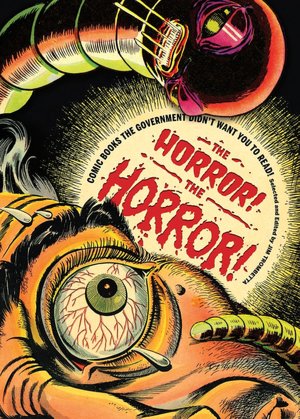
Of all the media formats that have distributed the horror genre to the masses, few have had it more difficult than the comic book. Congressional hearings that were held during the mid-50s based on nothing more than a fleeting fit of public hysteria caused horror comic books to suddenly vanish from newsstands everywhere and dealt a crippling blow to the comic book industry in general. The horror comic eventually came back during the 60s and 70s, with DC, Marvel and Warren Publishing contributing titles that would help this format recover. The most notorious contributor to the horror comic revival was Eerie Publications, which is the central topic of Mike Howlett's engaging and informative book, The Weird World of Eerie Publications: Comic Gore That Warped Millions of Young Minds. Howlett's approach to the history of Eerie Publications and its contributions to the horror comic format is exhaustive, almost to a fault. Howlett obviously loves the work of Eerie Publications and you'll finish the book with the conviction that he could tell you anything and everything about that company at a moments' notice. Yet even if you only have a passing familiarity with horror comics and the titles produced by Eerie Publications, Howlett's book is worth purchasing for a snapshot of what pulp horror publishing was like during the 60s and 70s. Curiously, Weird World also indirectly highlights the conspicuous similarities between low-budget horror comic publishing and low-budget exploitation horror filmmaking. Read on for my complete review. The ideal companion text for Howlett's book is Jim Trombetta's The Horror! The Horror!: Comic Books the Government Didn't Want You to Read!. (Read my review of that book here.) Trombetta's book covers the rise and fall of the horror comic during the early 50s, and Howlett covers the revival of the horror comic during the 60s and 70s (albeit from the perspective of Eerie Publications). Reading these books together will give horror fans a more complete picture of horror comic history and how the horror comic format was forced to change due to cultural and political events and changes in public media consumption and in the publishing industry. Where the books differ is in terms of approach: While Trombetta's book largely explores the recurring themes and imagery in horror comics from the 50s, Howlett devotes his book to the history of Eerie Publications and its artwork, artists, publication staff and newsstand competitors. 

As the U.S. release date of Prometheus draws closer, I'll wrap up my reviews of items from my personal Alien collection with a book by Dark Horse called Aliens/Predator: Panel To Panel . If fans want good Alien artwork, they can either pick up books that feature artwork by the original Alien designer H. R. Giger
 or they can get behind-the-scenes books that detail the production of Alien
 , its sequels
 and its crossover
 spin-offs
 . Yet fans should not overlook Aliens/Predator: Panel To Panel, because it features Dark Horse's best comic art of the Alien and the Predator and their various incarnations. This book features page after page of full color art of facehuggers, chestbusters, Warrior Aliens and Alien Queens, as well as Predators and various Alien oddities. Best of all, this book allows you to enjoy great Aliens, Predator and Aliens vs. Predator art without having to pick up the omnibus collections of each title. The quality of the Dark Horse stories range from good to mediocre to atrociously bad, and the quality of their art is just as variable. Thankfully, the less adequate artwork of Aliens and Predators is nowhere to be found in Aliens/Predator: Panel To Panel.
Today marks the passing of Ray Bradbury, one of the greatest science fiction writers ever to grace the genre. I honestly don't know what to write here--his body of work and artistic influence are so large that I no idea where to begin. He truly was a giant in his field. Of the many stories he wrote that I've read over the years, one of my favorites is a short story called "The Fog Horn". Before reading it, I never thought that a story about a giant prehistoric monster could be such a heartbreaking meditation on loneliness--Bradbury was that good. This story would later inspire The Beast from 20,000 Fathoms (1953), a movie that featured innovative stop-motion effects work by Bradbury's long-time friend, Ray Harryhausen.There a plenty of more detailed Bradbury obits out there and I particularly recommend the one by Cartoon Brew, which will give you a better idea of how Bradbury's interests and talents extended beyond the written word.
Even though I write a lot about movies, TV shows and video games, I believe that it's important to encourage strong reading habits among young children. Not only do strong reading skills help them excell in school and develop a sense of intellectual curiousity that will serve them well for the rest of their lives, but they will also prepare them for when they choose to devote countless hours of their lives to reading obsessive and trivial publications such as this blog. With that in mind, here are two titles that I recommend for the knee-high, up-and-coming movie monster fans in your life. * That's Not Your Mommy Anymore: A Zombie Tale , by Matt Mogk (Author) and Aja Wells (Illustrator) When a friend first told me about this book, I thought she was kidding. I'm glad to know that she's not, because who could rightfully deny their child the opportunity to read such delightfully morbid prose such as this: * Grandpa Won't Wake Up
 , by Simon Max Hill (Author) and Shannon Wheeler (Illustrator) The title says it all: Two children find that their sleeping grandpa won't wake up, so they take matters into their own hands. Yes, occultism is involved at one point. Of course, there are plenty of other monstrous books to recommend for youngsters of all ages. For example, Edward Gorey's The Gashlycrumb Tinies
 is perfect for helping children learn the alphabet ("A is for Amy who fell down the stairs. B is for Basil assaulted by bears. ...."). For more advanced readers, try Gary Larson's There's a Hair in My Dirt! A Worm's Story
 , which provides an educational and heartwarming explanation as to how human hair inevitably becomes part of a worm's diet. Yummy!
As someone whose first video game console was an Atari 2600, I can tell you with great certainty and enthusiasm that video games have come a long way since their early Pong days in the 70s. But don't just take my word for it--it appears that the Smithsonian agrees with my opinion in their current exhibit, The Art of Video Games.
If you live in Maryland or anywhere else near the Chesapeake Bay area and feel the need to get your comic book geek on, you’re in luck. Third Eye Comics will be holding the 2012 Annapolis Comic-Con on March 24 and 25.This year’s con has an impressive list of guests, including John Ostrander (Suicide Squad, Star Wars: Legacy), Jo Chen (Buffy the Vampire Slayer, Angel), JK Woodward (Crazy Mary, Zombie Tales), and many more. The topics of panel discussions will range from comic writing and painting, to selling your original comic book creations, to zombie survival techniques (yes, you read that last item correctly). There will also be a cosplay forum and a costume contest—must-haves at any self-respecting comic book convention.Check out the Annapolis Comic-Con site and Facebook page for more details and pictures from last year’s convention.
When I think of horror and sci-fi stuff from the 1950s, three things immediately come to mind: the rise of the "atomic mutant" subgenre of horror/sci-fi movies, the popularity of alien invasion stories, and Hammer Studio's early ventures into horror cinema. On the other hand, I never thought much about horror comics from that era. I knew that there were Senate hearings about the content of comic books in 1954, and that these hearings were prompted by the publication of Seduction of the Innocent, a book by psychiatrist Fredric Wertham. In his book, Wertham accused comic books of inciting juvenile delinquency on an epidemic level. By the end of the hearings, the comic book industry implemented a self-regulating Comics Code Authority (CCA) just so it could stay in business.


The Woman in Black, a ghost story that takes place during the Victorian era in England, made its debut in theaters across the US this weekend. While it's the first horror film from Hammer Films in decades, it's hardly a new tale. The Woman in Black started as a 1983 novel by Susan Hill, and it was later adapted for the theater, radio, and television.With that in mind, I've assembled a list of nine horror stories that have three or more film adaptations under their belts. What these stories all have in common is that they started out on the printed page, either as books, novellas or play scripts. Yet unlike Dracula or Frankenstein--two of the most adapted horror novels in film history--none of the stories on this list ever got around to spawning a single film sequel or spinoff.Click below to see these nine terror tales, which I've arranged according to the number of film adaptations that have been made for each title. Please note that some totals are estimated, because the more popular titles have been adapted so many times with varying degrees of faithfulness to the source material that it's difficult to determine which adaptations qualify as such. For example, the unpublished short story entitled "The Wax Works" by Charles Spencer Belden was adapted twice, once in 1933 and then in 3D in 1953. A third film in 2005 bears the same title as the 1953 version, House of Wax, but it is not based on the same source. Read on....1. Conjure Wife by Fritz LeiberNumber of Movie Adaptations: 3, Weird Woman (1944), Night of the Eagle (a.k.a. Burn, Witch, Burn!) (1962), and Witches' Brew (a.k.a. Which Witch is Which?) (1980)Skeptics hold a special place in the horror genre. By the end of the novel, TV show or movie, the skeptic usually becomes either a true believer or monster chow (or both)--no exceptions. Leiber took that character type one step further with his Conjure Wife novel, where the skeptic in the story discovers not only that his wife is using witchcraft to advance his career, but that the wife of one of his professional rivals is out to sabotage his career by the same means. No other skeptic in horror ever had it so bad, so much so that this novel has been adapted for the movies three times. Trivia bonus: The second adaptation was co-scripted by horror legend Richard Matheson.
2. Donovan's Brain by Curt SiodmakNumber of Movie Adaptations: 3, The Lady and the Monster (1944), Donovan's Brain (1953), and The Brain (1962)A human brain kept alive in a jar is one of the many go-to concepts that writers use as shorthand for science run amok, and it can serve as either a main plot point in story or simply a background decoration in a mad scientist’s lab. Donovan’s Brain was the first story to popularize this idea among horror and sci-fi filmmakers, and it has three film adaptations to its name to prove it. Of course, this doesn’t begin to cover the countless Donovan’s Brain rip-offs that have been released since the first adaptation of Siodmak’s novel, rip-offs such as The Brain from Planet Arous, The Brain That Wouldn't Die, and They Saved Hitler’s Brain.
3. I Am Legend by Richard MathesonNumber of Movie Adaptations: 3, The Last Man on Earth (1964), The Omega Man (1971), and I Am Legend (2007)It’s easy to lose count of the number of films and TV shows that have been adapted from Richard Matheson’s novels and/or from screenplays he’s written, but I Am Legend is the one that has been adapted the most times. What’s particularly noteworthy about this trilogy of adaptations are the diversity of actors who have starred as the main character (Vincent Price, Charlton Heston and Will Smith), none of the adaptations have the same ending as the novel, and that I Am Legend served as an inspiration of one of the most imitated horror films of all time: George Romero’s Night of the Living Dead.
4. The Island of Dr. Moreau by H.G. WellesNumber of Movie Adaptations: 3, Island of Lost Souls (1933), The Island of Dr. Moreau (1977), The Island of Dr. Moreau (1996)Like Richard Matheson, H.G. Welles has provided plenty of material for movies; in Welles’ case, movie adaptations of his work date as far back as the silent era. While The Invisible Man and War of the Worlds may be two of his most well-known novels due to the popularity of their film adaptations and sequels, The Island of Dr. Moreau remains one of Welles’ most adapted works that has yet to produce a single sequel--plenty of rip-offs, but not a sequel.
5. The Body Snatchers by Jack FinneyNumber of Movie Adaptations: 4If the 1950s are to be a guide about understanding alien invasions to Earth, then we can expect the invaders to attack in one of two ways: They’ll either vaporize us with their high-tech weaponry as they did in War of the Worlds, or they’ll overrun us with human duplicates as in Invasion of the Body Snatchers. Jack Finney struck a significant chord in the collective human psyche when he envisioned an invasive alien race that did not need any form of advanced weaponry to conquer the human race; instead, they rapidly reproduced like hyper-fertile plants and effortlessly assumed the identities of people while they slept. Such a terrifying idea resulted in four adaptations and countless imitators, but not a single continuation of the original story.
6. The Cat and the Canary by John WillardNumber of Movie Adaptations: 6The Cat and the Canary is the only title on this list that started as a stage play, which premiered in 1922. It’s also one of the few listed here that has been adapted either as a horror story or as a dark comedy. Nevertheless, its central plot--a group of people who come to a gloomy, secluded mansion for the reading of a will and find themselves stalked by a mysterious killer--was quite influential and has a inspired other titles in the horror genre, particularly in the giallo/slasher subgenre. It should also be noted that a similar play from the same era called The Bat was adapted for film three times, and that The Bat is credited by comic book writer Bob Kane as the inspiration for his most popular character, Batman.
7. Strange Case of Dr. Jekyll and Mr. Hyde by Robert Louis StevensonNumber of Movie Adaptations: 10+Horror and sci-fi characters who develop split personalities through mad science all have a common ancestor in Robert Louis Stevenson’s notorious Dr. Jekyll. Stevenson’s novella has been adapted so many times that it’s hard to get an exact count of what can be considered an actual adaptation. Further muddling the exact total are adaptations of this tale that add an element of gender bending, as was the case in Hammer’s Dr. Jekyll and Sister Hyde.
8. The Phantom of the Opera by Gaston LerouxNumber of Movie Adaptations: 10+Gaston Leroux wrote many detective novels throughout his career, but his most popular story involves a vengeful, disfigured maniac who lurks behind the scenes at an opera house. Like Dr. Jekyll and Mr. Hyde, The Phantom of the Opera has been adapted so many times and in so many formats (it was adapted into a musical twice) that the exact total of adaptations remains unclear. It has also been adapted to fit more contemporary settings, as in the case of Phantom of the Paradise and Phantom of the Mall.
9. The Picture of Dorian Gray by Oscar WildeNumber of Movie Adaptations: 10+Curiously, the only published novel by Oscar Wilde also became one of the most adapted stories in horror cinema. Even though The Picture of Dorian Gray is a variation of sorts on the themes explored in Stevenson's Strange Case of Dr. Jekyll and Mr. Hyde (which was published four years prior to Dorian Gray), Wilde’s book takes the old adage of how beauty is only skin deep to such sinister depths that filmmakers found it too irresistible to avoid adaptation.
Looking back, I grew up during an interesting time in the history of horror movies. I was in elementary school in the years that immediately preceded the rise of the home video industry, so that left most of us fledgling horror fans with syndicated television, magazines and books to satiate our horror needs in between horror film releases on the big screen. When it came to books, Crestwood House published a series about classic horror monsters and movies that were picked up by school libraries all over the country. These books familiarized monster kids with the best that classic horror films had to offer--which was fantastic, considering that we couldn’t always see these movies ourselves. (Read my post about Crestwood House's movie monster books here.) In addition to reading Crestwood House books, I was also fortunate enough to pick up a fantastic horror movie reference book at my local bookstore in 1983: The Great Book of Movie Monsters, by Jan Stacy and Ryder Syvertsen. I don’t remember the exact circumstances that led me to purchase this book--or what convinced my parents to let me purchase this book--but to this day I’m glad I have it as part of my personal collection. While it has its share of errors and quirks, The Great Book of Movie Monsters is still one-of-a-kind in many ways and an absolute treat for horror fans of both popular and obscure horror titles. Read on for my complete retrospective, including pictures from the book that provide examples of its unique design.Stacy and Syvertsen’s book is a reference book, so it is not meant to be read from beginning to end. Unlike other movie reference books, none of the movies are rated according to their quality; instead, the book’s gimmick is to provide individual profiles of the many monsters that have appeared on the silver screen, from the silent era to the early 80s. The profiles provide basic plot summaries of the movies in which each monster appeared and statistical data about each monster such as method of creation, size and weight, gender, superpowers, habits, and so forth. It is in these profiles that the book assumes a somewhat humorous tone: for example, a monster’s high number of victims is listed under “Accomplishments”, and other movie monsters that are similar to the one you are reading are listed as “Relatives”. Each profile also lists “What to Do If You Meet”, offering jokey solutions as to what you can do to stay alive when having a close encounter with the profiled monster.At its worst, the humor in book’s profiles is somewhat uneven, particularly when Stacy and Syvertsen profile monsters in such grim and gruesome films as And Now the Screaming Starts, The Brood and I Drink Your Blood. Their humor works best when they apply it to notoriously hokey B movies such as Beach Girls and the Monsters and Invasion of the Saucer Men, which calls into question why they chose to include more serious horror movies as part of their book’s goofy approach. Then again, their selection of movies to profile--and not profile--can be baffling to understand at times. For example, many of Hammer Film Productions’ creature features are listed, but The Abominable Snowman and The Gorgon are conspicuously absent. Likewise, early slasher films such as Psycho and Halloween get profiles for their respective killers, but none are provided for Texas Chainsaw Massacre or Black Christmas.None of the drawbacks in The Great Book of Movie Monsters detract from how well it works as a reference book for horror movies. The book features four indexes, which allow you to look for profiles according to monster, movie title, director, and studio. Each profile contains a picture of the monster and enough tantalizing details to convince you to seek the movie(s) that feature the monster. Best of all, many, many cult classics and obscure titles are included along with the classic movie monsters. This book introduced me to unique films such as Burn, Witch, Burn!, Don’t Be Afraid of the Dark, Equinox, The Mutations, and even a really strange, largely forgotten flick from 1953 called The Twonky. I haven’t seen any another horror movie book provide as much loving attention as The Great Book of Movie Monsters does to so many lesser-known titles. Its comprehensive scope alone convinced me that it was a labor of love for Stacy and Syvertsen to produce, and that they probably grew up glued to the TV set whenever their local TV stations ran a classic horror film from Universal’s Shock Theater library. (Click here to read my review of Jim Clatterbaugh's book, Shock Theater: An Illustrated History.)The Great Book of Movie Monsters is a great addition to any horror fan’s collection, particularly for those who are interested in fan-friendly horror movie books from the 80s. It would also make for a great companion text to John Landis’ recent book, Monsters in the Movies. Below are a few pages from the book, which you can click to enlarge.


