Showing posts with label parasites. Show all posts

20th Century Fox and Sega Get Alien: Isolation Ready for Launch

0 comments


A few weeks ago, I did an update post about the Alien franchise that listed new projects that are currently in development: comic books, a trilogy of novels, and a video game. The video game in question, Alien: Isolation, got a significant push forward this week in terms of media publicity, with a few articles, interviews, video clips, and an official Web site and Facebook page. According to the new information, Isolation should be ready for release by the end of this year. Read on for additional details about Isolation and what it could mean to the future of the franchise's video game titles.

I've never developed a video game before so I have no idea how long it takes to produce a game of decent quality. I've heard that some games flopped because they were rushed into production and then released with serious technical problems; on the flip side, some games have started development but then were put into limbo for years due to complicating issues (e.g., game developer bankruptcy). The development of Isolation's predecessor, Aliens: Colonial Marines, officially began in 2008 and it wasn't released until February 2013 (almost a year ago), yet all that time in development still didn't prevent the myriad of problems that caused it to bomb. I suspect that 20th Century Fox and Sega have set the release date of Isolation at the end of this year as a form of damage control to compensate for Colonial Marines, to prove to both critics and fans alike that Alien is still a viable franchise with a profitable future in video gaming.


Isolation is set 15 years after Alien and it will focus on Amanda Ripley, daughter of Ellen Ripley. According to the latest news, the story of Isolation involves Weyland-Yutani approaching Amanda to help find her mother by retrieving the Nostromo's flight recorder that was somehow retrieved by the crew of the space station Sevastopol. However, when Amanda arrives at the station, its crew are fighting among themselves and an 8-foot tall Alien is stalking the station's halls, vents and crawlspaces to find fresh human prey.

From what I've seen of the game footage, the game's developers at Creative Assembly have gone out of their way to recreate the look and feel of Ridley Scott's 1978 movie. The space station's exterior looks similar to the ore refinery that the Nostromo was transporting, and the technology and build of the station's interior match the gritty, "low-fi" feel of the first film's sets. Players won't have pulse rifles, smart guns or other military-grade weapons to use, but they will have a motion detector that looks like something in between the bulky motion detector that Dallas used in Alien to the smaller, sleeker version in Aliens. Like the original film, the title creature is sleek, stealthy and extremely intimidating; according to the developers, much AI programming is being done for the creature's behavior in order to keep players on their toes.


Even though using Ripley's daughter as the main character may cause some fans to complain about the game's desperation to find a link between the game and the movie series, casting Amanda as the game's lead makes plenty of sense. Not only would she have a motive to search for her missing mother, but her extremely brief appearance in Aliens means that no major retcon of the events in the movies has to happen in order to fit Isolation into franchise continuity (as opposed to Colonel Hicks in Colonial Marines). So far, nothing has been said if Isolation will have any narrative connections to Prometheus or the upcoming Alien novels and comic books.

One thing I've noticed about the coverage of Isolation is the frequent accusation of how the Alien as a monster used to be scary but is not anymore. To paraphrase Nora Desmond from Sunset Boulevard, the Alien has always been scary--it’s the video games that featured the Alien that got timid. Looking back, most '90s era Aliens and Aliens vs. Predator games were designed to capitalize on the then-popular first-person shooter games such as Operation Wolf, Doom and Quake, and that association between shooters and the Alien franchise stuck for years afterwards. Video game developers inevitably became lazy with the Alien license, since it was easier and cheaper to make run-and-gun games with multiple, easy-to-kill targets than to create an engrossing and terrifying survival horror game. Given the ample amount of weapons that players could choose from in Colonial Marines, those programmers were obviously thinking more along the lines of games such as Call of Duty than games such as Amnesia: The Dark Descent, and such thinking isn't going to create a worthwhile horror game.


I have high expectations for Alien: Isolation and that at the very least it will encourage future game developers to approach the Alien franchise from a survival horror perspective. I'm just hoping that the new release date won't compromise the quality of the finished product.


Alien Franchise Update: Reboots, Sequels, and a Prequel Sequel

0 comments


As a horror and sci-fi nerd, I do what I can to keep my franchise scorecard up to date. Right now, Star Wars and the superhero universes of DC and Marvel are currently developing a selection of movie and TV releases, while many other franchises are stuck in some form of reboot--either making another reboot sequel (Star Trek), preparing to release a reboot (RoboCop), or starting pre-production of a reboot (Terminator). I've also been keeping current with developments in the Alien franchise, which has a number of projects in development but only one movie in the works. Read on for more details about what 20th Century Fox has in store for the horror franchise where no one can hear you scream.

Comic Books: The only reboot that's planned right now for the Alien universe is being done by Dark Horse for its lines of Aliens, Predator and Aliens vs. Predator comics. According to io9's interview with the creative team behind the reboots, the new comics are being planned in conjunction with each other along with Dark Horse's new line of Prometheus comics. Presumably, this new expanded Alien, Engineer and Predator universe will be much more unified than the previous Dark Horse comics, which I think is a step in the right direction.

While the new comics will regard all of the previous stand-alone movies as canon, it appears that the AvP movies will not be referenced in any way by the new comics. Then again, since those movies cribbed most of their key ideas from Dark Horse's AvP comics anyway (such as Predators hunting Aliens as a rite of passage and the possibility of Alien-Predator hybrids), I don't think that the omission of specific details from those films will make much of a difference in the new comic stories.


Movies: So far, the only movie that's planned for the Alien franchise is a sequel to Prometheus, the 2012 Alien prequel. Director Ridley Scott and cast member Michael Fassbender have both confirmed that Prometheus 2 will happen and it will most likely go into production in 2015.

Video Games: Even though Sega's Aliens: Colonial Marines was a disaster, that hasn't discouraged the company from trying its hand at publishing another Alien game. According to Kotaku, Sega is overseeing the development of a new game called Alien: Isolation that will place a greater emphasis on survival tactics over run-and-gun action. Isolation will take place on a space station and most of the game will feature only a single Alien; however, the most interesting details about this game are that its protagonist will be Amanda Ripley, daughter of Ellen Ripley, and its other characters will include clones. (FYI, Amanda is mentioned in the extended director's cut of Aliens, not the theatrical release.)

Amanda's presence in Isolation suggests that it will take place between Alien and Aliens, although why Amanda is being used at all outside of her obvious connection to Ripley remains a mystery. Furthermore, clones don't appear in the Alien saga until Alien Resurrection, which takes place 200 years after Alien 3. Perhaps Isolation will provide more background details about certain plot points in Resurrection, but that's just speculation for now.

Novels: A new novel entitled Alien: Out of the Darkness will be published in January 2014. Written by Tim Lebbon, Out of the Darkness is the first of a trilogy of novels that take place between Alien and Aliens. The other two books in the trilogy are being written by other authors, but each novel has been developed under the supervision of 20th Century Fox with the intent of making them part of franchise canon. Whether the new novel trilogy will have any connections to the Alien: Isolation game is currently unknown.

Lebbon has already said in interviews that the plot of Out of the Darkness will involve Ripley and Ash. According to him, some of Ash's android consciousness remained alive in the computer of the Narcissus escape pod, but he hasn't said how Ripley will be involved in the story while also remaining in hypersleep. I'm guessing that the novel with have a situation along the lines of the early scenes of Prometheus where the android David was watching Elizabeth Shaw's dreams--maybe the disembodied Ash will be invading the dreams of Ripley.


I think that each of these projects have great potential for continuing and expanding the Alien universe. However, the fact that 20th Century Fox is only willing to develop "canon" stories in video games and novels suggests to me how reluctant it is to commit to a new Alien movie project. Ridley Scott may still be working on Prometheus 2, but that doesn't mean that Fox couldn't support the production of a new Alien movie in the meantime. Furthermore, even though Fox is willing to label certain non-movie Alien projects as franchise canon, it's questionable as to whether such classifications will be maintained over time. For example, the Colonial Marines game was hyped as being "canon", but I suspect that the game's poor sales and critical drubbing has since caused Fox to retract that claim.


Network Television was Better Off with Better Off Ted

0 comments


I have to give Netflix credit: Because of its wide selection of television titles, it’s a great resource for me to find high-quality but short-lived series that somehow escaped my attention when they were originally aired. (This is a welcome change from most television syndication arrangements, where only popular shows are aired repeatedly on channels other than the one that originally aired them.) In fact, it was thanks to Netflix that I found Better Off Ted, a wickedly intelligent satire of corporate culture that aired for two 13 episode seasons on ABC from 2009 to 2010.

Better Off Ted is a half-hour sitcom that takes place in the offices of Veridian Dynamics, a monolithic mega-corporation that engages in all sorts of odd and amoral activities to increase worker productivity and maximize profits, often at the expense of everyone and everything else. The characters consist of the titular Ted Crisp (Jay Harrington), a single father who heads Veridian’s research and development department; Ted’s intimidating, hyper-competitive boss Veronica Palmer (Portia de Rossi); and Ted’s underlings, product tester Linda Zwordling (Andrea Anders) and product development scientists Phil Myman (Jonathan Slavin) and Lem Hewitt (Malcolm Barrett).

While the interplay among the characters provide the plots for the episodes, most of the jokes in Better Off Ted are targeted directly at the behavior of modern-day corporations and their approach to people and science--or, as Lem puts it in one episode, “the place science goes to bend over and grab its ankles”. Throughout the series, various Veridian products become the subject of absurd and dark humor, such as its revolutionary cure for baldness (that is also a parasite) and a sound device that can deliver messages straight into a person’s brain (and can also cause uncontrollable, explosive vomiting when set at high frequencies). In a way, Veridian is less openly violent but just as misanthropic as Omni Consumer Products, the devious military-industrial conglomerate in Paul Verhoeven’s RoboCop. Indeed, notorious mad scientists such as Frankenstein, Jekyll and Moreau would feel right at home in the laboratories of Veridian Dynamics.

I love Better Off Ted and if you love comedy that is smart, sinister and strange, then you should check it out too.


Alien Abductees Get Even in Altered (2006)

0 comments


As movie monsters go, filmmakers have gotten plenty of mileage from the concept of extraterrestrial threats. There have been countless movies about high-tech alien invaders (War of the Worlds, Earth vs. the Flying Saucers), parasitic alien biology (Alien, The Thing), and too-close-for-comfort contact with an alien intelligence (Fire in the Sky, The Fourth Kind). In the midst of this crowded field of alien terrors is Altered, a 2006 creature feature that was directed and co-written by Eduardo Sánchez, co-writer and co-director of The Blair Witch Project.

Altered is about four men who were abducted and tortured by alien visitors when they were teenagers. After years of unsuccessfully coping with the trauma they endured, three of the men decide to hunt down and capture one of the visitors as an act of retribution; yet once they capture an alien, they're not completely sure of what they should do next. To make matters worse, their alien captive isn't quite as helpless as he looks and he has some sinister plans of his own ....

I'm recommending Altered to creature feature fans for many reasons. It's a well-made film that takes a unique approach to both alien horror movies and modern alien abduction lore. It effectively uses practical effects to bring its alien menace to life (no CGI here), and it also does an excellent job at balancing the horror with some bits of clever humor. Some scenes feature inventive examples of splatstick humor, and there are a few bits of redneck humor because the abductees in this movie are working class southern white men. However, this is not Tucker and Dale vs. Evil--Altered is a tale of terror at its core. In fact, some of the concepts and visuals in this movie reminded me of Scanners and The Fly, two classic "body horror" films by David Cronenberg.

Because most horror films feature characters who are being stalked by and defending themselves from a monster, the movie's story about men who search for and capture a monster makes it very different from most other films of its kind. Even though Altered is a horror movie, the pacing of its story reminded me fatalistic pulp crime dramas that begin with a major event (e.g., a bank heist gone wrong) and then subsequently unravel as the protagonists attempt and repeatedly fail to cope with the events they set in motion. The film also lets you understand the characters and the bitter motivations behind their actions. While hunting extremely deadly monsters sounds like something only a fool would do, you come to realize how the abduction left the main characters so broken in their adulthood that alien hunting has become the only meaningful thing left for them to do with their lives.

Altered ranks alongside Abominable and Alien Raiders as one of the better low-budget creature features to be released within the last ten years. It's everything that big-budget alien movies such as Signs and Dreamcatcher should have been but weren't, proving that some of the best horror films out there are the ones that never made it to national movie theater chains.


Four Tips for Building a Better Alien Video Game

0 comments


In the many months since of the Aliens: Colonial Marines video game, Gearbox attempted to fix a few of its many errors in the game by releasing a stream of upgrade patches and downloadable content (DLC). The latest DLC, which was released on July 24th, has been titled Stasis Interrupted and it is a complete campaign that depicts how Corporal Dwayne Hicks escaped the grim fate that was depicted for him in Alien 3. Click here to see a post on the AvP Galaxy site that features video clips that cover the entire campaign.

From what I've seen in the video clips provided, Stasis Interrupted really is the kind of story that Alien franchise fans were hoping for when Colonial Marines was first announced. It's not a perfect story, but it's a significant improvement over the original game's plot and mechanics. The cast of characters in Stasis Interrupted are much more interesting than the ones in Colonial Marines, the Aliens behave more like the stealthy, calculating threats that they're supposed to be, and returning Aliens cast members Michael Biehn and Lance Henriksen are given much more interesting things to do with their respective roles. Sadly, the fact that Gearbox has treated Stasis Interrupted as an insignificant afterthought by quietly releasing it six months after the release of the main game is just another line item to be added to the extensive list of everything Gearbox did wrong with its contribution to the Alien franchise. Click here to read my original post about the disastrous release of Colonial Marines.

With that in mind, here are a few suggestions that I have for game developers who will be developing whatever Alien games are commissioned in the future. For all of its improvements, Stasis Interrupted still treated the Aliens as nothing more than moving targets that are meant to be shot. Read on for four Alien attributes that game developers can utilize to make a superior video game experience.

1. The Alien is extremely resilient. As the franchise has depicted on many occasions, the Alien is ready and able to survive in even the harshest of environments. Thus, an Alien game could put players in a situation where they have to survive against an Alien onslaught while stuck in a hostile environment (e.g., a toxic atmosphere, frequent incidents of extreme weather, a lighter or heavier gravitational pull, etc.). Here's where developers could learn something from The Thing video game that was released back in 2002: In addition fighting against attacks from the titular Thing monsters, players also had to frequently find shelter from the relentless Arctic cold before they froze to death.

2. The Alien can rapidly evolve to meet changing environmental demands, such as new kinds of hosts and prey. As it was hinted at throughout the franchise and directly addressed in Prometheus, the Alien has a genetic plasticity built into its parasitic reproductive process that allows it to assume new shapes, behaviors and abilities. For example, the deleted cocoon scene in Alien suggested that the Alien could function as a solitary predator, while the hive present in Aliens suggested that the Aliens could organize themselves into a social hierarchy for the purpose of overtaking a large population of hosts/prey in a short amount of time. A future Alien game could take place on worlds with forms of life that produce a very different kind of Alien, or it could introduce a new Engineer artifact that would greatly influence the evolution of the Alien.


Imagine what an Alien video game would be like if it were set in the Avatar universe.


3. The Alien has acid blood. When considering what is known about the Alien, video games that are built around it should provide fully destructible environments that can be damaged by the Alien's acid blood. In most Alien video games, the acid blood that erupts from shooting an Alien at close range may damage the player, but it doesn't eat through floors, walls or other surfaces like it does in the Alien movies; thus, these games emphasize the shooter aspect of game play while ignoring one of the Alien's most distinct characteristics as a movie monster. When fighting a horde of Aliens in an enclosed space, shooting them by the dozens with a machine gun will be the last thing you want to do, since their blood would compromise the structural integrity of the building, space station or space craft that surrounds you. Thus, an Alien game should allow players to use alternate forms of weaponry--weapons that shock, cauterize and incapacitate rather than puncture, shatter and explode--which will put a greater emphasis on strategy and survival than firepower and marksmanship.


4. The Alien is very, very weird. I'll give Colonial Marines credit where credit is due: It expanded upon the designs of Weyland-Yutani technology used by humans, but it did nothing to provide something new and bizarre from the biomechanical world of the Aliens and their Engineer creators. There's much more to Alien and its sequels and prequels than claustrophobic spaces and heavily industrialized environments; at its most disorienting and intimidating, protagonists in each film are confronted by something unmistakably alien. Game designers for future Alien games should spend plenty of time reviewing the grotesque and erotic artwork of H.R. Giger in order to take gamers further into the universe where no one can hear you scream.


Giant Insects Reign Supreme in Wii's Escape from Bug Island

0 comments


I'm a big fan of "big bug" movies, so it would seem obvious that I would pick up a copy of a survival horror video game called Escape from Bug Island for my Nintendo Wii, right? Well ... not necessarily. When the game first appeared in the U.S. back in 2007, it was panned by most video game reviewers. Yet with this game's drop below the $10 price point, I recently decided to give this game a chance anyway to see if the critics were right. Speaking as a big bug movie fan, they weren't.

I can think of several survival horror video games for the Wii that have better graphics, better level designs, and better stories. Even Wii's other bug-centric game, 2009's Deadly Creatures, has better production values. Yet where Escape from Bug Island really delivers is where it delivers the most: It's got plenty of big, icky, human-eating bugs ... and that is AWESOME! Read on for my complete review.

In Escape from Bug Island, you play as Ray, a university freshman who reluctantly accompanies Michelle (Ray's secret crush) and Mike (Ray's best friend) to Beelzebub Island, an isolated location that's perpetually shrouded in a thick fog, so that Michelle can study the island's insect population. After Michelle and Mike wander off from the characters' camp site, Ray goes after them and encounters the island's many monstrous residents while searching for his lost friends.


Bug Island is a basic game as survival horror titles go. The graphics lack polish and the music cues are few in selection. The game's story is simple--there aren't many characters, and there are no puzzles to solve or secret codes to remember. Even the game's time travel subplot, which has you playing some of the levels again with new weapons and unlocked areas, doesn't complicate the overall story or game play. That said, the game's dialog is written in a hokey style that openly pokes fun at the game's b-movie premise. (Case in point: one of your weapons is a can of bug spray.) Bug Island isn't the same over-the-top exercise in camp as Zombies Ate My Neighbors! or Stubbs The Zombie, but its attitude of self-mockery is impossible to miss.

The game is played mostly from a third-person perspective, with occasional shifts to a first-person perspective depending on the weapon(s) you are using. Your weapon inventory grows from simple blunt objects (a stick, a baseball bat and rocks) to more sophisticated means of self-defense (knives, swords and guns) as the game progresses, and each level consists of maze-like forests, swamps, caves and ancient ruins that you have to traverse from beginning to end. Even though controlling Ray's walking and running motions through the Wii nunchuk is somewhat clunky at times (he doesn't handle sharp turns very well), controlling the weapons through the Wiimote is both accurate and intuitive.

A giant centipede feeding frenzy.

As the game's title suggests, Bug Island provides an ample supply of bugs for you to avoid, squash, beat, shoot and/or kill. The bugs range in size from a foot long to human height to car-sized, as well as various points in between. They include centipedes, flies, cockroaches, spiders, crickets, praying mantises, moths and maggots. (Curiously, spiders are the only arachnids in the game--over-sized scorpions, ticks and mites are nowhere to be found on the island.) These bugs crawl on you, jump at you, fly into your face, stab at you with their claws and cut you with their sharp mandibles. They buzz, screech and make other noises that one would expect to be made by really big bugs. The only normal-sized insects are the ones that fly together in large swarms that will eat you alive in a matter of seconds if you attract their attention. Fighting off this menagerie of creepy critters will inevitably make your skin crawl, so much so that anyone who has entomophobia and/or arachnophobia should avoid this game.

If the big bugs aren't enough, Bug Island provides plenty of other monsters as well, including sharp-toothed flying fish, bear trap-like carnivorous plants, giant frogs, and King Kong-sized apes with exposed brains and glowing red eyes. There's also a selection of human-animal hybrids such as lizard women, dog-like creatures with human faces, and a delightfully disgusting human-insect hybrid that has a steady stream of maggots dripping from its abdomen.


Indeed, Bug Island has enough monsters to rival any Resident Evil game, and the scares they produce are intensified by the game's use of ambient noises and pervasive application of fog. In a practical sense, the fog hides some of the game's graphic shortcomings, but it also leaves you guessing time and time again as to what will crawl, jump or fly towards you next.

If you're a creature feature junkie like me, then Escape from Bug Island is the game for you. It's the worst camping trip that you'll love to play.


Ridley Scott’s Prometheus: Building Better Biomechanical Worlds

0 comments


Being the obsessed Alien franchise fan that I am, I saw Prometheus last weekend in IMAX 3D. I was very impressed with the whole experience, both the quality of the 3D and Ridley Scott's return to the franchise that he started. Yet when it came time to write this review, I had no idea where to begin. Scott's film has so many details and ideas that I could rapidly identify and understand due to my appreciation of all four of the Alien movies, yet I keep seeing reviews, articles and posts on the Web that gripe over how incomprehensible and creatively bankrupt they think Prometheus is. So, since this is a fan blog of sorts anyway, I'm going to drop the pretense of providing some kind of neutral review and discuss the Alien prequel as an Alien fan. Besides, my general rule of thumb about movie franchises is that the best of them build upon ideas and themes over the course of several movies, so it is pointless to discuss sequels--especially third, fourth and fifth sequels--without mentioning the previous movies.

Here's my short, spoiler-free review: Prometheus is a fantastic movie, both as a prequel and a stand-alone. Scott shows a genuine interest in bringing new ideas into the Alien franchise, which is the main reason why this film works. Sure, the visuals are amazing, the effects are impressive and the cast is top-notch, but it all would've fallen apart if Scott didn't want to push the franchise into bold new directions. If you have any interest in Alien and its sequels--or if you have any interest in films that successfully blend horror and sci-fi--Prometheus is an amazing cinematic experience.

That said, I can see why Scott remained noncommittal about the Prometheus's status as a prequel. By making an indirect prequel to Alien, Scott is able to explore a theme that is present in all of the Alien movies but couldn't be adequately explored in those other films due to their emphasis on a monster-driven narrative. The theme in question can be summed up in the slogan of the omnipresent mega-conglomerate in the Alien universe, the Weyland-Yutani Corporation: "Building Better Worlds". Read on for my spoiler-filled thoughts about what drives Prometheus and how it broadens the Alien franchise into frightening new areas of deep space dread.

One of the curious details about Prometheus is how its plot parallels that of Alien in the sense that they are both about space travelers whose true mission has been concealed from them by sinister interests. In Alien, the crew of the Nostromo thought that they were returning an ore refinery from some distant mining operation back to Earth, only to find out that their employer, Weyland-Yutani, used this mission as a front for them to retrieve a deadly alien organism from the planet LV-426. In Prometheus, Elizabeth Shaw (Noomi Rapace) and Charlie Holloway (Logan Marshall-Green) think they are leading a scientific expedition to the planet LV-223 to learn more about the human race's possibly extraterrestrial origins, only to find out later that they are merely facilitating the wish of their elderly benefactor, Peter Weyland (Guy Pearce), to become immortal through seeking favor with an advanced alien race, the Engineers. Whereas the android Ash (Ian Holm) in Alien was willing to jeopardize the Nostromo crew by letting an alien life form on board, the android David (Michael Fassbender) in Prometheus meticulously analyses the Engineers' remains on LV-223 and deliberately exposes the expeditionary crew to unknown alien pathogens in order to understand the dangers present before allowing Weyland to meet with a surviving Engineer.


(It should also be mentioned here that a previous post I wrote, which was a speculative comparison of Prometheus to Alien vs. Predator (2001), turned out to be accurate. While both films feature scientists who travel to a remote location to seek out "ancient astronauts"--and they both feature terminally ill characters named Weyland who meet similar ends--Scott's movie brings many more interesting ideas and visuals to the screen than Paul W.S. Anderson did in his crossover story.)

While this comparison may sound like Scott merely rehashed the same story he directed back in 1978, it is quite the opposite. Scott uses the plot device of a space expedition to learn more about the Alien through their creators, the Engineers. Prometheus begins with one of the Engineers roaming Earth before life evolved out of the oceans, only to have him sacrifice himself in a way that will ensure that his DNA will be encoded into the life forms that will subsequently evolve. The prequel uses this opening to later provide motive to the space expedition, that the scientists are traveling to another planet to understand humanity's true origins.

It is never explained why the Engineers wanted to incorporate their DNA into the early life of prehistoric Earth at all. The movie plays up the idea of humans meeting and understanding their true creators, along with a few fleeting conversations between characters about the nature of divinity and faith. Yet the early scene with the Engineers also suggests something else entirely--that the Engineers planted their DNA on Earth for possible future colonization. In other words, by adding their DNA to the building blocks of life that were already forming in Earth's ancient oceans, the organisms that would later evolve and the ecosystems that surround them would be compatible with Engineer biology and thus make the Engineers' colonization easier to achieve with a breathable atmosphere, non-toxic food sources and diseases that could be understood scientifically and cured. Think of it as extremely preemptive terraforming, the process of deliberately modifying the atmosphere, temperature, surface topography or ecology of a planet, moon, or some other astral body to make it habitable by humans--or in this case, Engineers.


The idea that the Engineers seeded Earth with their DNA for possible colonization explains a few of the film's plot details which are otherwise vague. For example, the Engineers visited Earth multiple times since their initial DNA seeding and left behind a star map to tell ancient civilizations where they can be found--that's how the crew finds LV-223, as well as what prompted the expedition in the first place. These ancient visits could have been surveys by the Engineers to see how their DNA seeding process was evolving and if Earth could still be considered fit for colonization. As for the star map, it could have been the Engineers' way of coaxing any space-faring race of humans that would rise out of Earth to visit their labs on LV-223 so that the Engineers could assess human technological development without drawing unwanted attention to themselves.

Terraforming and space colonization has been the recurring themes in each Alien movie, which hinted at (but never fully detailed) how humanity during the time of the movies have developed all sorts of off-world operations, including colonies, ore mines and prisons. In fact, the main setting of Aliens, the Hadley's Hope colony, was a terraforming operation that was established to turn LV-426 into an Earth-like planet through an atmosphere processor. From the films' contexts, Weyland-Yutani is a major corporate player in the space colonization industry--ergo its "Building Better Worlds" slogan. In Prometheus, we see the early years of Weyland-Yutani when it was just the Weyland Corporation, but even in those early years space travel and colonization was on Weyland's agenda. When we first see corporation founder Peter Weyland in pre-recorded holographic form, his is surrounded by construction that is taking place on one of his colonies. It is in the common themes of terraforming and space colonization where the name "Prometheus" finds its significance: Much like how the mythic titan Prometheus shared fired from the ancient Greek gods with humanity, self-proclaimed world builder Weyland uses his ship, the Prometheus, to learn the secrets from aliens that have been building worlds long before humanity existed.

Where the Engineers differ from Weyland-Yutani in their approach to terraforming is in the area of microbiology. Instead of building giant machines such as an atmosphere processor to make a planet habitable, the Engineers appear to understand that habitable ecosystems are initially built on the microscopic level. That explains the melting Engineer at the beginning of the movie, as well as the dark liquid that the expedition team finds in the Engineers' labs on LV-223. The dark liquid contains some kind of micro-organism that is capable of deconstructing preexisting DNA and bonding with it to create new complex organisms. Of course, this DNA bonding weapon is deadly and unpredictable, as it clearly led to the deaths of almost all of the Engineers on LV-223, but the exact logic behind the weapon is never explicitly stated.

The Engineers planned to send the DNA bonding weapon to Earth (even after an unexpected delay that lasted over 2,000 years) to wipe out humanity, but it is unknown why they chose DNA bonding as a weapon as opposed to some other technology. It could be that it was intended to further shape Earth to the Engineers' exact specifications, much like the red weeds that the Martians planted on Earth in H.G. Wells' The War of the Worlds novel. It could also be that instead of creating a less complex bioweapon such as microscopic pathogen, the Engineers concluded that their DNA bonding weapon would be more effective because it could attack humans on both micro- and macroscopic levels.


The DNA bonding weapon ultimately sets the stage for the evolution of the Alien as it is seen in the original films. Prometheus shows two different kinds of proto-facehuggers, and a proto-Alien emerges from one of the Engineers at the end of the film (in a scene that reminded me so much of the Newborn birthing scene in Alien Resurrection). The logic behind the DNA bonding weapon matches that of the Alien's lifecycle, in the sense that both can adapt to almost any environment and they both reproduce rapidly through parasitic infection and bonding with the host's DNA. In fact, the prequel strongly suggests that the Alien, as it is seen in the original movies, is the perfected version of the Engineers' imperfect DNA bonding weapon.

Everything I'm rambling about here is purely speculation based on what I've seen in Prometheus and in the original Alien movies. The prequel ends with a cliffhanger, and the answer to why the Engineers would want to wipe out the human race--even over 2,000 years after their original target date--has not yet been provided. I think that the Engineers want to destroy the human race because their own civilization (which by the time of Prometheus could span multiple solar systems and even galaxies) has started to fall apart so unexpectedly and at such a rapid pace that colonizing Earth is their only option left for survival. If this is so, it would give greater significance to this line of dialogue from the prequel: "Every king has his reign and then he dies. That is the natural order of things."

The sequel to Prometheus could prove everything that I've written here to be wrong. Nevertheless, any prequel or sequel that can provide this much food for thought is a success in my opinion, and I look forward to seeing what else Ridley Scott has in mind next for his fascinating franchise.


A Review of Dark Horse's Aliens/Predator: Panel To Panel Book

0 comments

As the U.S. release date of Prometheus draws closer, I'll wrap up my reviews of items from my personal Alien collection with a book by Dark Horse called Aliens/Predator: Panel To Panel.


If fans want good Alien artwork, they can either pick up books that feature artwork by the original Alien designer H. R. Giger or they can get behind-the-scenes books that detail the production of Alien, its sequels and its crossover spin-offs. Yet fans should not overlook Aliens/Predator: Panel To Panel, because it features Dark Horse's best comic art of the Alien and the Predator and their various incarnations. This book features page after page of full color art of facehuggers, chestbusters, Warrior Aliens and Alien Queens, as well as Predators and various Alien oddities.

Best of all, this book allows you to enjoy great Aliens, Predator and Aliens vs. Predator art without having to pick up the omnibus collections of each title. The quality of the Dark Horse stories range from good to mediocre to atrociously bad, and the quality of their art is just as variable. Thankfully, the less adequate artwork of Aliens and Predators is nowhere to be found in Aliens/Predator: Panel To Panel.


Micro Machines Alien Collection Review

0 comments


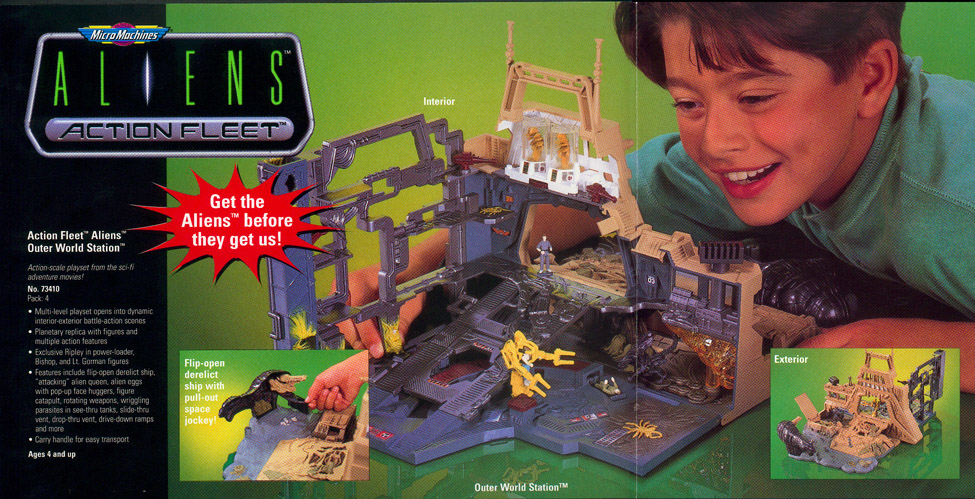
There was a time during the 80s and 90s when Micro Machines, a toy line produced by Galoob, was the go-to line for miniature replicas of all sorts of vehicles, both real and fictional. Micro Machines started with vehicles such as cars, trucks, boats and airplanes, and then it profited greatly by producing miniatures of vehicles from popular sci-fi franchises such as Star Trek and Star Wars. In fact, those miniatures proved to be popular enough that Galoob would expand those licenses to include micro-sized playsets and a new line of larger vehicle toys that would fit scale-sized micro figures.

With two major sci-fi franchises under its belt, Galoob decided to add licenses of other sci-fi titles to its Micro Machines line, including Alien, Predator and Terminator. This review will cover the Micro Machines Alien collection, including pictures of each item in the collection. Read on....

Looking back, the addition of R-rated sci-fi franchises such as Alien, Predator and Terminator to a toy line aimed at kids doesn't make much sense, particularly R-rated sci-fi franchises that aren't known for unique and collectible vehicle designs. Yet of these three titles, Alien had the largest selection of franchise-specific vehicles and it's those items that make the Micro Machines Alien sets worth the purchase.

Galoob released three Micro Machines Alien sets with four miniatures per set. The miniatures can be classified into four categories: vehicles from Alien, vehicles from Aliens, Alien characters, and human characters. Because the sets were produced before Alien Resurrection, none of the vehicles or characters from that sequel is included in these sets.


ALIEN VEHICLES

The Nostromo cargo ship (the ore refinery that the Nostromo towed was not included in any of the Micro Machines collections):


The Narcissus escape shuttle:


The derelict space ship on LV-426:


Each of these vehicle miniatures features highly-detailed sculpts that allow fans to see certain aspects from the Alien movie represented in them. You can see the circular openings in the underside of the derelict ship where Dallas, Kane and Lambert entered to find the Alien eggs, and you can see the airlock door in the Narcissus that Ripley used to push the Alien monster into the deep void of space. I think that the Nostromo sculpt is the most noteworthy in this group, because it conveys how large the ship was supposed to be even in its miniature reproduction.


ALIENS VEHICLES

The USS Sulaco:


The Colonial Marines Dropship:


The Armored Personnel Carrier (APC):


The best thing about the Aliens vehicles is that two of them include moving parts. The Dropship includes booster engines that unfold, and the APC has moving wheels, a rotating frontal gun turret, and a rotating rear gun turret that can be folded behind the vehicle to move through passages with low overhead clearance. The Sulaco miniature is somewhat disappointing, because its small size forces some omissions of detail in its sculpt; nevertheless, it's accurate enough to be a worthwhile addition to the Micro Machines set.


ALIEN CHARACTERS

This category includes the Warrior Alien from Alien, the Alien Queen from Aliens, and the Dog Buster from Alien 3.


Due to their diminutive size, the micro figures in the Micro Machines sets aren't nearly as impressive as the vehicle replicas. These figures are ideally meant for pint-sized play with the larger Alien vehicles that were produced in the Micro Machines "Action Fleet" line, such as the Narcissus and the APC, and the Micro Machines Alien Transforming Playset (and presumably with the Predator Action Fleet vehicle and Transforming Playset).

That said, the sculpts for the Warrior Alien and Alien Queen are interesting for what they are. Many details are omitted to accommodate the figures' tiny size (e.g., the Queen's smaller arms look like strange bumps along her rib cage) and the Queen is positioned in an awkward stance, yet the figures still have enough details to admire. In contrast to the Warrior Alien and Queen Alien is the Dog Buster, which is the worst figure sculpt in the collection. I'm not sure why they choose the Dog Buster over the adult Dog Alien from Alien 3, but Galoob should have chosen a better sculpt to complement the other Alien figures in the collection. Between its odd coloring and awkwardly lumpy design, the Dog Buster stands out like the figurative sore thumb when looking at the Alien collection in its entirety.


HUMAN CHARACTERS

This category includes Ripley and Kane from Alien and Hicks from Aliens.


There's nothing exceptional about the human figures, except that there's enough detail in the Ripley figure to know that it's the Ripley from Alien and not Aliens or Alien 3. The Hicks figure looks like he could be almost any of the Colonial Marine characters from Aliens. I can understand why Galoob wouldn't want any of the space convict characters from Alien 3 included in their Alien toy sets, but adding Kane with a facehugger wrapped around his head while wearing his spaceman tightie-whities is a baffling choice.

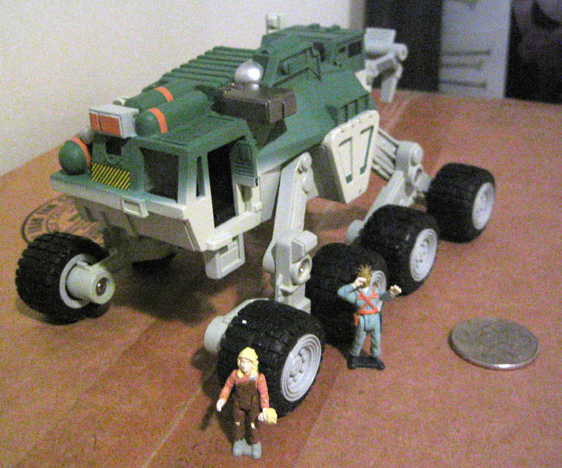
To be fair, the Micro Machines Alien collection pales in comparison to the Alien collections produced by Konami in Japan back in 2003 (see here and here). Not only did that collection include creatures and vehicles from all four Alien movies, but the slightly larger sizes of the miniatures allow for sculpts that are much more detailed than Galoob’s. Furthermore, the Alien license for Micro Machines was discontinued before it could add even more items to the collection, items such as a Power Loader, an LV-426 playset, and an eight-wheeled land rover from the extended cut of Aliens. Yet the Micro Machines Alien collection has enough well-made items to make it worth the purchase, and you can get the entire collection in only three sets for a reasonable price. For Alien fans, that’s worth a recommendation.