Showing posts with label book review. Show all posts

Dark Horse Returns to a Familiar Future War in Terminator Salvation: The Final Battle

0 comments


Given the number of comic book, movie, novel and TV series that I've followed over the decades, I'm used to having key questions, plot developments and character fates remaining unresolved. I don't like this--I much prefer to explore interesting ideas in further detail instead of forgetting them--but I suppose it comes with being a horror and sci-fi fan.

That said, Dark Horse has brushed the dust off of its Terminator license and is currently publishing Terminator Salvation: The Final Battle, a 12-issue miniseries that's written by J. Michael Straczynski and drawn by Pete Woods. The first issue arrived last month and the second issue is currently available at comic shops, newsstands, and other places that carry Dark Horse titles. The miniseries sets itself up to answer certain questions posed in the first four Terminator movies, questions that will probably not be addressed when the franchise is rebooted in 2015. So far, Final Battle looks to be the most ambitious Terminator comic book miniseries since Malibu Comics' two-part Cybernetic Dawn and Nuclear Twilight miniseries. Read on for my complete review, and why Final Battle is worth a look for any Terminator completist.

Terminator Salvation: The Final Battle takes place in two different time periods: in 2029 during the days before John Connor's final attack on Skynet, and in 2003 during the months before Skynet's nuclear assault on humanity (a.k.a. "Judgment Day"). Most of the action in 2029 centers on John Connor and his wife Kate, while the action in 2003 involves Dr. Serena Kogan, the enigmatic character that was introduced in Terminator Salvation. (Other characters that were introduced in Salvation--Marcus Wright, Blair Williams, Barnes, Star, and John and Kate's unborn child--haven't appeared in Final Battle yet and I don't know if they will at all.) Another character, Simon, appears in both 2029 and 2003; he's sent back to 2003 by John to prevent something related to Dr. Kogan's research that could secure Skynet's victory against the human resistance.


The Terminator franchise has a very haphazard history when it comes to who-owns-what within the franchise, so it's nice to see Dark Horse trying to put the pieces together before the 2015 reboot. I wasn't a fan of Straczynski's signature TV series, Babylon 5, and I'm not familiar with his extensive work in the area of comic books; regardless, his experience with complex, multilayered narratives shines through in the first two issues, and the ground work that he's laid so far is shaping up to be an engrossing conclusion to the first four Terminator movies--or at least a conclusion to the story threads from the Terminator 3 and Terminator Salvation timeline. (Terminator fans who are looking for a conclusion to the Sarah Connor Chronicles will have to look elsewhere, unfortunately.) Adding to the story's quality is Pete Woods' artwork, which expertly captures the look and feel of the Terminator universe. In one panel, he even included a Skynet machine that bears a similar design to the T-1 tank in T3.

Terminator novels, comic books and video games and flirted with the idea of human sympathizers for Skynet, but Dr. Kogan is shaping up to be a sympathizer who is essential to Skynet's overarching plans. Just as Cyberdyne and Miles Dyson were crucial to the birth of Skynet, Dr. Kogan is proving to be essential to the development of T-800 units, Terminator hybrids, and other Skynet technology that uses organic components.

What I also find fascinating about Dr. Kogan is that she only appears in the T3 - Salvation timeline; her involvement with that timeline's Skynet would also explain why T-800s appear almost a decade earlier than they do in the timeline that the Kyle Reese from the first movie came from. The unexpected early appearance of the T-800 in 2018 is a muted but crucial plot point in Salvation, the plot point that leads John Connor say this: "I knew it. I knew it was coming. But this is not the future my mother warned me about. And in this future, I don't know if we can win this war." This summarizes his realization that all he and his mother Sarah knew about Skynet--its strengths, weaknesses, and stages of development--came from a different timeline and may wind up leading humanity to its doom. What exactly Straczynski has in mind to do with Dr. Kogan isn't completely clear yet, but I'm sure it will be an interesting addition to the Terminator saga.


Early conceptual art of Dr. Serena Kogan for Terminator Salvation.


Click here and here to read my reviews of other tie-in comics and novels for Terminator 3 and Terminator Salvation.


Republics, Empires and Rebellions that Might Have Been: A Star Wars Art: Concept Book Review

1 comments


With 2014 just beginning, I'm going to kick off this year’s posts the only way a geek like me knows how: by talking about some of the swag I got for Christmas. For now, I’ll be taking about Star Wars Art: Concept which was recently published by Abrams Books. Read on for my complete review.

Star Wars Art: Concept provides a historical cross section of Star Wars concept art, from the pre-production years of the first movie during the mid-70s up to the present day over three decades later. As such, it is not a comprehensive archive of concept art but a concept art sampler, providing glimpses into the conceptual work behind the movies, animated series and video games.

To understand why this book was assembled and published in such a way, you have to consider that Concept is part of a larger series of Star Wars art books published by Abrams, a series that also includes Star Wars Art: Illustration, Star Wars Art: Comics, Star Wars Art: Visions and Star Wars: Frames. Each of these books covers different visual aspects of the franchise as a whole, instead of focusing on a single title within the franchise. If you want a complete set of concept art for a specific Star Wars movie, animated series, comic book series or video game, you’ll have to look elsewhere.

The opening essays in Concept by Star Wars movie vets Joe Johnston, Ryan Church and Doug Chiang, as well as a concluding interview with Erik Tiemens, who worked on Revenge of the Sith, do a great deal to explain how essential visual art has been to the success of the franchise, so much so that there probably wouldn't be a franchise without it. Indeed, having a clear understanding of what the audience should see on the screen is crucial to building fantastic, fictional worlds; if special effects-driven movies fail to impress--either practical effects or CGI--it’s because their makers didn’t think creatively enough ahead of time before using the effects.

Star Wars Art: Concept does have some unusual choices made by the publisher. The movies are well-represented, as is The Clone Wars animated series; however, concept art from only a handful of video games appear in Concept. Concept art from video games released during the '90s is conspicuously absent, and not a single example of concept art from the popular Knights of the Old Republic series appears within the book’s 176 pages. Curiously, artist Hajime Sorayama gets four pages for his private commission work, even though none of the work in question had anything to do with the development of any Star Wars title; thus, why his work is in Concept and not Star Wars Art: Visions is a mystery to me.


Star Wars Art: Concept is a great purchase for fans who appreciate the franchise's lengthy history and understand where each of the pieces featured in the book belong in its chronology. As someone who grew up with Star Wars and remains fascinated by it, I love Concept and I look forward to picking up some of the other Abrams Books publications to see more perspectives on a galaxy far, far away.


Adults Become the Ultimate Monsters in the Vernon Smith's Hide

0 comments

"Killer kid" stories, stories where one or more children become bloodthirsty murders, has long been a popular subgenre in horror. A few of my favorite killer kid horror movies include Village of the Damned (1960), Who Can Kill a Child? (1976), and The Children (2008). Yet for a many killer kid novels, short stories and movies that there are, there are very, very few that reverse the roles in this subgenre. In other words, while there are plenty of stories about previously normal children becoming relentless and remorseless killers of adults, few dare to depict a situation where previously normal adults become relentless and remorseless killers of children. Not so with Hide, a new comic book series that's written and drawn by Vernon Smith and published by El MacFearsome Comic Squares.


The plot behind Hide is as simple as it is scary: One day, people over the age of 18 decide to go on a killing spree against everyone who is under the age of 18. (By everyone under 18, I mean everyone--no child is spared.) No clear reason is given in the comic (at least not yet) as to why this is happening; even creepier is that the adults still behave normally around each other and only become consumed by a violent rage whenever they see a teenager or a child.

The first issue of Hide is currently available at comic stores, and you can read it online at the El MacFearsome Comic Squares site. According to the site, Hide should total at 140 pages in length when it is finished; judging by what I've seen in the first 22 pages, this is going to be a wildly terrifying ride.


The Weird World of Eerie Publications Book Review: Reviving the Horror Comic Book Through Recycling

0 comments


Of all the media formats that have distributed the horror genre to the masses, few have had it more difficult than the comic book. Congressional hearings that were held during the mid-50s based on nothing more than a fleeting fit of public hysteria caused horror comic books to suddenly vanish from newsstands everywhere and dealt a crippling blow to the comic book industry in general. The horror comic eventually came back during the 60s and 70s, with DC, Marvel and Warren Publishing contributing titles that would help this format recover. The most notorious contributor to the horror comic revival was Eerie Publications, which is the central topic of Mike Howlett's engaging and informative book, The Weird World of Eerie Publications: Comic Gore That Warped Millions of Young Minds.

Howlett's approach to the history of Eerie Publications and its contributions to the horror comic format is exhaustive, almost to a fault. Howlett obviously loves the work of Eerie Publications and you'll finish the book with the conviction that he could tell you anything and everything about that company at a moments' notice. Yet even if you only have a passing familiarity with horror comics and the titles produced by Eerie Publications, Howlett's book is worth purchasing for a snapshot of what pulp horror publishing was like during the 60s and 70s. Curiously, Weird World also indirectly highlights the conspicuous similarities between low-budget horror comic publishing and low-budget exploitation horror filmmaking. Read on for my complete review.

The ideal companion text for Howlett's book is Jim Trombetta's The Horror! The Horror!: Comic Books the Government Didn't Want You to Read!. (Read my review of that book here.) Trombetta's book covers the rise and fall of the horror comic during the early 50s, and Howlett covers the revival of the horror comic during the 60s and 70s (albeit from the perspective of Eerie Publications). Reading these books together will give horror fans a more complete picture of horror comic history and how the horror comic format was forced to change due to cultural and political events and changes in public media consumption and in the publishing industry. Where the books differ is in terms of approach: While Trombetta's book largely explores the recurring themes and imagery in horror comics from the 50s, Howlett devotes his book to the history of Eerie Publications and its artwork, artists, publication staff and newsstand competitors.


The story told about Eerie Publication's horror comics as told in Weird World largely revolves around two individuals: publisher Myron Fass and editor Carl Burgos. Fass specialized in the publication of low-budget pulp magazines, and Howlett's book reviews the full range of trashy and unscrupulous magazines that Fass produced in addition to Eerie Publications' horror comics. In following his preference for material that's cheap and quick to produce, Fass published multiple horror comic titles (Horror Tales, Terror Tales, Tales from the Tomb, etc.) by re-publishing horror comic stories from the original golden age of horror comics during the early 50s. Burgos, a veteran comic book artist, oversaw the production of the Eerie Publications' titles. Before working for Fass, Burgos' most noteworthy accomplishment was his creation of the Human Torch character during the 1940s. When Marvel Comics revived the character for its Fantastic Four series in 1961, Burgos received no compensation from Marvel for his creation; his falling out with Marvel estranged him from the mainstream comic book industry, which led to his editor role at Eerie.

Howlett details how Fass and Burgos could get away with publishing multiple horror comic titles by mostly recycling horror comic stories that were already published back in the 50s. Eerie Publications would release some completely new material from time to time, but rehashing old material was Fass and Burgos' dominant method of publication. However, instead of just republishing the original stories, Fass and Burgos would hand the stories over to artists who would re-draw and re-script the stories with varying degrees of faithfulness to the source material. Some revisions were similar to the original stories, while others would take the stories in completely new directions. Either way, the new versions of the stories were always much gorier and more sexualized than the originals. Some stories would be republished up to three or four times; all Fass and Burgos did was hand an old story to a new artist and provide a new title, and thus the story could be regarded as "new". Even the cover art was recycled over and over again with minor variations. (Click here to see a gallery of Eerie comic cover comparisons that I assembled in a previous post.)


While I was reading Howlett's book, two things came to mind:

* Eerie's method of repeatedly recycling creative content and adding lots of gore and sex to each reiteration is almost symmetrical to how low-budget horror films were made during the 50s, 60s and 70s. Cheap horror films frequently recycled plots, props and footage from other movies, in addition to using stock footage and background music to pad thin production budgets. During the 60s and 70s, the grindhouse conventions of sexual titillation and increasingly detailed gore effects were used by low-budget filmmakers to promote their otherwise obscure horror films.

* If anything, the revival of the horror comic book proved exactly how hollow the 50s Congressional hearings and the subsequent Comics Code Authority (CCA) really were. In the case of Eerie Publications, it not only republished the very same stories that Congress set out to ban, but it also made them gorier and sexier than their original versions. Furthermore, Eerie couldn't be restricted by the CCA because it called its publications "magazines" and not "comics" and thus was not subject to CCA oversight.

The only problem I had with Weird World is its occasional excess of minutiae. I understand how Howlett wanted to ensure that everyone who was involved in Eerie Publications got their due, but there were times in the book when I was struggling to keep up with who's who outside of Fass and Burgos. Yet this complaint is minor, because the book offers so much information and artwork that horror fans are sure to enjoy. I highly recommend The Weird World of Eerie Publications for both horror and comic book fans who are interested in learning more about the horror genre and its relationship with the comic book industry during the 60s and 70s.


A Review of Dark Horse's Aliens/Predator: Panel To Panel Book

0 comments

As the U.S. release date of Prometheus draws closer, I'll wrap up my reviews of items from my personal Alien collection with a book by Dark Horse called Aliens/Predator: Panel To Panel.


If fans want good Alien artwork, they can either pick up books that feature artwork by the original Alien designer H. R. Giger or they can get behind-the-scenes books that detail the production of Alien, its sequels and its crossover spin-offs. Yet fans should not overlook Aliens/Predator: Panel To Panel, because it features Dark Horse's best comic art of the Alien and the Predator and their various incarnations. This book features page after page of full color art of facehuggers, chestbusters, Warrior Aliens and Alien Queens, as well as Predators and various Alien oddities.

Best of all, this book allows you to enjoy great Aliens, Predator and Aliens vs. Predator art without having to pick up the omnibus collections of each title. The quality of the Dark Horse stories range from good to mediocre to atrociously bad, and the quality of their art is just as variable. Thankfully, the less adequate artwork of Aliens and Predators is nowhere to be found in Aliens/Predator: Panel To Panel.


The Brief History of 50s Horror Comics Exposed in The Horror! The Horror!: Comic Books the Government Didn't Want You to Read!

0 comments

When I think of horror and sci-fi stuff from the 1950s, three things immediately come to mind: the rise of the "atomic mutant" subgenre of horror/sci-fi movies, the popularity of alien invasion stories, and Hammer Studio's early ventures into horror cinema. On the other hand, I never thought much about horror comics from that era. I knew that there were Senate hearings about the content of comic books in 1954, and that these hearings were prompted by the publication of Seduction of the Innocent, a book by psychiatrist Fredric Wertham. In his book, Wertham accused comic books of inciting juvenile delinquency on an epidemic level. By the end of the hearings, the comic book industry implemented a self-regulating Comics Code Authority (CCA) just so it could stay in business.


Fans of superhero comics (myself included) are well-versed in how the CCA Code sanitized the content of DC's superhero universe, and how also it set the stage for Marvel to introduce a new generation of innovative-yet-CCA-compliant superheroes. Yet in comparison to other genres, horror comics vanished from newsstands overnight because of the CCA. In his book The Horror! The Horror!: Comic Books the Government Didn't Want You to Read!, author Jim Trombetta recounts the hysteria surrounding horror comics during the mid-50s and the people who were involved--the critics, the publishers, and the artists. He also reprints many examples of artwork from these controversial comics, which he uses to critically analyze the comics' recurring imagery and themes. Click below to read my complete book review, and why Trombetta's work is a great addition to the short lists of books that chronicle the most successful act of government-sponsored censorship in the US.

Trombetta begins his book with an overview of the Senate hearings and the hysteria that led up to the hearings, with subsequent chapters devoted to particular aspects of 50s era horror comics (skeletons, sexuality, shrunken heads, race, etc.). Each chapter is separated by pages of reprinted artwork from the comics themselves, including covers, panels and a few complete stories. In one of the initial chapters, Trombetta succinctly describes the reasoning that drove the censorship of horror comics: "(I)n April 1954, comics became the first pop-art medium to be regulated nearly out of existence by the government. ... It was, in true Orwellian fashion, as if the government thought that bad things would vanish if they couldn't be read or thought aloud." Given how comic books have been repeatedly derided by cultural elites as "junk" entertainment, it's astonishing to read Trombetta's account of how influential members of our own government willingly believed that horror comics could do so much harm to society and that banishing them to the point of complete cancellation would ultimately serve the greater good.


What I enjoyed about The Horror! is how Trombetta analyzes horror comics and the fears and insecurities they reflected at the time. Early horror comics feature many of the same ideas and images that many other forms of horror storytelling have, but Trombetta keeps his scrutiny of them rooted in the popular culture of the late 40s and early 50s to give readers a better frame of reference for understanding. To that end, he notices certain overlaps between the horror comics with the then-contemporary war comics and "true crime" comics.

Further contextualizing the horror comics is the inclusion of an episode of Confidential File, which is on a DVD inserted in the book's rear flap. Confidential File was a news magazine show that ran from 1953-58 and was hosted by LA Times reporter Paul Coates; the episode on the DVD shows Coates "investigating" horror comics. If you think that news in our current era of 24-hour cable- and Internet-driven coverage is nothing but empty sensationalism, then you need to see this episode. Not only does Coates lack any meaningful facts or credible "experts" to support his indictment of horror comics, but he uses child actors a provide dramatization of what he thinks kids do to each other after reading horror comics as he prattles on about how reprehensible he thinks the comics are. The dramatization is so blatantly staged to fit Coates' view of what horror comics do to kids (think The Lord of the Flies in suburbia) that it's hard to believe that anyone other than Coates would take this episode seriously. Curiously, the episode was directed by Irvin Kershner, who would later go on to direct Empire Strikes Back.


(Then again, it has been argued by some that horror comics of the pre-CCA era weren't meant for kids in the first place. According to graphic designer Art Chantry, "The artists working this turf back then were virtually all war vets (it seems) with varying sorts of emotional damage (let’s be honest). The writers were virtually unknown haggard hacks and a few really f#$ked up madmen tossed in to the stew. Combine that with a forgotten generation of comic book professional hacks and an entire new generation of adult men who entered WW2 and the Korean war as children (and had to grow up way too fast) and you begin to see a crazy new market emerging. The truth was that these horror comics weren’t really made for 'kids' at all. They were made for new postwar damaged adults taking over the new modern world." Read Chantry's complete post about pre-CCA horror comics over at the Madame Pickwick Art Blog here.)

Trombetta's contextualization of the horror comics would be incomplete if he couldn't convey how popular they were before their government-mandated discontinuation. This point is driven home by the reprints of the horror comic covers from various titles between 1951 and 1954. There are dozens upon dozens of the covers on page after page in the book; I had no idea that there were so many horror comics published in such a short amount of time, which makes their subsequent disappearance from the newsstands after 1954 that much more stupefying to comprehend. If you only buy The Horror! for its reprints of rare comic art, you still won't be disappointed.


Where The Horror! stumbles badly is in its conclusion. Trombetta jumps from the mid-50s to the post-9/11 era in an attempt to make some larger point about censorship and how it functions in two different times in American history, but his argument falls flat due to its lack of substantial connection to the rest of the book. Had he paid more attention to how the horror genre and its fan culture had continued after 1954--and how many times that horror-related materials have been the subject of controversies both frenzied and fleeting in the years since then--he might have been able to build a firmer link between the 50s and now. For example, even though the CCA vanquished horror comics for a few years, it didn't stop Eerie Publications from publishing several horror anthology comic magazines from 1966 to 1981. Trombetta could have used this example to emphasize how futile the anti-comics effort ultimately was and how tragic it was for our government to violate the First Amendment for the sake of appeasing momentary hysteria.

Overall, The Horror! The Horror!: Comic Books the Government Didn't Want You to Read! is a book I would recommend to any horror fan who has a fervid appreciation of macabre visual art (such as horror VHS covers from the 80s and horror special effects work by artists such as Tom Savini, Rob Bottin and Rick Baker) and would like to learn more about the frequently forgotten golden age of horror comics.


The Great Book of Movie Monsters Retrospective

0 comments


Looking back, I grew up during an interesting time in the history of horror movies. I was in elementary school in the years that immediately preceded the rise of the home video industry, so that left most of us fledgling horror fans with syndicated television, magazines and books to satiate our horror needs in between horror film releases on the big screen. When it came to books, Crestwood House published a series about classic horror monsters and movies that were picked up by school libraries all over the country. These books familiarized monster kids with the best that classic horror films had to offer--which was fantastic, considering that we couldn’t always see these movies ourselves. (Read my post about Crestwood House's movie monster books here.)

In addition to reading Crestwood House books, I was also fortunate enough to pick up a fantastic horror movie reference book at my local bookstore in 1983: The Great Book of Movie Monsters, by Jan Stacy and Ryder Syvertsen. I don’t remember the exact circumstances that led me to purchase this book--or what convinced my parents to let me purchase this book--but to this day I’m glad I have it as part of my personal collection. While it has its share of errors and quirks, The Great Book of Movie Monsters is still one-of-a-kind in many ways and an absolute treat for horror fans of both popular and obscure horror titles. Read on for my complete retrospective, including pictures from the book that provide examples of its unique design.

Stacy and Syvertsen’s book is a reference book, so it is not meant to be read from beginning to end. Unlike other movie reference books, none of the movies are rated according to their quality; instead, the book’s gimmick is to provide individual profiles of the many monsters that have appeared on the silver screen, from the silent era to the early 80s. The profiles provide basic plot summaries of the movies in which each monster appeared and statistical data about each monster such as method of creation, size and weight, gender, superpowers, habits, and so forth. It is in these profiles that the book assumes a somewhat humorous tone: for example, a monster’s high number of victims is listed under “Accomplishments”, and other movie monsters that are similar to the one you are reading are listed as “Relatives”. Each profile also lists “What to Do If You Meet”, offering jokey solutions as to what you can do to stay alive when having a close encounter with the profiled monster.

At its worst, the humor in book’s profiles is somewhat uneven, particularly when Stacy and Syvertsen profile monsters in such grim and gruesome films as And Now the Screaming Starts, The Brood and I Drink Your Blood. Their humor works best when they apply it to notoriously hokey B movies such as Beach Girls and the Monsters and Invasion of the Saucer Men, which calls into question why they chose to include more serious horror movies as part of their book’s goofy approach. Then again, their selection of movies to profile--and not profile--can be baffling to understand at times. For example, many of Hammer Film Productions’ creature features are listed, but The Abominable Snowman and The Gorgon are conspicuously absent. Likewise, early slasher films such as Psycho and Halloween get profiles for their respective killers, but none are provided for Texas Chainsaw Massacre or Black Christmas.

None of the drawbacks in The Great Book of Movie Monsters detract from how well it works as a reference book for horror movies. The book features four indexes, which allow you to look for profiles according to monster, movie title, director, and studio. Each profile contains a picture of the monster and enough tantalizing details to convince you to seek the movie(s) that feature the monster. Best of all, many, many cult classics and obscure titles are included along with the classic movie monsters. This book introduced me to unique films such as Burn, Witch, Burn!, Don’t Be Afraid of the Dark, Equinox, The Mutations, and even a really strange, largely forgotten flick from 1953 called The Twonky. I haven’t seen any another horror movie book provide as much loving attention as The Great Book of Movie Monsters does to so many lesser-known titles. Its comprehensive scope alone convinced me that it was a labor of love for Stacy and Syvertsen to produce, and that they probably grew up glued to the TV set whenever their local TV stations ran a classic horror film from Universal’s Shock Theater library. (Click here to read my review of Jim Clatterbaugh's book, Shock Theater: An Illustrated History.)

The Great Book of Movie Monsters is a great addition to any horror fan’s collection, particularly for those who are interested in fan-friendly horror movie books from the 80s. It would also make for a great companion text to John Landis’ recent book, Monsters in the Movies. Below are a few pages from the book, which you can click to enlarge.


The Hidden Book Review: An Undead Apocalypse of a Different Kind

0 comments


Of the many horror comic writers/artists I've read over the years, I consider Richard Sala to be a special find. I can't think of anyone else who can balance the goofy, the gory and the gothic within a single story so effortlessly, both in terms of plotting and visual style. His stories are rife with absurd characters and situations, yet they feature grizzly acts of violence and body counts that are higher than many "serious" horror comics. The best description I can think of to summarize Sala's work would be what horror comics would look like if the late cartoonist Charles Addams had decided to apply his dark humor and unique illustrations to expressionistic tales of terror. Yet even that fails to capture what makes Sala's work so unique and entertaining.

Over the holidays, I received a copy of The Hidden, Sala's latest book. (Note: Sala's The Hidden is not to be confused with the awesome 1987 space parasite movie of the same name.) Sala retains his distinct style in this new title; however, by placing it in a story about the end of the world, he takes themes he has previously explored into eerie new territory. Read on for my complete review.

The Hidden tells the story of a young couple who discover that the world has begun to violently fall apart while they were away on a hiking trip in the deep wilderness. During their search for survivors, they encounter a man who can't remember his name or where he's been ... but he may hold the key to understanding the mystery behind the apocalyptic horrors. To say anything more about this story would give too much away.

Other critics have noticed the similarities of themes and ideas between The Hidden and Mary Shelley's Frankenstein, which is true. The story also reminded me at times of Richard Matheson's I Am Legend, Edgar Allan Poe's The Masque of the Red Death, and Lucio Fulci's unofficial "Gates of Hell" trilogy of movies. Yet the central subtexts of the story--the futility of denying one's own mortality and inevitable horrors that arise when death is cheated--have appeared in Sala's other works, such as Mad Night. In fact, I wouldn't be surprised if a sequel to The Hidden (something I'd love to see, of course) would include nods to Septimus A. Crisp and Massimo Ibex, characters who have appeared in Sala's other stories.

While Sala remains true to his style in The Hidden, it differs from his other work in a few significant ways. Some of his prior tales of terrors have featured multiple conspiracies and covert plots that somehow fit together no matter how convoluted or preposterous they got. In contrast, The Hidden features a few subplots and details that are never fully explained or developed further. Such a fragmented approach adds to the characters' lingering anxiety and the story's dour atmosphere--much more so than Sala's previous works.

Welcome to the end of the world. Have a nice day!

In spite of its depressive mood (you know, with it being about the end of the world and such), The Hidden exemplifies the effectiveness of Sala's application of a "less is more" visual style to broad, complex stories. His drawings are simple and cartoonish, a style that provides an ample amount of flexibility to match whatever kind of story he aims to tell. Where humor and horror are mixed into a single setting, such drawings both facilitate and accentuate shifts in mood; in situations where the horror has both corporeal and existential dimensions, Sala uses his drawings to bestow a palpability of sorts to the most fantastic of frights. It is as if by portraying the possible and the impossible in a modest, straightforward fashion, both achieve the same sense of presence. Thus, when the ghastly, gangly reasons for the world's end finally appear alongside of the survivors in The Hidden, the cartoon pictures assume qualities of menace and shock.

I can't recommend Sala's books enough, and The Hidden is one of his best works to date. Be sure to pick up a copy if you're looking for something more than global plagues and cannibalistic zombies in your world-ending entertainment. Go to Richard Sala.com for more information about The Hidden and other Sala books.


Incredible Change-Bots Graphic Novel Review: More Than Just Machines!

0 comments


For as much as I love robot toys, I think that many of the narratives that have been built around them are frequently hokey and forgettable. Take the Transformers, for example: The toys themselves are creative, colorful and well-designed playthings, but the stories behind them are paper-thin pretenses to sell the toys. While there are still plenty of die-hard Transformers fans out there, I could never seriously accept the blatantly absurd premise of an ongoing war between anthropomorphic, shape-changing robots from outer space.

Thankfully, there's a graphic novel out there for both Transformers fans and naysayers alike: Incredible Change-Bots by Jeffrey Brown. Change-Bots tells the story of two warring groups of transforming robots, the good (yet dysfunctional) Awesomebots and the bad (yet incompetent) Fantasticons, and how they bring their unending and aimless conflict to Earth. Read on for my complete review.

This 2007 parody is a must-have for anyone who loves transformable robot toys and remembers the dozens of cartoons, comic books and movies that have been used to help sell them to kids. Through Change-Bots, Brown expertly takes the narrative devices behind stories written for the Transformers toys (as well as their less successful counterparts, the Go-Bots) and turns them on their shiny metal heads. He pokes fun at everything from the robots' goofy extraterrestrial origins, to the strange sounds they make when they transform (or in this case, “incredible change!”), to their choice of conspicuously self-descriptive names. One of my favorite Change-Bot names is Wheeeee, the name of the robot that incredible changes into a motorcycle.

On the rear flap of the book, Brown describes Change-Bots as "part parody" and "part nostalgic tribute". This description is spot-on, and I doubt that Brown could've done such a great job at satirizing transforming robots if he weren't a fan of them at one point. In fact, much of Brown's humor reminded me of the kind of geek-friendly humor found in Twisted ToyFare Theater, so much so that Brown could've have told the same Change-Bots story with word balloons printed over still pictures of robot toys and not miss a beat.

Autobot Leader Optimus Prime,
as depicted on Transformers toy boxes ... 

... and Awesomebot Leader Big Rig,
as seen in Incredible Change-Bots.

Not only does he spoof the Transformers stories, but Brown also throws in a few jabs at other aspects of toy-centric transforming robot franchises:

* On the last page of the book is an ad for the Incredible Change-Bots Fan Club, which promises an official membership card, an exclusive mini-comic, and a hand-drawn picture of the Change-Bot of your choice.

* Change-Bots begins with two-page spreads that list every Change-Bot character (one spread for the Awesomebots, the other for the Fantasticons). These spreads are arranged like the mini-catalogs that would be included with many of the Transformers toys (collect them all!).

* One page features a detailed, painted picture of one of the Change-Bots, the Awesomebot leader Big Rig. This picture imitates the detailed, painted robot art that would adorn the boxes of Transformers toys to enhance their visual appeal.

* Even though Change-Bots is printed in English, the printing on the book's spine is entirely in Japanese characters--a clever nod to where the transforming robot trend really began.

The Official Incredible Change-Bots
Fan Club Membership Kit

Brown recently released a sequel called Incredible Change-Bots Two, which I hope to pick up and review soon. Also, be sure to check out the exclusive Incredible Change-Bots mini-comic over at Comics Alliance.


Shock Theater Book Review

0 comments


I recently read a book titled Shock Theater: An Illustrated History by Jim Clatterbaugh, the editor and publisher of Monsters From The Vault magazine. I actually got this book from a friend shortly after its initial publishing in 2001, but it became lost among my tons of stuff during two successive moves around the Washington DC/Maryland area.

When I first looked at this book, it didn't sink in to me exactly what Shock Theater was and what it meant to the horror film fan community during the early years of TV and before the arrival of technologies such as VHS tapes and DVDs. However, upon reading Clatterbaugh's book, it became very clear just how important "horror hosts" and the wide distribution of horror movies on syndicated television during the 50s, 60s, 70s and 80s have been to the horror fan community. Read on for a complete review of this eye-opening book, which provides a detailed retrospective of a key moment in horror movie history that ensured its successful transition from the silver screen to the living room.

Mass media content consists of two essential, inescapable parts: production and distribution. It doesn't matter which medium about which you're talking (paintings, books, magazines, music, movies, etc.), no one will see or hear much of anything if the media content is not distributed to the masses. Every TV show, novel, comic book and movie you've ever seen and loved--or that have ever been seen and loved by anyone--simply would not have been if no one bothered to mass produce and distribute them. This is true for all media, including horror movies. Clatterbaugh's Shock Theater book reflects on the history of this horror movie distribution system, how it inspired the creation of horror hosts, and how it fostered new generations of horror fans for almost three decades.


The Shock Theater book is 136 pages long, and is filled with both color and black and white photos on glossy stock paper. The book consists of the following:
  • An introduction by the "Cool Ghoul" horror host himself, Zacherley (John Zacherle).
  • A complete reprint of the extremely rare promotional book for the Shock! TV package, which consisted of 52 horror films from Universal Studios. The book and TV package was distributed by Screen Gems, the television subsidiary of Columbia Pictures, in October 1957.
  • Various items from John Brunas' two-volume personal scrapbook of Shock Theater.
  • "Shock Treatment," Steve Kronenberg's personal tribute to Shock Theater and the effect it had on his life.
  • Memories of Shock Theater and its various iterations over the years from the writers of Monsters From The Vault magazine.
  • Pages of rare photos and promotional material.
The movie memories shared by the contributors to the Shock Theater book provide a snapshot of what it was like to grow up during a time when exposure to classic (and not so classic) horror movies was limited to late night weekend viewings ONLY--no home recordings, downloads or one night rentals for convenient viewing. With all of the different ways that media content has been digitized for distribution these days, it's easy to forget that there was a time when movies were only available at certain times and places. Here’s an excerpt from one of the book’s contributors, Richard Scrivani, who paints a simple but accurate picture of what it meant to be a monster movie fan when Shock Theater first hit the airwaves:

“Try to imagine the uptight, conformist, and slightly paranoid atmosphere in the decade following World War II, not a lot of room for things different and bizarre, and within a matter of weeks being drawn to a new, sometimes scary, but indescribably fun world of monster-mania. And, if you were fortunate enough to locate a friend who shared your enthusiasm for all of it, to form a fan club or the like, to trade monster pictures (lots of times newspaper ads) like baseball cards, and to have a sleep-over to watch the latest Shock Theater entry, it was a fringe benefit, a perk, the icing on the cake.”
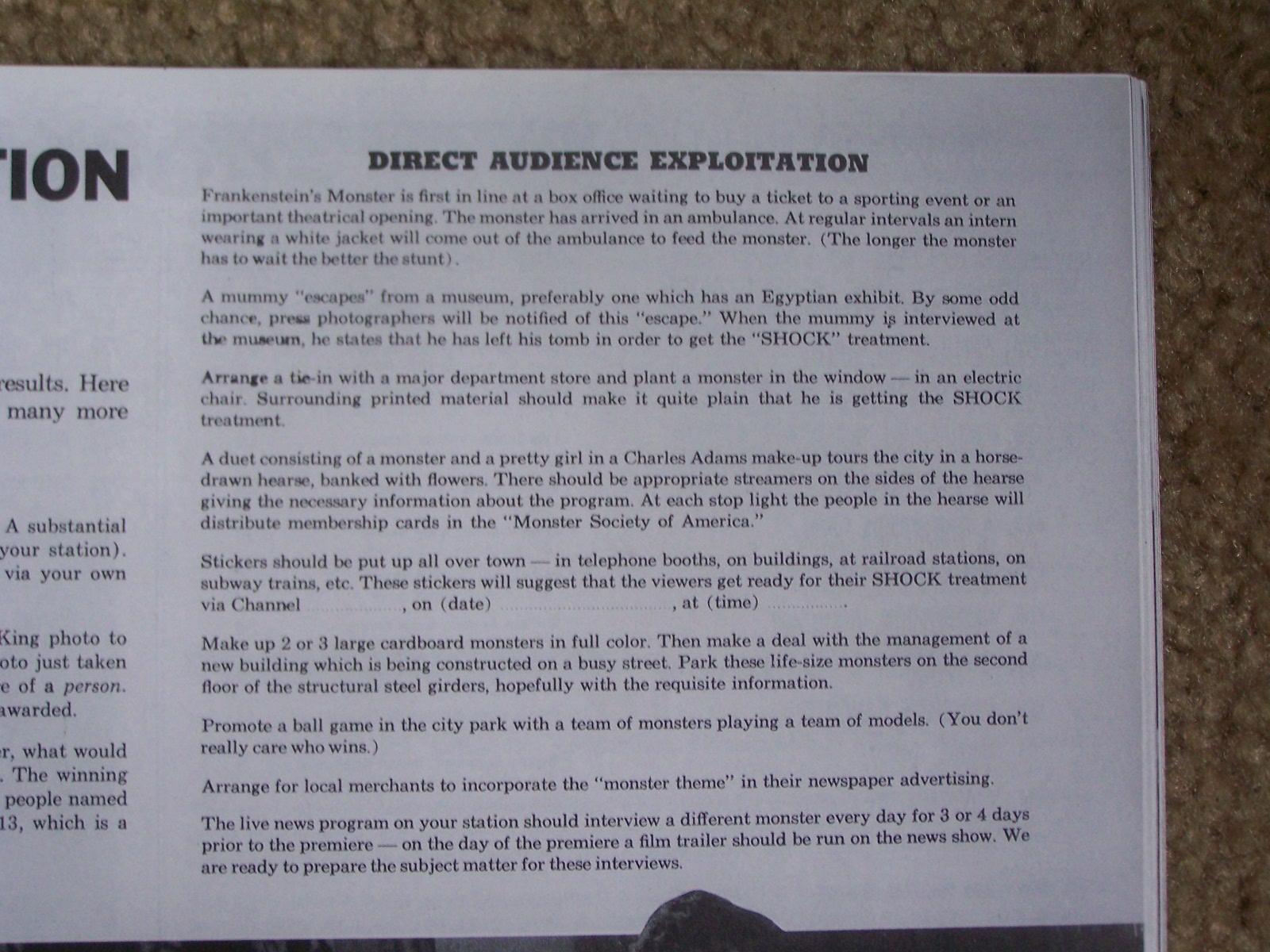
Another noteworthy feature of Shock Theater is the complete reprint of Shock!, the promotional book that was distributed to television stations as part of the Shock Theater movie package. The Shock! book was a guidance manual for TV stations that instructed them how to encourage audience participation in and press coverage of their weekend broadcasts of the Universal horror movies. These recommendations were essentially the blueprints for the horror hosts who would later appear in TV markets across the country.


Interestingly, Vampira (Maila Nurmi), the first horror host to appear on TV, had nothing to do with Screen Gems’ Shock Theater; Vampira hosted horror movies on her own series, The Vampira Show, for the ABC affiliate in Los Angeles, CA between 1954 and 1955. However, what started with Vampira and her short-lived show was popularized across the country through the distribution of Shock Theater.

Each of the movies that were included in the Shock Theater syndication package had its own page within the Shock! promotional book, a page that included the movie’s synopsis and credits, 10 second and 20 second scripts for on-air promotions, a TV news release for local newspapers, and a short biography of one of the movie’s cast members.


If a TV station wanted to order additional promotion material for the movies they were showing, an order form was included that was organized by movie title.


Even though it was originally created as a way to distribute movies on syndicated TV, Shock Theater's legacy continues to this day. For example, horror hosts paved the way for similarly themed B-movie entertainment such as Mystery Science Theater 3000. Even though Shock Theater itself has faded into history, many horror hosts are still out there, still hosting horror movie viewings on the Internet and/or local public access television. I’ve even found a few of these hosts still doing their shtick in my own neck of the woods, hosts such as Count Gore De Vol and Dr. Sarcofiguy.

As I've posted before, most of my early encounters with classic movie monsters were through books, not TV, and I lived in TV markets that didn't have their own horror hosts. The only horror host that I knew of for a long time was Cassandra Peterson's alter ego--Elvira, Mistress of the Dark--but that was only through her appearance on TV shows and commercials, so the idea of what she did as a horror host was still pretty vague to me. Nevertheless, as the years passed, I remembered that most of my early monster movie memories had something to do with the weekend TV watching. My first viewings of classic monster movies, including The Mummy and Godzilla, happened during weekend, rainy day channel-surfs; that was also the same time when I got my first taste of less popular but no less interesting creature features such as The Car, Gorgo, 20 Million Miles to Earth, and Phase IV.

Clatterbaugh's Shock Theater book put my past experiences into a wider context, rooting them in a tradition of sorts that started with Shock Theater. I’m sure that you too will see parts of your own horror movie experiences in a whole new light when reading this book, no matter how old you are. Unfortunately, this loving and thorough tribute to Shock Theater experienced some problems during its initial publication, so it is currently sold out and there are no plans for a second printing at this time. Your best bet it to try to find copies of the book online, or visit Clatterbaugh's Monsters From The Vault site for possible updates on the book’s publishing status. Regardless, Shock Theater: An Illustrated History is a great addition to any horror film fan’s library.