Showing posts with label dinosaurs. Show all posts

Crayola Encourages Budding Kaiju Fans Through Its Create 2 Destroy Toy Line

0 comments

Imagine this holiday shopping scenario: You're a life-long fan of giant monster movies and want to foster an appreciation of such entertainment in the next generation of geeks--your kids, your nieces and nephews, or both. However, you think that they're too young to grasp the finer points of such giant monster mashes such as Godzilla, Gamera: Guardian of the Universe and Pacific Rim, so you have no idea what to get them for Christmas. Well, never fear because Crayola has got your back this year with its Create 2 Destroy line of playsets.


The Create 2 Destroy playsets aren't strictly kaiju merchandise, but they might as well be because half of the playsets involve giant monsters trashing a city, a shopping mall, and a suburban community. These playsets make up the Dino Destruction sub-series, where kids use Morphix (Crayola's answer to Play-Doh) to mold cars, buildings and trees that the included dinosaurs can stomp with their feet and crush with their jaws. Some of the dinosaurs have spring-loaded tails that kids can use as catapults to launch Morphix-molded boulders into nearby targets.

The other Create 2 Destroy sub-series, Fortress Invasion, are designed to have kids build fortresses, castles and walls with the goal of knocking them down by using the included catapults. While these playsets don't include any monsters, adult fans of King Kong can buy their kids a Dino Destruction playset and a Fortress Invasion playset that so they can imagine dinosaurs tearing through the enormous protective wall on Skull Island. This is the kind of stuff that brings geek families closer together during the holiday season!


Ray Harryhausen, 1920 - 2013

0 comments


I heard this week that stop-motion effects legend Ray Harryhausen passed away at the age of 92. Geek sites of all stripes have been doing obit and retrospective pieces about Harryhausen and his astonishing legacy, so it's only fitting that I share a few thoughts of my own about this amazing monster maker.

I was first exposed to Harryhausen's work the same way I was first exposed to most classic fantasy, horror and sci-fi cinema: through syndicated TV, during weekend afternoon sessions of channel surfing. I initially didn't know who Harryhausen actually was, but I knew his work when I saw it. The Beast from 20,000 Fathoms, It Came from Beneath the Sea, Earth vs. the Flying Saucers, 20 Million Miles to Earth, Mysterious Island ... whenever these movies would air, I would tune in and gawk in amazement at Harryhausen's stop motion creations as they terrorized us feeble, fragile human beings. I couldn't have told you a thing back then about how he brought his creations to life, but I knew that there was something magical about them. Harryhausen was a master puppeteer and animator, and his attention to the details of emotion, form and movement was so meticulous that even after I had a firmer understanding of how stop motion animation actually operates, it still felt like these creatures had a kind of life of their own. Some may complain that stop motion animation isn't "realistic" enough, but such a complaint completely misses the wonder and excitement that comes from artistic inspiration and ingenuity.

If we can learn anything from Harryhausen's work, it is that the creation of illusions is an art form unto itself. Making things move that do not otherwise move, making things big that are actually small, and making things appear close together when they are actually far apart were techniques that Harryhausen skillfully applied to make his creations seamlessly share scenes with flesh-and-blood actors. It's easy to take these techniques for granted, especially since movies in general specialize in creating a wide variety of fantasies, but Harryhausen was an artist in a truest sense who in turn influenced subsequent generations of special effects artists.

I don't mind CGI effects in general, but something gets lost when physical effects like stop-motion are replaced by digital images, when computers do most or all of the sculpting, animating, assembling and calculating; the craftsmanship and creativity of artistic vision gives way to the novelty and convenience of technology. The mass production of CGI effects has led to the mass production of flashy yet forgettable blockbusters with no uniqueness of their own. In contrast, Harryhausen was a pioneer of imaginative cinema and his distinct and distinguished work will live on long, long after the CGI-overloaded movie franchises are forgotten.


Erth's Dinosaur Petting Zoo is Coming to the U.S.

0 comments


As I was looking through the newspaper today, I found this interesting tidbit that might be of interest to monster, dinosaurs and/or puppetry aficionados: Erth's educational puppet show, "Dinosaur Petting Zoo", is currently touring England and will soon arrive in the U.S.--namely, locations in California, Texas and Arizona.

According to Erth's site, Dinosaur Petting Zoo is "(a) unique show that allows heaps of interaction for kids and adults while they travel with the Erth performers on a journey through prehistoric Australia. Experience an amazing selection of dinosaurs and creatures that inhabited that landscape millions of years ago. Children will have the opportunity to help feed, water and care for these prehistoric marvels with simple lessons in animal husbandry."


Erth is an Australian puppet company that began in 1990, and has used a creative selection technology and techniques throughout its history to bring a large assortment of amazing creatures to life. Given how impressive live puppetry has been for stage productions of The Lion King and War Horse, I think that it's wonderful that dinosaurs are getting their due in this form of performance art. However, others may disagree:


Click here to see the 2013 Dinosaur Petting Zoo touring schedule.


Robotech Returns (Sort of) with the Genesis Pits Role-Playing Game Sourcebook

0 comments

2013 will see the return of several beloved horror and sci-fi titles, including Iron Man (as a sequel), Evil Dead (as a remake), and Aliens (as a video game). Yet one that I didn't expect to return was Robotech, the popular anime series from 1985 that has yet to see a successful and consistent continuation in the decades since. From I've read on various anime sites, another straight-to-video film titled Robotech: Love, Live, Alive is scheduled for release sometime this year, although its exact release date has yet to be determined. This post isn't about that. Instead, I'm focusing my attention on a role-playing game (RPG) sourcebook that was published less than a month before the end of 2012: the Robotech Genesis Pits Sourcebook.


The Robotech RPG has been around for a while and new modules of the game usually mirror what is considered to be "canon" (i.e., the animated episodes, as opposed to the comic books or novels). In contrast, the Genesis Pits Sourcebook takes some of the most interesting ideas from the Robotech saga and goes absolutely berserk with them, in a way that makes it sounds like the most promising Robotech release I've seen in years.

According to Palladium Books, the Genesis Pits Sourcebook "takes an in-depth look at the Invid Genesis Pits, their purpose, function, the mutants and monsters they unleash and the dangers they pose for non-Invid. It is jam-packed with never before seen source material, mutations, mutation tables (so you can generate your own Genesis Pit monsters and characters) and more." Here are a few of the things that are included in the sourcebook:

* Inorganics and other war machines of the Invid Regent
* Gura-Invid: Monstrous mutant Invid that do not leave when the Regess and her Invid legions depart a planet
* Evolutionary experiments gone wrong, like giant insects and extinct creatures from Earth's past
* Genesis Pits on alien worlds filled with strange monsters
* Frankenmechs: Monstrous machine hybrids created from the remains of older mecha
* The last surviving Robotech Masters and their clones
* Mutated Zentraedi
* The fate of the Alaska Grand Cannon

I don't even play RPGs outside of video games that include RPG-like scoring systems, but I might pick this book up anyway to see how it pushes Robotech into strange, freaky new directions. Armies of mecha, monsters and mutants, all in one game--what's not to love?


Blast Away Dinosaurs in Wii's Jurassic: The Hunted

0 comments


Jurassic: The Hunted is the best first-person dinosaur shooter for the Wii that was published by Activision back in 2009. This may sound like a dubious honor, since other Wii FPS games such as Red Steel 2 and the Conduit games leave Jurassic in the dust. Nevertheless, it helps to keep two things into mind when considering a game like Jurassic:

1. Jurassic is one of the few horror/sci-fi themed FPS games for the Wii that doesn't involve aliens, zombies, or futuristic cowboy-ninjas.

2. The other Wii dinosaur FPS games, Dino Strike and Top Shot Dinosaur Hunter, are cheaply-made shovelware titles in comparison to Jurassic.

If you've got an itchy trigger finger that's craving for some carnivorous dinosaur thrills, keep reading for my complete review of this dino shooter game.

In Jurassic, you assume the role of former Navy Seal Craig Dylan. When the game begins, Dylan and his war buddy Armando "Rock" Depiedra are escorting scientist Sabrina Sayrus to the Bermuda Triangle in the search for her missing father, James Sayrus. When a strange electrical storm forces their plane to crash land on a mysterious island, Dylan becomes separated from Rock and Sabrina and he finds himself repeatedly attacked by various predatory dinosaurs. During the course of the game, Dylan learns the secret of the island and the electrical storm, and what they mean for the future of Earth and the human race.


The game play in Jurassic is very straightforward. Each level takes place in a specific location on the island, and you have to make it from point A to point B without being eaten by a dinosaur. Your ammunition is limited, but your selection of weapons increases at the game progresses. You also have the "adrenaline burst" feature, which causes the game to slow down for a few seconds and allows you to see a dinosaur's points of weakness (heart, lungs, brain, liver, etc.) that you can aim at for a faster kill. The story itself is simple as well--no complex conspiracies, no challenging puzzles, and no playable locations that take place outside of the island. The plot does feature some interesting ideas that could have been put to better use to make the game more interesting and unique, but it's OK for what it is.

Where Jurassic shines is in its depictions of lush prehistoric environments. The island scenery is gorgeous and multi-layered, and the dinosaurs move through the environments without looking like they were pasted in there through shoddy programming. A lot of work obviously went in to making this game look good, even if the game itself isn't very complicated; what you get as a result is an opportunity to shoot many, many dinosaurs without thinking too hard about it. Depending on what mood you're in, this format can make for a very satisfying gaming experience.


My only complaint about Jurassic are the fortification sieges, which happen at several points within the game. These areas are very difficult and even though they provide ample amounts of ammunition, it takes a while to figure out how to fend off dinosaurs that are attacking you simultaneously from multiple directions.

If you're in the mood for a FPS game where you kill dinosaurs with a decent selection of firearms and explosives, Jurassic: The Hunted your kind of game. Honestly, I would've preferred a FPS version of Dino Crisis and/or its sequels and spinoffs--something along the lines of what Capcom did for Resident Evil in its Umbrella Chronicles and Darkness Chronicles titles--but since that isn't going to happen, Jurassic is the next best thing.


An Interview with Jaws Maquette Sculptor Mike Schultz (Part 2 of 2)

0 comments


Here is the second half of my interview with Shark City Ozark’s Mike Schultz about his ongoing series of Jaws maquettes. In this half, Schultz talks about the responses he’s been getting about his Bruce maquettes from Jaws fans of all stripes, what he’s learned from working with the Jaws franchise, and the challenges and rewards that come with earning a living in the scale replica business. This half also includes a picture gallery of Shark City Ozark’s Jaws 2 maquette (a.k.a. “Brucette”), which will make its debut at the upcoming JawsFest in Martha’s Vineyard. (Photos courtesy of Shark City Ozark.) Read on….

Titans, Terrors and Toys: From what I've seen on your Shark City Ozark (SCO) blog, your Jaws maquettes and busts have been a big hit among Jaws fans. What kind of feedback have you been getting from the fans and movie prop collectors?

Mike Schultz: We have enjoyed receiving consistently positive and ecstatic feedback from our customers and fans. I’m proud to say that we have achieved a pure 100% satisfaction level, with nearly everyone writing back that their SCO shark is the crown jewel of all their collectibles. We have sold sharks to young children and people older than me, and we have sold to both everyday Jaws fans and famous Hollywood directors.

In fact, Mr. Greg Nicotero--from The Walking Dead himself--not only is one of our happiest customers, he actually commissioned us to build him a special scale Bruce Dry-Dock display stand. He loves his Nose to Tail (NTT) Bruce shark so much he actually molded and remodeled other variations of the other Bruce sharks. The on-screen sharks were all very different from each other and even from themselves, as skin padding, paint-jobs and mouth corrections were made throughout filming. We have been working with Mr. Nicotero since April 8 this year toward his future project of releasing a full scale and full length Bruce Shark display! I have a detailed article about this process that we will be posting on our Shark City Ozark blog very soon. We have already shipped to him our original prototype 1/12 scale 25 inch long Ultimate Bruce Shark, which he has laser scanned towards increasing it to a full 1:1 scale. (Editor’s Note: Click here to read the latest update on the SCO blog about the full-sized Bruce replica project.)

We are doubly honored to not only have been chosen by Nicotero and called into this project, but that it is our shark and our work that has been chosen as the best of the best for the project. What an exciting honor for our family, and I’m very excited to be involved in this process. This is also a great payment towards the many months of 16-hour shop days we’ve put in to make these sharks and molds and prototypes. The hard work is paying off finally for the entire family, and in ways we never thought possible.


Shark City Ozark's NTT Bruce Shark maquette, complete with 
Dry-Dock display stand and scale-sized barrels.


TTT: I've read that Jaws art director Joe Alves was really impressed with your Bruce replicas. Have any other cast and/or crew members for the Jaws movies commented on your work?

MS: So far, we have been pleasantly surprised every time that our phone has rung and the ID reads “California”. Mr. Alves was the first to call me. He had been kind enough to respond to many of our e-mails and he provided me with a great deal of information and materials for both Bruce and Brucette--the Jaws 2 shark. It has been several years since he first called me out of the blue, and it’s been at least since November 2011 since I last spoke with him. He has been very encouraging, guiding us to get these sharks just right. I am currently trying to begin a dialog with several other cast and crew members from the Jaws films, but so far it is slow going as many of them still do not know me well enough.

TTT: How supportive has Universal been?

MS: Sadly, I gave up on Universal four years ago. Much like George Sohn of Toynami told me last year, they make it nearly impossible to achieve anything of any value. It’s almost like they deliberately refuse to produce any marketable licensed Jaws materials that have any lasting value to them. George and I agreed to work with Universal at one point, but George got so disheartened in dealing with them that he wrote me and said that he swore to never, ever to deal with them again until they changed leadership. Universal desk-pilots and bean-counters may very well be the leading reason why there has been such a dearth of collectible licensed material for Jaws these last 30 years. They simply do not operate in any form or fashion like any of the other studios do. Many toy companies refuse to deal with them.

TTT: I'm sure that forming an association with the Big Bad Toy Store site was a major boost to your customer base. Have any other toy and/or movie replica distributors expressed an interesting in partnering with Shark City Ozark?

MS: Big Bad Toy Store has opened up a whole new world for us. They are affiliated with a large number of other retailers, especially in the orient where we do well. We are also partnered with Star Wars Toy Box, which has been very helpful for us. We are still trying to attract the interest of other big name toy and collectible producers, but so far the answer has been the same as from Toynami--namely, that few who have dealt with that particular arm of Universal Studios ever go back for another round of the same.

A lot has happened these last few years. It was a big deal when I got to be a guest speaker on that Comic-Con panel in San Diego in 2011. I sat with Hasbro on one side and Mattel on the other--and that was during my second year of making Bruce maquettes! Many artists spend their entire careers doing what they do and are not able to enjoy such exposure, and I give full credit to these sharks.

Who knows what the next year or release will bring us? Personally, I would give my left anything just about to partner with Hot Toys or Sideshow Collectibles so that they would distribute one of our sharks.


Mike Schultz with a Bruce bust at Comic-Con 2011.


TTT: During your research into the mechanical sharks, what was the most surprising thing you've learned about the Jaws franchise?

MS: Honestly, what surprised me the most was what I have learned about myself. Nobody has been successful at doing this for 30 years now because I do not believe many have the experience to this correctly. I believe that a few other passionate and experienced Hollywood effects artists could have done what I have been doing these last few years had this been their passion, and done better than me to boot. But I am surprised that I have had what it takes to do what I've been doing all along. I should have been braver and stepped out on a limb 10 years ago.

I guess the next big thing I have learned that was surprising to me--and this more directly answers your question--is the absolutely crippling level of politics involved in these Jaws movies, let alone marketing them. I stand amazed that any movie can be made successfully EVER, with the dead weight that passes for leadership in many of these production companies and studios. Everything rises or falls on leadership. It seems to me that anyone who is skilled at what they do for a living must spend far more time with inept leadership, or fending off gossip, or shouldering the griping and backstabbing, or pushing to do something correctly than whatever it was that they were actually hired to do. I applaud Alves, Roy Arbogast, Kevin Pike and all of the others who must have had to fight far more than we’ll ever read about to do what they did for the Jaws movies. They’re real champions in my book.

TTT: Now that you have committed to doing maquette work on a full-time basis, how have things changed for you and your family?

MS: One thing we had to do and are almost completed with is revamping our lives from the ground up. You see, what makes other collectibles so affordable that they are mass produced in China or Mexico. We want our prices to be lower, because obviously we can sell more with lower prices, but that’s not very possible for most people living in America these days due to the economy. So, what my family and I are doing is restructuring our entire lives from the ground up, in order to make ourselves more like China or Mexico!

What we have been doing all year is cutting our needs to the bone. It could all be summed up by asking this question, “How much money would you really need to survive if you could live mortgage free?” We have moved to a much smaller and simpler lifestyle, without many modern conveniences. We now live in a very small and much older house than what we used to enjoy, and our mortgage will soon be paid in full. Instead of city water, we live off of a well. It’s a very basic lifestyle, but we already are getting used to it and appreciating it. Instead of living in splendor and trying to pass the cost to our customers, we have taken a serious cut in luxuries to live more simply, and are passing the savings to our customers for all our future releases. It’s been good for us, and it will greatly benefit our customers.

TTT: After you finish your current line of Jaws sharks, what do you plan on doing next? Will you continue to produce movie replicas for collectors?

MS: YES! Some of the areas I want to move into soon are dinosaurs and superheroes. I already have a few prototypes in the works along these lines. There are so very many sectors of untouched fandom crying out to get their own collectibles that I feel I could stay busy for life just trying my hand here and there. But dinosaurs and their kind have always been near and dear to my heart. I would like to have 50 active products online, but the challenge is that each product has its own unique needs in terms of production materials. That range of products makes it difficult to maintain stock of everything needed for every separate thing.

We also want to add dramatically to our Reel Life Shark series as well. We have 29 additional Jaws and Reel Life Shark prototypes either complete or nearly complete that we desire to market. Each should have its turn in the spotlight, although I do not wish to spend another year or two making the same sharks every day, week and year so I cannot guarantee how long what we currently offer will remain on the SCO site.

We are serious about what we do, and we want to be doing this for many years to come. The two things that everyone wants are the very best and the very affordable. Keeping that in mind, we will try to juggle all the variables to provide both of these things to our customers through our products. Putting out the best shark replicas was good enough from 2008 until now, and we feel that the combination of putting out the best sharks at the most irresistible prices is the key to surviving and excelling into 2013.


Thanks for the interview, Mike! Keep checking the Shark City Ozark site for updates about their series of Jaws maquettes, which will soon include replicas of the mechanical sharks from Jaws 3 and Jaws: The Revenge. Shark City Ozark will be at JawsFest: The Tribute, which will be held at Martha’s Vineyard during August 9 – 12, where the Brucette maquette will make its official debut. See below for pictures of this amazingly accurate sequel shark maquette, which is a 1:12 scale replica of the platform "luxury" shark that was used during the filming of Jaws 2.


An Interview with Jaws Maquette Sculptor Mike Schultz (Part 1 of 2)

0 comments

Two Bruce maquettes from Shark City Ozark.


August is going to be a fin-tastic month for Jaws fans. Not only will Jaws be released on Blu-ray on August 14th, but the JawsFest: The Tribute event will be held in Martha’s Vineyard from August 9th to the 12th. At this event will be yet another Jaws milestone: Shark City Ozark will be at JawsFest to officially launch its Jaws 2 maquette, the second in its “Ultimate Bruce Shark” Collector’s Set. That fact that Shark City Ozark has already produced several different movie-accurate Bruce maquettes is amazing, but its production of movie-accurate maquettes for the sequel sharks is unprecedented for the Jaws franchise.

To help celebrate the long overdue Jaws milestone, I had the chance to interview Mike Schultz, the owner of Shark City Ozark and its chief sculptor. Read on for the first part of the interview, where Schultz recalls his first encounter with Jaws, his experiences with sculpting his own mechanical sharks, and his struggles to bring to Jaws fans their own complete versions of Bruce--as Quint himself would say, “The head, the tail, the whole damn thing.” (All photos are provided courtesy of Shark City Ozark.)

Titans, Terrors, and Toys: How long have you been a Jaws fan? When did you first see Jaws?

Mike Schultz: I did not see Jaws when it first came out. I was about 7 years old at that time, so I didn’t see the shark until the re-release. The audience I watched it with included very large woman who blocked most of my view. Every time the shark made an appearance, she screamed and jumped in front of me so I couldn’t see a thing! So, even when I finally did get to see Jaws, that first time was completely Bruce-less. Still, I had loved sharks before that and I was into reading about them and modeling them as well as dinosaurs. If an article, toy, comic or magazine had a shark involved, I collected it.

It was not until home VCRs came out that I began to collect really usable reference materials of the many different Bruce sharks. I would close all of the curtains in the room, set up a camera on a tripod, pause the VCR at the good spots, and take photos. I would study these pictures to death for my different sculptures and models. Back then, I mostly made stop motion puppets and not the fully mechanical kind. They came later. So Jaws has pretty much dominated my time ever since I can remember. Had it not been for that movie, who knows?

TTT: So your interest in sculpting began though your interest in sharks?

MS: Yes. I learned drawing, sculpting, modeling, metal and wood working and working with many different natural and synthetic materials just so that I could achieve my different goals of making sharks, monsters and spaceships for my Super 8 films. I studied under magnifying glass any photos I could get of special effects workshops. If they used a particular tool or material, then I would research it at the library and through effects publications. I was actually making plastics out of spoiled milk and formaldehyde like they used to for making billiard balls last century, and making latex foam using citric acids! Back then, the real materials were too expensive for a kid mowing lawns, so I did what I could with what I learned from study. I would also hang out a lot with maintenance men at apartment complexes and auto mechanics and junkyards just to get experience working with tools and torches and the like. All for the goal of making my stop motion films better. Later, that grew into sets and miniature work, which led to cable control creatures.

Everything somehow always led back to sharks. I even made my first mechanized shark when I was 11 years old. I had to vulcanize the rubber using steam, and I remember suffering many of the same problems that the movie crew suffered with their Bruce sharks. My shark’s paint was stiff and cracked at the stretchy points, and its skins tore and wore rapidly. Smoothly running joints and motors would inevitably stick and jam. The snout and jowls would wrinkly horridly and unrealistically if the mouth closed too far. That sort of stuff. Another shark I made in high school was cable controlled and never broke down, but I got tired of making new skins for it as they wore out rapidly. Many of the sharks I made were just for fun, but this one got me an A as a science project since it could bare its upper jaw just like a real shark.


A Shark City Ozark maquette of a mako shark.


TTT: Did your interest in sharks lead you into the line of work you’re doing today?

MS: Sort of. I decided in my early twenties that I enjoyed making sharks, but did not like the career aspect. The people in the field that I had talked with spent more time worried and unemployed than working, and when they did work it was during insane hours and under high pressure, and not ever enough pay. I did not want that life. Even the pros seemed stressed and burned out and quite used up. Although I loved it, I did not love it that much to lose my life to it. So I no longer aimed to make that field my life’s work. I wanted to have my cake and eat it too somehow.

I became a garbage truck driver for almost 8 years. It allowed me to marry, start a family and pay the bills, but I always had a workshop and a project going. Some of the shark sculpts and models that are pictured on my commissions gallery page on Shark City Ozark came from those years. During that time, I made the forward 6 feet of a 10 foot great white shark. It even rode on its own trolley arm. It was water-tight, pneumatic and strong enough to lift me off the ground. We actually used that prop years later to try and win money in a short funny sketch trying to get on this new TV series called America’s Funniest Home Videos. (You may have heard of it.) I often wonder what happened to that footage we sent to them.

Once Jurassic Park and its sequels came out, I pretty much put the sharks aside to make the money by making dinosaurs. On the side, we set up own local/semi-local Internet business to make and sell dinosaur fossil replicas. We sold thousands of Velociraptor claws and T-Rex teeth at the time. This led to us building the dinosaur displays for museums, too. One job usually led to another, since dinosaurs stayed hot for the first Jurassic Park sequel. Those were fun years. I even got to work on a large fossil dig for awhile in Texas due to knowing the right crowd for such a project. Good times and good pay.


A Shark City Ozary T-Rex Head Mount--a perfect gift for Turok!


TTT: That sounds like it was a lot of fun. What made you decide to pursue the Jaws license as a professional project?

MS: When the dinosaur-craze cooled down, I returned to work in sharks. Sharks are almost always hot in terms of demand. I had acquired a poor quality taxidermy great white shark head about this time. I cut off about 35 percent of it, added about 50 pounds of clay, and remodeled it into a picture-perfect Great White Trophy Head Mount. Once molded, I was able to produce and sell these replicas of a ten foot great white shark’s head at a rate of about two per month on Ebay. I did this for about six years to make ends meet.

One day after searching the Internet for anything new on Jaws, I realized that it was a dead field--dead only because nobody was making anything for fans that was worth their money. I felt that between my background in shark fishing, shark modeling and special effects, I might just be the guy to do Bruce justice. So I found a fan site and announced my goals.

TTT: How hard has it been to find materials regarding the Jaws sharks?

MS: It has been a nightmare finding worthwhile material of the movie sharks. Like many fan bases, it was rare to find those in the Jaws arena who had what I needed and then convince them to share it with me. You have personalities who horde everything that comes their way and once they get their hands on something they never share, even though they often hint at what they have for pride’s sake. Others actually have been doing their homework and gathering materials all these years for things like the Memories From Martha’s Vineyard book. Let me tell you, if had I the photo reference material put out in that book last year, the Jaws fans would already have been drowned in my accurate Bruce Shark collectibles years ago!

TTT: How hard has it been to make something that actually looked like Bruce, as opposed to just a mean looking shark?

MS: I believe that the two main areas that must be addressed in order to replicate the Bruce sharks perfectly are that of proper resource material study, and then sticking with what the reference materials measure out as and never guessing or going with some artistic flair. What many artists and fans do not understand at all is the simple nature of these props. Most have never made a mechanical shark or stop motion puppet. They don’t understand the materials or reality of what is in front of their faces. They think “shark” and superimpose their will on their model and that is the basis for nearly every attempt at modeling Bruce coming out looking like a great shark, but not like Bruce. Or, if the artist does try hard and does have talent, then he will achieve a ‘Bruce-like’ shark that looks somewhat like Bruce from maybe two or three angles but the illusion melts from any other angle. I had never seen anyone actually make a proper scale model of Bruce the shark like they would an F-16 fighter jet or model tank.

My scale Bruce shark model was going to be different. Mine would reflect the actual proportions, with carefully measured angles and curves that make Bruce look like just like Bruce. In a nutshell, I did back then what laser scanners do for people now. Even if I don’t believe my eyes, I will still convey those curves and angles and measurements. I have built props and puppets and mechanical sharks for over 30 years, so that is naturally part of the input as well. I understand the properties of skin stretch and where and why models have hard and soft areas. My wrinkles will look like Bruce’s wrinkles because I know what was under that skin, what that skin was made of, how that skin works, how thick the padding is, and what these materials are like when waterlogged and stressed. You can’t replicate on this scale at this level of museum display quality and remain accurate historically unless you have truly been there, done that and got the t-shirt yourself.


A Bruce maquette wearing a bib, because munching on Amity swimmers can get messy.


TTT: How do you go about converting the information that you get about the mechanical sharks (productions stills, schematic drawings, etc.) into something that can be scaled down into a miniature size?

MS: I do what a laser scanner tries to do, only it has the benefit of working from an actual three dimensional model. For me it has been slow going. My archenemies are lens warping, and poorly cropped or poorly lit photos. Of the 14 GB of photos and footage I have of Bruce, I would be stretching the truth to put my blessing on even 3 GB of that material being of any use as reference material. Often what you need to measure is covered by water, or a boat, or someone’s hand or head. In other cases, the area you need to see is dim or out of focus or in the shadows or something. It is a very frustrating process, and very time consuming and error prone once the material can be found and measured. It must be taken into Photoshop and tortured into giving up its useful data.

Many don’t realize that the sculpting and modeling artist has been nearly completely replaced these days by lasers and computers in the toy and action figure industry, which is a shame. Rapid prototyping and the race for the quick buck has nearly wiped out the joy of getting your hands dirty with clay and materials. Those that still know how to get their hands dirty have been relegated to the tasks of simply cleaning up what the computer prints out in three dimensions. Very few companies will pay for talent, but they will mortgage their futures on the latest in rapid prototyping machines and software. To be blunt, it’s very sad. I think we garage-artists share the pain that Phil Tippet must have felt when computers were brought in to replace go-motion in Jurassic Park. Mind you, computers have a place like any other tool, but it is wrong to replace or to starve a talented artist just to rush the next “Amazing Spider-Man Dirt Bike” toy out to Walmart.


Stay tuned for part two of this interview, where Schultz discusses the fans’ response to Shark City Ozark’s maquettes, the feedback he’s received from Jaws franchise vet Joe Alves, and what he has in store for horror and sci-fi collectors in the future.


Nerd Rant: The Loch Ness Monster Resurfaces in Louisiana Private Schools

0 comments

When I was a child, I read books about modern legends such as Bigfoot and the Loch Ness Monster (in between reading books published by Crestwood House about movie monsters, of course). I would often get the books out of my elementary school library, with the certainty that these supposedly "real" monsters would never be discussed in any of my classes. How times have changed.


According to several news articles that I've read across the Internet, private religious schools in Louisiana are using a textbook published by the Accelerated Christian Education (ACE) Inc. that identifies the Loch Ness Monster as proof that dinosaurs still exist in the modern world and thus validates "Young Earth Creationism", the idea that the Earth is only a few thousand years old, and invalidates the theory of evolution. Many of the articles reprint the textbook passage that mentions Nessie, which I will also do so here:

“Are dinosaurs alive today? Scientists are becoming more convinced of their existence. Have you heard of the ‘Loch Ness Monster’ in Scotland? ‘Nessie’ for short has been recorded on sonar from a small submarine, described by eyewitnesses, and photographed by others. Nessie appears to be a plesiosaur.”

It should also be noted that the school in question, the Eternity Christian Academy in Westlake, is accepting students through publicly funded vouchers. In other words, taxpayer money is being used to teach kids that the Loch Ness Monster conclusively disproves the work of Charles Darwin and all of his successors. Really.

I'd normally laugh at this, except that someone is getting paid with government money to perpetuate such a preposterous idea. I mean, if you're going to challenge a widely-accepted scientific theory, shouldn't you be using something that actually qualifies as, you know, evidence? Claiming that the modern legend of the Loch Ness Monster invalidates evolution is like claiming that the Elvis sightings from the 80s and 90s invalidates the idea that repeatedly ingesting drug cocktails of Valmid, Quaaludes, codeine, Placidyl and phenobarbitol can be lethal.

Have you seen me lately?

Then again, maybe I should write an angry letter to ACE that claims discrimination over their curriculum's omission of Raystown Ray, the lake monster from my home state of Pennsylvania. Why should taxpayers fund private schools to talk about foreign monsters when we have plenty of perfectly good monsters right here in the US of A?

All I can say is that if the Loch Ness Monster is going to stay in a creationist-centric biology curriculum that's funded by taxpayer money and used in private religious schools, then The Crater Lake Monster (1977) must be mandatory viewing for the students. Each viewing will then be followed by an essay test where students must describe in detail how they'd use construction equipment to fight a rampaging dinosaur.

Teach the controversy!


Ray Bradbury, 1920 - 2012

0 comments


Today marks the passing of Ray Bradbury, one of the greatest science fiction writers ever to grace the genre. I honestly don't know what to write here--his body of work and artistic influence are so large that I no idea where to begin. He truly was a giant in his field.

Of the many stories he wrote that I've read over the years, one of my favorites is a short story called "The Fog Horn". Before reading it, I never thought that a story about a giant prehistoric monster could be such a heartbreaking meditation on loneliness--Bradbury was that good. This story would later inspire The Beast from 20,000 Fathoms (1953), a movie that featured innovative stop-motion effects work by Bradbury's long-time friend, Ray Harryhausen.

There a plenty of more detailed Bradbury obits out there and I particularly recommend the one by Cartoon Brew, which will give you a better idea of how Bradbury's interests and talents extended beyond the written word.


Public Education: Keeping Fantasy, Horror and Sci-Fi Alive and Well for Our Emotionally Fragile Youth

0 comments


This week is Teacher Appreciation Week (May 7 through 11) so, like last year, I thought I'd devote a post to the devoted educators who keep our public schools running for the benefit of our youth--and in particular, the benefit of up-and-coming fantasy, horror and sci-fi devotees.

For this post, I decided to turn my attention to a news story that made headlines last March about the New York City Department of Education's decision to ban certain words and topics from standardized tests. The Department has since rescinded this decision but it still stuck with me because the words that were proposed for banning were common, mundane words such as "birthday" and "celebrities". From what I've read, the motive behind the word ban was to improve student test scores by removing any subject matter that could upset the students and thus hinder their testing performance. Yet after found the complete list of words that the NYC Department of Education, it occurred to me that had this ban been enforced, it would not bode well for teachers, students, and the genres of fantasy, horror and sci-fi. Read on ....

I could devote an entire blog to the problems with censorship in public education, but I'm only going to spend time discussing NYC's banned word list with specific attention to certain words that made the list. Here are some of the banned topics and words that surprised me the most:
  • Disasters (tsunamis and hurricanes)
  • Children dealing with serious issues
  • Creatures from outer space
  • Evolution
  • Halloween
  • Nuclear weapons
  • Occult topics (i.e. fortune-telling)
  • Parapsychology
  • Running away
  • Television and video games (excessive use)
  • Vermin (rats and roaches)
  • Witchcraft, sorcery, etc.
If these words had remained banned in standardized tests and that the ban then extended to the curriculum (which can happen--just as any teacher what the phrase "teaching to the test" means), then everything that could possibly be related to horror and sci-fi--assigned readings, school library books, creative writing assignments, art projects and class discussions--would be gone. (Come to think of it, reading about this list gave me a brief flashback to the Congressional hearings in the early 50s that led up to the creation of the Comics Code Authority.)

The NYC Department of Education, reacting to the word "evolution".

Want to do a term paper about Willis O'Brien or Ray Harryhausen? Nope, because they spent their careers bringing controversial creatures such as dinosaurs on to the silver screen. How about an art project based on Alice in Wonderland or Wizard of Oz? Forget about it, because those books feature children who run away from home while under great stress and encounter the occult and witchcraft during their journies. While we're on the subject, don't even think about doing book reports about Jules Verne, H.G. Wells, Robert Louis Stevenson, Edgar Allen Poe, or even that notorious anti-educational miscreant himself, William Shakespeare.

To quote the document that accompanied the list of banned words, a topic might be unacceptable if it "could evoke unpleasant emotions in the students that might hamper their ability to take the remainder of the test in the optimal frame of mind." By that rationale, I could never have scored highly on a standardized test because my preferred forms of arts and entertainment would've left me an emotionally vegetative state. Everything that I mentioned in last year's teacher appreciation post would've been banned from school grounds had this standard of student-level emotional distress been applied to my districts.

An example of what the NYC Department of Education believes
would ruin a student's "optimal fame of mind".

This recent fiasco with the NYC Department of Education provides yet another reason why fantasy, horror and sci-fi fans should be thankful for their teachers and public education. Even when the curriculum educators teach doesn’t directly address the genres that geeks like me love, it does cover topics such as art, astronomy, biology, history and literature that help fans further appreciate what they hear, read and see when they are not in the classroom. In contrast, sanitized and standardized tests made by private, for-profit companies are created to yield test scores, not stimulate the intellect or the imagination. To let this model of education run the schools is bad news for everyone, no matter what genres you prefer.

Check out the Popehat blog and the Visual Thesaurus site for more commentary about the banned words story.

I prefer that my standardized tests to come from KCRA TV.


Pissed at The Mist (2007)

0 comments


Good monster movies are hard to come by, let alone good monster movies that were released in theaters. In the case of The Mist, the 2007 adaptation of a Stephen King novella that was released in theaters nationwide, we get a monster movie that is well made and has a lot of potential. The central premise about an invasion from another dimension is intriguing, the cast is solid, and the scriptwriting and direction by King adaptation vet Frank Darabont keeps the plot moving at a steady pace. Unfortunately, the story itself never comes together, largely because it’s nothing more than an assemblage of familiar King character types and situations taken from other, better monster movies. Read on for my complete review.

The Mist is about a group of people who are trapped in a supermarket by a mysterious mist that appears to consume anyone who dares to venture into it. As the monstrous inhabitants of the mist slowly reveal themselves through a series of brief encounters both inside and outside of the supermarket, tensions violently escalate between rival factions of the human survivors.

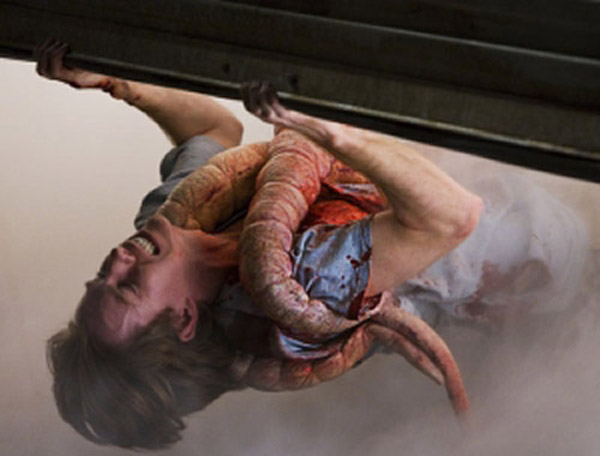
The best part about The Mist is its large menagerie of monsters, both great and small. Their appearances are infrequent, but these creatures handily steal the show from the human characters. If you love movie monsters such as big bugs or dinosaurs--or even bug-like dinosaurs or dinosaur-like bugs--then you might want to give this film a chance just to see what these beasts look like. (In fact, while I was watching The Mist, I kept wondering what this film would've looked like if it were shot in the 50s and classic creature creator Ray Harryhausen had been tasked with doing the monster designs and effects.)


That said, the greatest strength of The Mist is also its biggest drawback. For as deadly and fearsome as the monsters are, they only attack whenever the script requires them to attack and only retreat whenever the script requires them to retreat. They are extremely capable of tearing the supermarket asunder and feasting on all of the people trapped within yet they never do, and it’s never made clear what attracts them and what repels them. Likewise, the mist that enshrouds the creatures is only as thick as the script needs it to be. Some people get lost in the mist and quickly become monster chow, while other people are capable of driving through the mist without colliding with other obstacles or getting stepped on by one of the larger creatures. Such inconsistencies drain the suspense out of the narrative, and I couldn't escape the nagging feeling that I've seen all of this done before and better elsewhere in Aliens, The Birds, Jurassic Park, Cloverfield, and George Romero's zombie movies. Given that the creatures' designs are much more inspired than the situations in which they are placed, they probably would’ve been better utilized in a survival horror video game based on The Mist instead of a direct adaption of the original story.

I've never been a Stephen King fan but I’m familiar enough with his work to recognize the character types that he frequently uses. Many of them are here in The Mist: the reluctant, brave and bland male hero; the outspoken yet ultimately doomed skeptic; the witty and well-spoken elderly sage; the sleazy and self-righteous antagonist; and the easily duped denizens of small town America who fall under the sway of the antagonist. These character types can be found in other horror stories but with King they usually follow the same dramatic trajectories, which makes the interpersonal conflicts inside of the supermarket feel contrived and they do not correspond with the external threats that lurk in the mist. By relying on formulaic character types and conflicts, King--and by extension Darabont--chose to play it safe in an otherwise apocalyptic scenario, and the story that begins with such promise ultimately sputters its way to the end. The film’s final few minutes tries to muster up one last, shocking twist, but the scenes immediately leading up the end are so bereft of momentum that it feels empty and undeserved.


I can only recommend The Mist to die-hard King fans, although some of them might think that this movie is just an abbreviated version of The Stand. Monster movie fans are better off with superior titles such as Alien Raiders, Infestation and Splinter, each of which I wrote about in a previous post here.


A Look Back at the 1979 Spider-Woman Cartoon

0 comments


It's not easy being a female superhero, especially if you're the less popular female version of a widely known male superhero. For example, while DC Comics makes oodles of cash from the popularity of Superman and Batman, it often seems completely clueless as to what to do with Supergirl, Batgirl and Batwoman.

Over at Marvel, there's Spider-Woman, the female counterpart of one of Marvel's most popular character, Spider-Man. Between 1977 to today, there have been at least three Spider-Women in the Marvel Universe--four if you include the one super villain who assumed the same name. The first Spider-Woman was Jessica Drew, who had her own comic book series that ran from 1978 to 1983. Unlike the other Spider-Women, Drew also had her own short-lived animated TV series that aired on ABC on Saturday mornings in 1979.

I vaguely remember seeing the Spider-Woman cartoon on Saturday mornings way back when I was just a wee lad, so I decided to track down all 16 episodes of the series to see how well it actually was and how it compares to more modern superhero cartoons such as Avengers and Young Justice. While Spider-Woman isn't that great of a show in terms of writing and animation when compared to the superhero cartoons of today, it sheds some light on how Marvel was still struggling in the late 70s to establish their characters in other mediums outside of comic books. Read on for my complete retrospective.

When I watched Spider-Woman during its original broadcast, I tuned in largely for the guest appearances of Spider-Man. Even though he only appeared in two episodes of the series, that was enough for me. Besides, Spider-Woman also gave me the chance to see another colorful spider-powered hero fight all sorts of outlandish super villains, so it was the next best thing to having a Spider-Man cartoon on Saturday mornings. Even though Spider-Man appeared on Electric Company and had his own short-lived live-action series in the late 70s, no Spider-Man cartoons were made during that decade.

Even to this day, Spider-Woman remains unique among half-hour superhero cartoons because it is one of the few shows that features a female superhero as the main character, not as part of a duo, trio, or team of other superheroes. (The second Spider-Woman, Julia Carpenter, would later appear in animated form during the mid-90s, but only as a secondary character in the syndicated Iron Man cartoon.) Spider-Woman also sets a record within the ranks of Marvel superhero cartoons: While other Marvel heroes had to wait a few years between the launch of their own comic book series and the production of their own cartoon, Spider-Woman aired less than a year and a half after the publication of the first issue of the Spider-Woman comic book in April 1978.


Yet such a background raises a few questions as to why Marvel chose to produce a cartoon based on a superhero who didn't have enough stories or her own rogues' gallery of super villains to transfer to TV. The early animated versions of Iron Man, Hulk, and the Fantastic Four from the 60s might not have been great cartoons, but at least they had super villains and stories that the script writers could use in creating cartoon plots. Another curious detail of the Spider-Woman cartoon was how different it was from the Spider-Woman comic book. In both the comic and cartoon, Spider-Woman had spider-like powers and the alter ego of Jessica Drew, but everything else was different. While the comic book Spider-Woman/Jessica Drew was a private investigator by profession and regularly fought the terrorist organization HYDRA and supernatural beings from Arthurian legend, the cartoon Spider-Woman/Jessica Drew was the editor and lead reporter for Justice Magazine who regularly went on adventures with her photographer Jeff Hunt and her nephew Billy. If the Spider-Woman cartoon was intended to boost readership of the Spider-Woman comic book, then changing the main character so drastically between the two versions seems counterproductive and ultimately self-defeating.
I can only speculate as to why Marvel did what they did with the Spider-Woman character and her cartoon adaptation. It could have been that because so many of the more popular Marvel characters were caught up in other legal arrangements, Spider-Woman was one of the few characters remaining for an animated series. For example, the second Fantastic Four cartoon, which aired a year before the Spider-Woman series, didn't feature the Human Torch because the rights to that character were tied up in a TV movie project that never happened. Marvel was working on live-action TV versions of characters such as the Hulk, Captain America, Spider-Man and Doctor Strange during the late 70s, so this theory could be true. It has also been suggested that because Filmation had a cartoon superhero character called Web Woman, the Spider-Woman comic book and cartoon were rushed into production to secure the intellectual property rights to the "Spider-Woman" name. Web Woman was part of Filmation's Tarzan and the Super 7 cartoon and while she did have spider-like powers, she had more in common with the Green Lantern than Spider-Man. Her costume even bore some similarities to that worn by Star Sapphire, one of Green Lantern's enemies. However, neither of these theories explain the differences between the comic book and cartoon versions of Spider-Woman.

A Web Woman animation cell.

After watching all 16 episodes, I concluded that Spider-Woman isn't that much better or worse than other superhero cartoons from its time. Since the show relied on the repeated usage of stock character animation of Spider-Woman performing various superheroic acts (flying, spinning webs from her fingers, shooting venom blasts from her hands, etc.), most of the dialogue consists of descriptive, exclamatory statements of events that just happened, are currently happening, or are about to happen. This budgetary limitation would also explain Jessica Drew's profession as a reporter (a quick way to explain how she encounters so many villains and situations that require the immediate involvement of Spider-Woman), the location of Justice Magazine (reusable background art, which would save money on the limited animation budget), and the involvement of Jeff and Billy (characters who can regularly interact with Jessica/Spider-Woman and provide more stock character animation to fill time). While Stan Lee was credited with adapting Spider-Woman for TV, each episode was scripted by veteran TV cartoon writer Jeffrey Scott. Scott's pre-Spider-Woman credits include The All-New SuperFriends Hour, Challenge of the SuperFriends, Scooby's Laff-A Lympics and Dynomutt Dog Wonder, so he knew how to write for cartoons with very low production budgets.

In spite of being a cheap, formulaic superhero cartoon, Spider-Woman does have its share of quirks that keep it interesting. On its surface, the relationship between Jessica, Jeff and Billy isn't too much different than the relationship between Clark Kent, Lois Lane and Jimmy Olsen in an average Superman story. Yet where things change in Spider-Woman are in the gender roles, which play out much differently than in other superhero stories with a central male character. While Jeff is a well-meaning character, his attempts to impress Jessica with acts of masculine bravado almost always backfire. For as predictable as this is within the context of the cartoon, I can't think of another animated superhero series that regularly puts the potential love interest of a female superhero in the role of unintentional (and somewhat emasculating) comic relief. While Jessica comes across as an intelligent and capable person (a characterization that is largely accomplished through Joan Van Ark's confident and playful line readings), she often has to portray herself as a helpless, flighty woman to convince Jeff and Billy that she is not Spider-Woman and provide excuses for her all-too-convenient absences whenever Spider-Woman is around. As a result, Jessica ends up assuming the roles of both the powerful hero and the powerless victim in each episode.


Another feature of Spider-Woman is its occasional indulgence in over-the-top plot twists. Perhaps as a way to compensate for the lack of source material from the then-fledgling Spider-Woman comic book, Jeffrey Scott utilized many sci-fi cliches (mad scientists, evil androids, space invaders, time travel, mind control, secret civilizations, etc.) in drafting scripts, sometimes to the point of absurdity--even by superhero cartoon standards. For example:

* In "The Amazon Adventure", Fort Knox is robbed by a group of powerful women who a dressed as Amazonian warriors. It turns out that they are actually from a secret Inca civilization in Peru, and they steal gold to power their solar technology that is capable of taking over the world. (It is never specified whether the women are Amazonian Incas or Inca Amazons.) They also are ruled by a queen who is over 400 years old but stays young because of a time rift.

* In "The Lost Continent", Jessica, Jeff and Billy investigate the Bermuda Triangle, only to find a secret island where a mad scientist who controls an army of dinosaurs and laser gun-wielding, jet fighter-piloting cavemen. The mad scientist later has his dinosaurs attack New York City.

* In "Games of Doom", an evil scientist Jacques LeRhode replaces athletes at the World Athletic Games with androids so they can each win gold medals. LeRhode needs the gold medals to transmit a radio frequency that allows him to control the minds of people (I guess silver and bronze medals can't do that). After Spider-Woman defeats his plans, it is revealed that LeRhode is actually an android who is controlled by the real LeRhode, who looks just like the android but is one-fourth the size of an average human being.

* Spider-Woman featured plenty of monsters, and many of them had the ability to turn people into monsters too. In "Pyramids of Terror", ancient Egyptian mummies are revealed to be alien mummies who intend to conquer Earth, and their attack includes shooting beams from their pyramid-shaped spaceships that turn people into stumbling, groaning mummies. In "Dracula's Revenge", Dracula, the Wolf Man and Frankenstein's monster plan to take over the world by turning people into monsters--not by biting them, but by shooting them with energy rays that shot from their hands, eyes and neck bolts, respectively. In a nod to The Fly, "The Spider-Woman and the Fly" features another mad scientist who uses a fly clone to turn himself into a winged human-fly monster who can shoot rays from his eyes that turn other people into human-fly monsters.


Adding to the goofiness of these stories are their poor sense of geography, which make distant locations such as Africa, England, and Romania look like close neighbors to New York City. Indeed, many of the Spider-Woman episodes would be right at home at Mystery Science Theater 3000.

For comic book fans who are interested in the history of Spider-Woman, they should pick up the reprints of the original Spider-Woman comic in the Marvel Essentials compilation paperbacks. Yet if you're a fan of animation history with a particular interest in superheroes, you should watch a few episodes of the Spider-Woman cartoon to get an idea of how this kind of animation was produced in the late 70s. (In particular, Marvel cartoon history buffs will recognize some of Spider-Woman's background music, which was reused in Spider-Man and His Amazing Friends in the early 80s.) A Region 2 DVD of the entire Spider-Woman series was released in 2009 and it still available from some retailers, and plenty of Spider-Woman video clips can be found on YouTube.