Showing posts with label Model Kits. Show all posts

Great Moments in Toy Robot History: Shogun Warriors

0 comments


The origins of popular and recurring trends in pop culture can sometimes be difficult to pinpoint, especially trends that have gone on for so long that they become an accepted fixture of everyday life. For this post, I'm talking about Japanese robot toys that are imported and sold in the U.S. I'm sure robot fans who are around my age will remember how Japanese robot toys dominated the shelves of toy stores during the 80s, but the trend of U.S. toy companies securing the rights to sell Japanese robot toys in North America actually began in the 70s with Mattel's Shogun Warriors. While the Shogun Warriors line didn't last long, its influence would impact the toy industry for decades to come. Read on for my retrospective of this trend-setting toy line.

The idea of importing toys from one country and then selling them in another is not a new idea unto itself. However, what made the Shogun Warriors different was that included merchandise from many different points of origin but was sold under a single brand name. Mattel marketed the robot toys as if they all inhabited the same shared universe but they actually originated from over a dozen different Japanese "Super Robot" anime series, series such as Brave Raideen, Gaiking and Voltes V.


To encourage the perception of a unified product line, Mattel gave the licensing rights to Marvel Comics to create a Shogun Warriors comic book series, where the robots coexisted as a single force for good against an evil alien force. There was also a syndicated cartoon series called Force Five that was set up to show five of the anime series upon which the Shogun Warrior toys were based. Unfortunately, the Shogun Warriors line was winding down by the time Force Five made it to the air and only a handful of TV markets carried the series for the brief time that it ran.


Not to limit itself to Super Robot anime, Mattel also secured the rights to Godzilla and Rodan, two monsters from famous Japanese Atomic Age kaiju movies, so that they could be added to the Shogun Warriors line as monsters for the giant robots to fight. As far as I know, Shogun Warriors is the only toy line that has combined Super Robot anime with live-action kaiju films; from that perspective, Guillermo del Toro's Pacific Rim (2013) could also have been named Shogun Warriors: The Movie.


A Godzilla figure from the Shogun Warriors line, complete with 
launching spring-loaded claw and extendable tongue of fire.


Shogun Warrior robots came in three different sizes: 24 inches, 5 inches, and 3.5 inches. Even though the 24-inch robots are what most people remember about the Shogun Warriors line, you could see some items from the robot toys' original anime series in the Shogun Warriors' "Action Vehicle" toys. For example, the Rydoto Action Vehicle was actually from the Brave Raideen anime series and the Kargosaur Action Vehicle was from Gaiking.


Curiously, some of the Shogun Warrior Action Vehicle toys had nothing to do with any Super Robot anime series; they were just toys that Mattel apparently decided to include in the line anyway because they looked similar enough to the robots. After all, none of the anime series upon which the Shogun Warriors toy line was based aired on U.S. television during most of the line's release, so it wasn't as if the kids who were buying the toys would know the difference.


The Shogun Warriors' Heli-Capter Action Vehicle 
(Japanese TV show of origin unknown).


The Shogun Warriors line didn't last long and completely disappeared from toy stores within a few years of its launch. Regardless, its approach to licensing Japanese robot toys in bulk was also used by other toy and model kit lines that were released in the U.S. during the 80s:

* Hasbro's Transformers line was a combination of Takara Tomy's Diaclone and Microman lines, and the Transformers marketing campaign depicted the robots and sentient beings from another planet.

* Matchbox's Voltron line was a combination of robot toys from three anime series: Beast King GoLion, Armored Fleet Dairugger XV and Lightspeed Electroid Albegas. However, when the Voltron cartoon series was assembled to help promote the toy line, footage from Albegas was not included.

* Revell's line of Robotech model kits combined robot kits from three anime series as well: Fang of the Sun Dougram, Super Dimension Fortress Macross and Super Dimension Century Orguss. Yet when the Robotech cartoon was assembled, footage from Dougram and Orguss were not used and Macross was edited together with footage from Super Dimension Cavalry Southern Cross and Genesis Climber MOSPEADA.


One of Revell's Robotech model kits that's originally from 
the Fang of the Sun Dougram anime series.


Over time, the concept of mashing together Super Robot anime series into a single line of merchandise eventually made it back Japan itself with the arrival of Super Robot Wars in 1991. Super Robot Wars is a series of tactical role-playing video games where players can choose from a selection of Super Robots from various anime and manga series. This selection also includes the titular robots from Mazinger Z and Getter Robo, two of the robots that were also featured in the Shogun Warriors toy line. The Super Robot Wars game series continues to this day, and has since expanded to include anime and manga series of its own.

To learn more about the Shogun Warriors, check out the following fan sites:

* Wildtoy's Shogun Warriors Page

* Weird Science-Fantasy's Shogun Warriors Page

* Ted Terranova's Robot Page.


A Shogun Warriors Halloween Costume.


Painting Giant Robot Model Kits Anime Style

0 comments

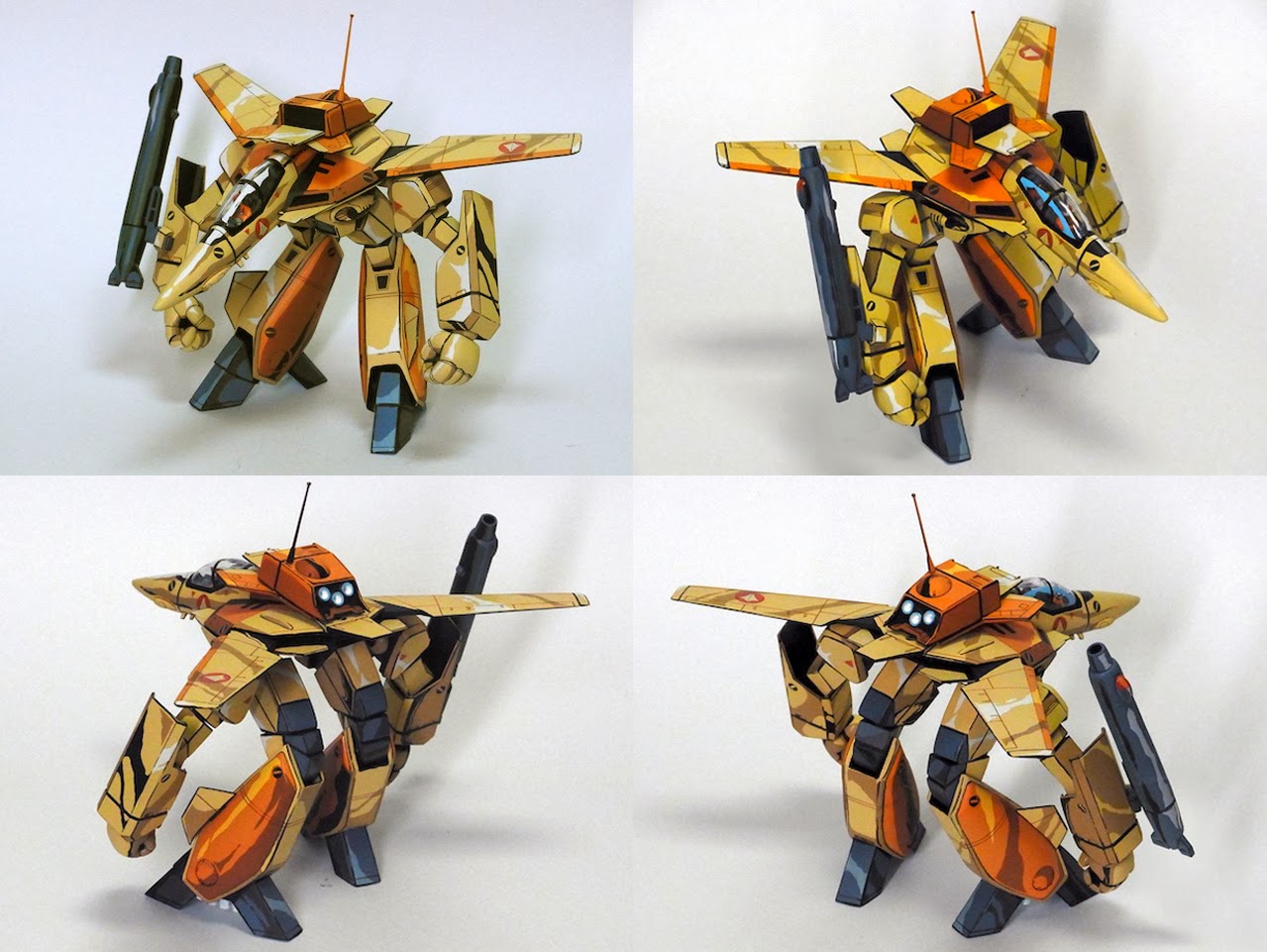
I love detailed miniature replicas of monsters, robots and spaceships from my favorite horror and sci-fi franchises, but the ability to competently assemble model kits of such replicas has always eluded me. I particularly admire those who can paint kits of robots, spaceships and other machines in a way that makes them look used (exposed to the elements, battle damage, etc.). In fact, I frequently regarded this kind of modeling skill as a remarkable achievement ... and then I saw this:


Yes, this really is a photo of a plastic model kit.


From what I read on Kotaku, a talented model builder in Japan has painted a Valkyrie kit from the Super Dimension Fortress Macross anime series (which is known to some as Robotech) in a cel shading style that makes the model appear as if it was pulled directly out of the Macross cartoon.


This makes sense, actually--since the Valkyrie design was originally intended for animation, why not paint a Valkyrie model kit like it was part of a cartoon? The picture below provides an overview of how each piece of the kit was painted to achieve the comprehensive anime look.


Click here to see the article about this kit on Kotaku. Click here to see the original Japanese post of this kit, which features many more pictures of the finished product.


Kenner's Imperial Troop Transporter Gets Lego-ized

0 comments

As I mentioned in a previous post, the upcoming Star Wars: Rebels animated series will incorporate some of Kenner's classic Star Wars toy designs as part of the series' selection of vehicles and weaponry, such as Kenner's Imperial Troop Transporter toy. Thus, it makes sense for avid Lego hobbyist BaronSat (a.k.a. Eric Druon) to make a Lego version of the Troop Transporter that's in scale with official Lego Star Wars minifigs. Check it out:


BaronSat's Lego Imperial Troop Transporter (above) and Kenner's original toy (below). 


Click below to see more pictures of BaronSat's Lego version of the Imperial Troop Transporter, along with a new Lego Hoth playset that he recently produced that draw inspiration from Kenner's short-lived Star Wars Micro Collection line.

BaronSat does incredible work with Legos and his interpretation of the Imperial Troop Transporter is no exception. As you can see in the photos below, his Troop Transporter includes almost all of the features as the original toy, such as opening front and rear panels and six side compartments that can hold minifigs.


BaronSat has also produced another minifig-scaled Star Wars playset that represents the Rebel base on Hoth, as seen in Empire Strikes Back.


If you look closely at the Lego Hoth playset, which includes the Rebels' ion cannon, blast door and shield generator, you'll notice that it bears some similarities to two play sets from Kenner's Star Wars Micro Collection line: the Hoth Ion Cannon and the Hoth Generator Attack playsets. (Photos below provided courtesy of RebelScum.com.)


While BaronSat's new Lego Hoth playset isn't a scale-accurate replica of the Micro Collection Hoth playsets, it nevertheless includes some of the features of the original playsets (such as an observation tower and an opening blast door) and it is complementary to BaronSat's previous Lego re-creation of Kenner's Imperial Attack Base playset.

Check out BarsonSat’s official site and Flickr pages for more examples of his work. You can also order custom Lego kits and custom kit instructions from him on his site.


Xevious Reborn: Hot Wheels RC Terrain Twister

0 comments

It's amazing how something things never go away. They just appear again under a different name.

Early this year, I did a retrospective piece about Namco's classic arcade game Xevious, its sequels, spin-offs and model kits. One of the items that I looked at was a Grobda model kit, a kit based on one of the enemy vehicles in Xevious that also had its own spin-off arcade game Grobda. As you can see in the model picture below, a Grobda tank doesn't have continuous track treads; instead, it has two spinning corkscrew tubes that propel it across terrain and over the water.


The Grobda tank makes for an interesting-looking detail in a video game, but who would want to actually see something like this move in the real world? Fast forward to today, where we now have the Hot Wheels RC Terrain Twister toy, which I have pictured below. Notice any similarities?


Apparently, this toy has been around for a while. It was first released almost a decade ago by Tyco under the same name "Terrain Twister", and it has recently been re-released under the Hot Wheels license. It's advertised as an RC toy that can go through dirt, sand, grass, water and snow, although I hear that it doesn't do very well on smoother surfaces. If you're a die-hard fan of the Xevious and Grobda games, you might want to give this toy a try. Not only does it actually move, but it's also much, much cheaper and easier to find than the official R.C. Berg Grobda model kit that I posted above.


A Look at Kotobukiya's ED-209 and RoboCop MK-2 Figures

0 comments


When it comes to figures and miniatures for the RoboCop franchise, plenty of figures, busts and model kits have been made of the titular RoboCop character. However, recreations of other robots from the franchise, such as the ED-209 and RoboCop MK-2 (a.k.a. RoboCain), have been much harder to come by and very expensive to purchase. Things are slowly turning around in terms of availability: NECA will be releasing an ED-209 replica this summer, while Hot Toys will be releasing an ED-209 replica in early 2014 to go with its new deluxe RoboCop figure. Yet with both versions of ED-209 costing a sizable chunk of cash--NECA is charging $50 and Hot Toys is charging $410--these new collectables may still be out of reach for many RoboCop fans.

Thankfully, I was able to add ED-209 and RoboCop MK-2 to my personal collection a few years ago for around $10 each, courtesy of the Japanese model and toy company Kotobukiya. Kotobukiya did a series of 3.5-inch figures based on robots from the original RoboCop trilogy. Each figure was pre-painted and only required minimal, snap-together assembly. Read on to learn more about these two fun and affordable RoboCop collectibles.

Looking back, discovering what Kotobukiya was releasing regarding RoboCop collectibles was dumb luck on my part, and I made it a point to take advantage of this cost-efficient opportunity as soon as I learned of it. I was not so fortunate when it came to Konami's figure series that was based on the Alien saga; by the time I discovered what Konami had done, several pieces from its Alien series had already become rare and expensive collector's items. (Between the work of Kotobukiya and Konami, I have to wonder: Why do the Japanese fans get such cool and affordable merchandise based on film franchises from America, while American fans of the same franchises don't get the same opportunities?)

Kotobukiya's ED-209 is remarkably detailed for such a small figure. It only has five swivel joints: two for the "hips", two for the guns, and one for the "waist". As such, it doesn't have the complete range of motion as the original ED-209 design. Yet because this figure is essentially a display piece--and an astonishing one at that--its lack of poseability doesn't matter.


In contrast to the ED-209 figure, Kotobukiya's RoboCop MK-2 only has two moving joints--one for each of the smaller arms, and that’s it. It comes with a small display stand that helps it stay upright and that's it. Nevertheless, this RoboCop MK-2 figure faithfully recreates many of the details of the original robot design.


These figures may still be available through some retailers on the Internet. If you happen to run across these figures--especially at their original prices--I highly recommend that you purchase them. It's rare when so much detail is put into a such small package and at such a low price, so don't pass up this opportunity if you can find it.


Kenner Star Wars Toys Strike Back: BaronSat's Lego Imperial Attack Base Playset

0 comments


A few months ago, I published a post about BaronSat (a.k.a. Eric Druon), a devoted Lego hobbyist who made two Lego replicas of playsets from Kenner's short-lived Star Wars Micro Collection line. I just heard from BaronSat again, and he's made another impressive Lego replica from Kenner's Star Wars toy line: the Imperial Attack Base playset from Empire Strikes Back, which Kenner released for its 3 and 3/4 inch Star Wars action figures. Just as he did before, BaronSat took everything about the original playset and re-scaled it for Lego's Star Wars minifigs and the results are outstanding. Read on for more details and pictures of BaronSat's latest work.

The way I see it, the name "Imperial Attack Base" for this playset is one of the goofs made by Kenner during its run with the Star Wars toy license. (See also the blue Snaggletooth action figure and the 4-LOM/Zuckuss naming mix-up.) It's obvious that it was modeled after the trenches that the Rebel Alliance used to defend its Hoth base from the Imperials' assault in Empire Strikes Back. Yet between the playset's name and the images printed on the box, it looks like this Hoth base is for Darth Vader and his Snowtroopers, not the Rebels.


BaronSat is not lost on Kenner’s goof either. As he puts it on one of his Flickr pages, “(P)eople at Kenner, in the early 80's, saw a different movie (than Empire), so let me tell you the story: The peaceful Empire has set up an Imperial base on the sweet planet Hoth. They enjoy skiing, building snowmen and throwing snowballs at Wampas. But one awful day, the Rebel scum land on their planet and savagely attack the base. It follows a very fierce battle, known as the ‘Battle of Hoth’. Finally the Rebels are driven out of the planet and the Imperials resume their winter holidays.”

Despite the naming and publicity shot errors, the Imperial Attack Base was the most entertaining of Kenner's Hoth action figure playsets. It came with a snow bridge and command post that would collapse at the touch of a button, and its scale was complementary to the AT-AT, AT-ST and Snowspeeder vehicle toys. Kenner even molded little action figure-sized footprints into the playset's base to suggest that heavy foot traffic had moved through the snowy trenches. Curiously, the Hoth Rebel laser gun turret was not included in this playset; that would later be released as part of the awkward Turret and Probot playset.

Given his keen attention to detail, BaronSat included all of the features from the original Imperial Attack Base playset into his Lego replica. Lego made a few Hoth-themed Star Wars sets before but none of them recreated the Rebel's snow trenches, so it’s great to see BaronSat’s Lego version of a Kenner playset that did. The pictures below provide examples of everything the replica does, including a clever nod to the deleted Wampa attack scene from Empire Strikes Back. Sith happens, indeed.


Check out BarsonSat’s official site and Flickr pages for more examples of his work. You can also order custom Lego kits and custom kit instructions from him on his site.


Flying RC Model Hobbyists Take to the Skies with Terminator and S.H.I.E.L.D.

0 comments


When it comes to being jealous of people who are more talented than me in the area of making horror and sci-fi replicas, I prefer to prioritize. I'm jealous of people who can assemble model kits so they appear nearly flawless; very jealous of people who can make professional-looking customized model kits and/or toys; and extremely jealous of people who can make customized model kits and/or toys that can move in some way, either along the ground, on/under the water, or through the air. In the last category, I recently found two talented hobbyists who were able to make vehicle replicas from the Terminator saga and last year's Avengers movie that could actually fly. Click below to read more about these amazing RC replicas and see video clips of each model in action.

The first hobbyist is from Russia, and he goes by the name of Native 118. He built two customized RC replicas that caught my eye: one based on the aerial HK design from Terminator and Terminator 2, and one based on the S.H.I.E.L.D. Helicarrier design from the Avengers movie. What's particularly impressive about the Helicarrier replica is that it floats on water and can launch itself into the air while in the water. Check out the videos below to see the models demonstrating what they can do.


Here’s a short video provided by Native 118 that provides an overview about how he assembled his HK model:


The other hobbyist is from Colorado and goes by the name kahloq. Inspired by Native 118's flying HK, he built a flying remote controlled aerial HK drone unit based on the design from Terminator 3. The main difference between the two flying Terminator models is that the Native 118 model has two fans on the outside with a third hidden in the nose, while kahloq's model has three fans on the outside according to the original T3 design. The video below provides some footage of this HK model in flight, as well as an overview of how kahloq built and tested his model.


R2-D2 and C-3PO: Kenner vs. Hasbro

0 comments


Anyone who has paid attention to the toy industry over the last few decades will tell you that when it comes to toys based on pre-existing creative properties (e.g., comic books, TV shows, movies and video games), the amount of features and details present in such toys has skyrocketed. Nowhere has this change of quality has been more evident than in the toys for Star Wars, a franchise that has been producing toys by the ton ever since it first arrived back in 1977.

Kenner found itself with a huge cash cow on its hands when it secured the toy license for Star Wars during the original trilogy, but the toys produced by Hasbro during the subsequent years are much more movie-accurate than their predecessors. This post will look at two popular Star Wars characters, the loyal droids R2-D2 and C-3PO, how they were represented as 12 inch scale figures by both Kenner and Hasbro, and the MPC Star Wars model kits played a part in these figure designs. Read on ...

The 12 inch figures produced by Kenner didn't last long in comparison to their 3 and 3/4th inch figures, and they had vanished from toy store shelves shortly after the release of Empire Strikes Back in 1980. I've read varying accounts as to why Kenner released a 12 inch scale line in the first place and the most plausible theory I've seen is that up until the release of Star Wars in 1977, it was a common practice in the toy industry to make action figures that were somewhere between 8 to 12 inches in height. Kenner’s action figures for The Six Million Dollar Man and The Bionic Woman were in this size range, as were licensed action figures produced by legendary toy company Mego. The way I see it, Kenner probably produced the 12 inch line of Star Wars figures as a contingency plan in case the smaller action figures didn't sell as well. Regardless, what the larger figures lacked in popularity they (almost) made up for in terms of detail in comparison to the other Star Wars figures that were available at that time.


Kenner's R2-D2

The large scale R2-D2 figure from Kenner is a major upgrade from its smaller version. The smaller R2-D2 had an oddly sculpted head and only a sticker to provide details for the body. In contrast, the larger R2-D2 has a body and head sculpt that captures most of the details from the movie.


Curiously, the head of R2-D2 figure seems oddly proportioned, with his main radar eye looking unusually small in comparison to the rest of the domed head.


Kenner's R2-D2 has movable legs with wheels underneath that allow the figure to roll and like its smaller counterpart, the head makes clicking noises whenever it is turned. The only other feature that this feature has is a rear panel that opens to reveal what looks like two circuit boards. The box that this figure came in identified these boards as "the Death Star plans", even though Princess Leia is never seen in Star Wars loading two pizza box-sized panels into R2's back. Interestingly, the rear panel in the large R2-D2 action figure is in the same place where the battery compartment is located for Kenner's remote controlled R2-D2 toy.


Hasbro's R2-D2

Hasbro's large R2-D2 action figure was released during the 90s and it is smaller than Kenner's R2. In fact, Hasbro's R2 almost matches the dimensions of the MPC R2-D2 model kit.


Even though it's made with a much more durable plastic, Hasbro's R2 doesn't have any of the opening panels that MPC's R2 has: MPC's model features a hinged front panel that opens to allow for the extension of R2's computer linkage arm and a removable rear panel to reveal R2's inner circuitry, but Hasbro's figure has neither of these features. Nevertheless, both Hasbro and MPC released an R2-D2 that has a retractable third leg, something that Kenner never got around to producing in any of its R2-D2 figures.


Comparing Kenner and Hasbro's R2-D2 figures side-by-side reveals which figure is more faithful to the movie version of the droid. Then again, Kenner's large-sized R2-D2 was the most movie-accurate replica of the droid that Kenner released when it had the Star Wars license, which just goes to show how affordable toy replicas of movie characters have improved in terms of detail during the last few decades.


Kenner's C-3PO

Of the figures reviewed in this post, Kenner's large-sized C-3PO is the lightest of the group. Even though the plastic itself is sturdy, it feels hollow and only weighs a few ounces. Most of Kenner's large-sized non-costumed action figures weighed less than the others; a childhood friend of mind had a large-sized Stromtrooper that weighed about the same as the large-sized C-3PO.


As with Kenner's R2-D2, the large-sized C-3PO is much more detailed than its smaller version. For example, the large-sized sculpt includes the restraining bolt that the Jawas attached to the droid shortly after he arrived on Tatooine.


Kenner's C-3PO features joints in the neck, shoulders and hips, and that's it; there are no panels to open or accessories to add. The hip joints are cut at an odd angle so that he can only sit with his legs splayed outward. (From what I remember, Kenner’s large-sized Stormtrooper had hip joints cut the same way.)


Hasbro's C-3PO

I got my Hasbro C-3PO as part of the C-3PO: Tales of the Golden Droid box set, which was part of the short-lived Star Wars Masterpiece Edition series of box sets. These sets--of which there are only three that I know of--were released to coincide with the release of The Phantom Menace in 1999. The sets included a 12 inch figure of a particular Star Wars character and a hard cover book devoted to that character: how the character was created, the history of the character within the Star Wars universe, and all of the merchandise that was produced between 1977 and 1999 that bears the character's likeness.


Hasbro put a lot of details into its C-3PO figure, including blaster residue on his gold plating, wires as part of his exposed midriff, and his mismatched silver plated leg. He has joints in his neck, shoulders, waist and hips, as well as limited movement hinge joints in the knees and ankles. Oddly, the hip joints in this figure are cut the same was as the Kenner version.


An added feature to this particular version of C-3PO is that it can be disassembled into various parts, so fans can recreate all of the times that the droid was damaged during the saga. The figure also comes with a netted backpack similar to the one used by Chewbacca to move the damaged droid around Cloud City in Empire Strikes Back. (I couldn't tell you if the backpack actually fits on a Hasbro Chewbacca figure, since I don't have one.)


Comparing the two C-3PO figures reveals how much closer Hasbro's sculpt is to the original movie version than Kenner's. The dimensions of Kenner's C-3PO sculpt makes it look bulkier than the droid should be, with a wider torso and broader shoulders. I suspect that, for the sake of convenience, Kenner based its C-3PO sculpt along the same dimensions used for the large scale Stormtrooper and Darth Vader figures.


Putting the droid figures together into their respective pairs shows that Hasbro did a better job at recreating the droids' details, except for one glaring error: Hasbro's R2-D2 is not to scale with its C-3PO figure. In contrast, Kenner's large-sized versions of R2-D2 and C-3PO are in scale with each other in spite of all the other details that were missed, which makes them a better complementary set than Hasbro's.


After getting so many details right, it seems odd that Hasbro would get this scale issue wrong. All I can conclude is that Hasbro really did base its R2 on MPC’s R2 model kit, because it would be easier and cheaper to base an R2 figure from a pre-existing design than to create a new one from scratch. As you can see from the comparison pics below, the MPC R2 was designed to be in same scale with the MPC C-3PO model kit, which is not 12 inches high. Thus, Hasbro’s R2 is in scale with MPC’s C-3PO but not with any of Hasbro’s 12 inch Star Wars figures.

From left to right: Hasbro's R2-D2 figure and MPC's R2-D2 model kit.


From left to right: Hasbro's C-3PO figure and MPC's C-3PO model kit.