Showing posts with label Guillermo del Toro. Show all posts

Great Moments in Toy Robot History: Shogun Warriors

0 comments


The origins of popular and recurring trends in pop culture can sometimes be difficult to pinpoint, especially trends that have gone on for so long that they become an accepted fixture of everyday life. For this post, I'm talking about Japanese robot toys that are imported and sold in the U.S. I'm sure robot fans who are around my age will remember how Japanese robot toys dominated the shelves of toy stores during the 80s, but the trend of U.S. toy companies securing the rights to sell Japanese robot toys in North America actually began in the 70s with Mattel's Shogun Warriors. While the Shogun Warriors line didn't last long, its influence would impact the toy industry for decades to come. Read on for my retrospective of this trend-setting toy line.

The idea of importing toys from one country and then selling them in another is not a new idea unto itself. However, what made the Shogun Warriors different was that included merchandise from many different points of origin but was sold under a single brand name. Mattel marketed the robot toys as if they all inhabited the same shared universe but they actually originated from over a dozen different Japanese "Super Robot" anime series, series such as Brave Raideen, Gaiking and Voltes V.


To encourage the perception of a unified product line, Mattel gave the licensing rights to Marvel Comics to create a Shogun Warriors comic book series, where the robots coexisted as a single force for good against an evil alien force. There was also a syndicated cartoon series called Force Five that was set up to show five of the anime series upon which the Shogun Warrior toys were based. Unfortunately, the Shogun Warriors line was winding down by the time Force Five made it to the air and only a handful of TV markets carried the series for the brief time that it ran.


Not to limit itself to Super Robot anime, Mattel also secured the rights to Godzilla and Rodan, two monsters from famous Japanese Atomic Age kaiju movies, so that they could be added to the Shogun Warriors line as monsters for the giant robots to fight. As far as I know, Shogun Warriors is the only toy line that has combined Super Robot anime with live-action kaiju films; from that perspective, Guillermo del Toro's Pacific Rim (2013) could also have been named Shogun Warriors: The Movie.


A Godzilla figure from the Shogun Warriors line, complete with 
launching spring-loaded claw and extendable tongue of fire.


Shogun Warrior robots came in three different sizes: 24 inches, 5 inches, and 3.5 inches. Even though the 24-inch robots are what most people remember about the Shogun Warriors line, you could see some items from the robot toys' original anime series in the Shogun Warriors' "Action Vehicle" toys. For example, the Rydoto Action Vehicle was actually from the Brave Raideen anime series and the Kargosaur Action Vehicle was from Gaiking.


Curiously, some of the Shogun Warrior Action Vehicle toys had nothing to do with any Super Robot anime series; they were just toys that Mattel apparently decided to include in the line anyway because they looked similar enough to the robots. After all, none of the anime series upon which the Shogun Warriors toy line was based aired on U.S. television during most of the line's release, so it wasn't as if the kids who were buying the toys would know the difference.


The Shogun Warriors' Heli-Capter Action Vehicle 
(Japanese TV show of origin unknown).


The Shogun Warriors line didn't last long and completely disappeared from toy stores within a few years of its launch. Regardless, its approach to licensing Japanese robot toys in bulk was also used by other toy and model kit lines that were released in the U.S. during the 80s:

* Hasbro's Transformers line was a combination of Takara Tomy's Diaclone and Microman lines, and the Transformers marketing campaign depicted the robots and sentient beings from another planet.

* Matchbox's Voltron line was a combination of robot toys from three anime series: Beast King GoLion, Armored Fleet Dairugger XV and Lightspeed Electroid Albegas. However, when the Voltron cartoon series was assembled to help promote the toy line, footage from Albegas was not included.

* Revell's line of Robotech model kits combined robot kits from three anime series as well: Fang of the Sun Dougram, Super Dimension Fortress Macross and Super Dimension Century Orguss. Yet when the Robotech cartoon was assembled, footage from Dougram and Orguss were not used and Macross was edited together with footage from Super Dimension Cavalry Southern Cross and Genesis Climber MOSPEADA.


One of Revell's Robotech model kits that's originally from 
the Fang of the Sun Dougram anime series.


Over time, the concept of mashing together Super Robot anime series into a single line of merchandise eventually made it back Japan itself with the arrival of Super Robot Wars in 1991. Super Robot Wars is a series of tactical role-playing video games where players can choose from a selection of Super Robots from various anime and manga series. This selection also includes the titular robots from Mazinger Z and Getter Robo, two of the robots that were also featured in the Shogun Warriors toy line. The Super Robot Wars game series continues to this day, and has since expanded to include anime and manga series of its own.

To learn more about the Shogun Warriors, check out the following fan sites:

* Wildtoy's Shogun Warriors Page

* Weird Science-Fantasy's Shogun Warriors Page

* Ted Terranova's Robot Page.


A Shogun Warriors Halloween Costume.


Big 'Bots and Belligerent Behemoths Clash in Pacific Rim (2013)

0 comments

Since I'm planning to wrap up 2013 with a look back at a few examples of Japanese robot toys--one of my favorite kind of toys--I thought I would kick off this year-end series of posts with a review of Guillermo del Toro's Pacific Rim, one of the big-budget releases from last summer that I missed when it was playing in the theaters.


Summer blockbusters have never been held in high regard by the film critic community, and such critics have been particularly displeased with Hollywood's over-usage of CGI effects to produce increasingly bigger and louder blockbuster movies. To be sure, such criticism is not entirely inaccurate: CGI does permit the creation of larger-scale environments and set pieces in ways that miniatures, matte paintings and other practical effect techniques could never allow. As such, CGI has enabled the production of many, many summer blockbusters that are enormous in terms of spectacle but conspicuously short in terms of creative ideas and conceptual depth. Pacific Rim is not one of those movies, because del Toro eagerly packs every frame of his film with enough details and ideas that fans who know what they're looking at will be reviewing this movie for years to come. Pacific Rim is a "big" in every sense of the term--big CGI, big landscapes, big battles, big ideas, and big ambition. In fact, I can't think of how any other special effects technique other than CGI could have accommodated del Toro's story.

In a nutshell, Pacific Rim is about a group of pilots, military leaders, scientists and technicians who build and operate giant robots called "Jaegers" that are designed to fight a seemingly endless series of giant monsters called "Kaiju" that have been emerging out of the Pacific Ocean for years to regularly trash the nearest city. The movie takes places during the closing days of the Kaiju war, when the Jaeger team is planning its final offensive that promises to put an end to the Kaiju menace.

Pacific Rim is a well-made film in every aspect: a well-written script, a well-cast ensemble of actors, and a well-directed approach to the material. Yet to really appreciate this movie, one has to understand that it is a tribute to Japan's "Super Robot" fantasy-science fiction genre and its "Real Robot" spin-off subgenre. Super Robot and Real Robot anime and manga usually involve giant robots that are piloted by human beings to fight giant monsters, other giant robots, or both. The Super Robot genre began in the mid-50s with the manga series Tetsujin 28, and it has continued with popular titles such as Mazinger Z, Mobile Suit Gundam, Patlabor and Neon Genesis Evangelion.


One of Pacific Rim's Super Robots, complete with "Rocket Punch" action.


Pacific Rim also draws inspiration from Japan's kaiju movies (ergo the collective name of the giant monsters in Rim), and the monster designs in the movie demonstrate how much del Toro and his production crew love and understand kaiju films such as Godzilla and Mothra. Nevertheless, most of the film's other details--the characters, their technology, the situations they face and the world they inhabit--are clearly modeled after Super Robot and Real Robot narratives. To put it another way, Pacific Rim is to Super Robot and Real Robot stories as Star Wars is to pulpy sci-fi space operas such as Buck Rogers and Flash Gordon.

With so many details spread throughout the movie, some aspects feel somewhat lacking. In particular, so much detail is applied to movie's fictitious world (a world where there's even a black market for dead Kaiju parts) that the characters feel more like broad personality types than fully-developed individuals. We see bits and pieces of who they are and their roles within the beleaguered, monster-pummeled society they represent but not much more than that; at times, it almost feels like watching Top Gun with giant robots instead of fighter jets. Yet del Toro's enthusiasm for the material permeates every aspect of the film, so I enjoyed geeking out with him just to see what kind of unique interpretations he could put on machines and monsters that are so closely associated with Japanese pop culture. To say that del Toro went above and beyond what he set out to do is an understatement, making this one of his best films to date.

If you don't understand why anyone would want to make a big-budget, live-action film based on anime and manga stories about giant robots, then Pacific Rim probably isn't for you. Otherwise, if you love big brawling 'bots and are looking for an example of CGI done right, then go grab some popcorn and treat yourself to del Toro's magnum mecha opus.


NECA Brings Aliens, Robots and Caped Crusaders to Toy Fair 2013

0 comments


It's February, which means that yet another Toy Fair has come and gone. I've looked through many of the horror and sci-fi offerings that were displayed at this year's event, and I'm glad to say that the National Entertainment Collectibles Association (NECA) keeps bringing the good stuff to the geek masses at affordable prices. Click below for a list of what NECA has in store for horror and sci-fi collectors later this year, complete with pictures courtesy of NECA and Figures.com.

Predator

I don't know exactly how valuable the Predator toy license is but if the 2013 preview items are any indication, this product line must be doing extremely well for NECA. So far, NECA has produced replicas of just about every Predator to appear in the stand-alone movies and the AvP spin-offs, so what could possibly be left? The skull trophy case from Predator 2, that's what. The trophy case includes all of the skulls that were seen in the 1990 sequel, and it's on the same scale as NECA's Predator figures.


NECA will also be releasing series 10 of their Predator figure line. The latest series includes action figures that are based on action figures from Kenner's Predator toy line from the 90s, with some sculpt modifications to make the original designs more movie-accurate.


Aliens

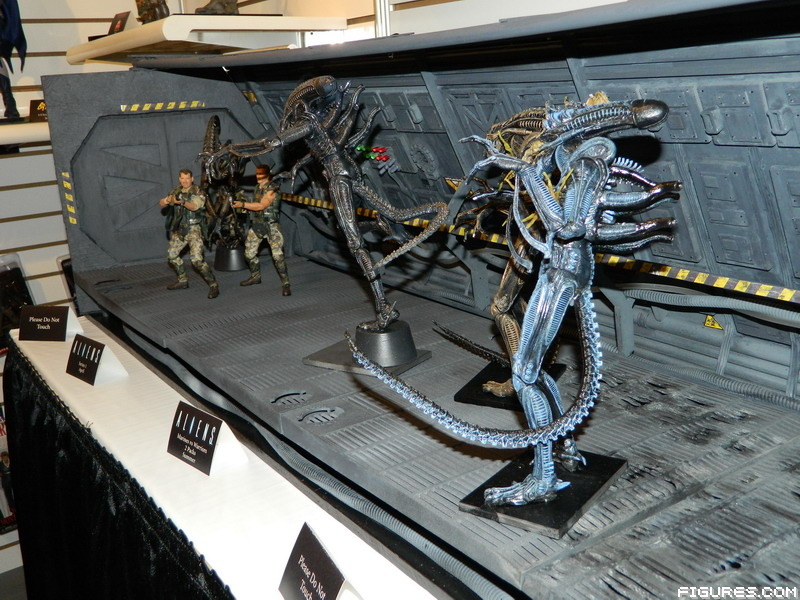
With the eagerly awaited Aliens: Colonial Marines video game arriving this week, some Aliens merchandise will also be appearing on toy store shelves as well. NECA's contributions to the Aliens revival include action figures based on the Colonial Marines characters from Aliens--namely, Hicks and Hudson--and Alien Warriors with varying degrees of battle damage. Whether NECA will continue its Aliens line to include nods to Kenner's Aliens toy line from the 90s remains to be seen.


Robocop

NECA hasn't done much with the Robocop toy license so far, although it deserves kudos for finally giving fans a Robocop figure with a movie-accurate spring-loaded pistol holder built into the figure's right thigh. As an encore to that accomplishment, NECA will be releasing an ED-209 figure this summer.


Pacific Rim

Speaking of robots, Robocop isn't the only mech-centric license in NECA's portfolio. NECA has also picked up the toy license for Pacific Rim, Guillermo del Toro's kaiju-vs.-giant-robots epic that will hit movie theaters later this year. So far, NECA's Pacific Rim line includes three robots from the movie: Gypsy Danger, Crimson Typhoon and Striker Eureka.


Batman

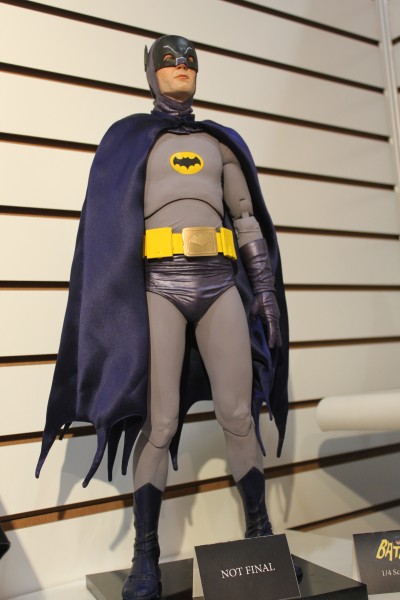
Like many other toy companies, NECA has eagerly jumped on the superhero bandwagon in the search of blockbuster profits. Upcoming NECA figures include versions of Captain America and Iron Man that are based on the latest live-action films; however, when it comes to Batman, NECA has decided to go retro with Batman figures based on the Adam West and Michael Keaton versions of the classic DC superhero.


NECA isn't the only company to look to the past for future superhero toys. Mattel plans to release a full series of action figures and vehicles based on the 1966 live-action Batman TV series.


A Promising Ghost Story Gets Orphaned in The Orphanage (2007)

0 comments

Did you ever watch a movie that you want to like but you simply can't because it doesn't adhere to its own internal logic? If you do, then you know how I feel about The Orphanage, a 2007 Spanish horror film directed by Juan Antonio Bayona.


The Orphanage is about Laura (Belen Rueda) and her husband Carlos (Fernando Cayo) who are renovating an orphanage into a home for special needs children. Laura herself was an orphan at the very same orphanage that she and her husband are restoring and they even have an adopted child of their own, Simon (Roger Princep). A series of mysterious incidents begin to occur as Laura and Carlos prepare the building for new occupants, incidents that culminate with the disappearance of Simon on the very day of the orphanage's reopening. Laura's subsequent search for Simon leads her into the building's forgotten past and the dark secrets that it hides.

As a gothic ghost story, The Orphanage drips with unrealized potential. The cinematography is gorgeous and creepy in equal measures, the underlying themes and symbolism adds emotional weight to story's proceedings, and performances given by the principle cast make you feel for the characters and their plight. The story builds to a crushing and bittersweet finale, but that feeling rapidly fades when you begin to think about the story and realize that much of its details don't make sense. Character motivations and actions don't add up, and curious details surface that go unresolved even though they should not. There's even a hidden door that plays a major part in the story, yet it doesn't take much to realize that the details behind the door--who finds it, how it is found, and why it was hidden in the first place--weren't very well thought out by the script writer.

Overall, the viewing experience that comes from seeing The Orphanage is akin to waking up from an intense, feverish dream and then realizing that what you just experienced--regardless of its emotional power--can't stand up to the scrutiny of conscious thought. In that regard, it felt like this movie was just a few script rewrites away from being a better movie. Perhaps if one or more of the secondary characters, subplots or themes had been removed, the total narrative would be greater than the sum of its many parts.

In his review, Roger Ebert wrote that The Orphanage "is deliberately aimed at viewers with developed attention spans". I think that the exact opposite is true: The viewers who pay close attention to the film's minutia will be the ones who find its biggest faults, regardless of how deftly the film appears to utilize the narrative conventions that are common in stories about ghosts and haunted houses. Without giving too much away, it would seem that the moral of The Orphanage is that if anyone ever goes missing in or around a recently renovated building, please be sure to check the building's blueprints before consulting with a psychic. Speaking as a horror fan, this is not the kind of concluding message that any decent fright flick should leave with its audience.


A Deviant Artist Takes a Closer Look at Mimic's Judas Breed Bugs

0 comments


As anyone who follows this blog knows, I'm a huge fan of monster art. In particular, I'm an avid collector of various mediums (books, magazines, toys, and scale miniatures) that provide accurate and detailed representations of certain movie monster designs that I consider to be art. Such designs would include the mechanical shark from Jaws, the biomechanical parasites from Alien, the submersible monster suit from The Creature from the Black Lagoon, and the various stop-motion puppets that Willis O'Brien and Ray Harryhausen used throughout their respective careers in movie special effects. Such an interest becomes an exercise in frustration when I find a movie monster design that I like but I cannot find any pictures or miniatures that provide me with a clear look at the design. Case in point: the Judas Breed insects, the giant GMOs from Guillermo del Toro's Mimic (1997) and its two sequels.

As demonstrated in the behind-the-scenes featurettes that were provided in the recent Blu-ray release of the Mimic director's cut, del Toro and his Mimic crew put a lot of work into the Judas Breed, both in terms of their fictional biology and the effects that were used to bring the creatures to life. Unfortunately, even the high-resolution images provided in the Blu-ray release didn't provide any clear pictures of what a Judas Breed insect looks like in its entirety. On the other hand, the only pictures I can find of the Judas Breed online are either incomplete or murky.

Thankfully, I have just found someone online who not only has a mutual interest in the Judas Breed design, but also has the talent to produce detailed pictures of what del Toro's carnivorous and camouflage-capable critters look like, both in the original movie and in the sequels. The Mexican artist in question goes under the screen name of BlackCoatl, and he added his Judas Breed pictures to his account on the deviantART site a few months ago. Click below to see BlackCoatl's beautiful renderings of the different Judas Breed designs, as well as some additional thoughts about the designs and their changes in the sequels.

The first picture below is of an adult Judas Breed female as it was seen in Mimic. Not only is this an accurate depiction of the creature's complete design, but it is also reminiscent of the scene in the movie when Dr. Susan Tyler (Mira Sorvino) has her first encounter with the mutated, human-sized version of her creation in a subway station in New York. If you take a close look at the creature's thorax, you will see where the creature's "lungs" are located that provide enough oxygen to sustain its larger size.


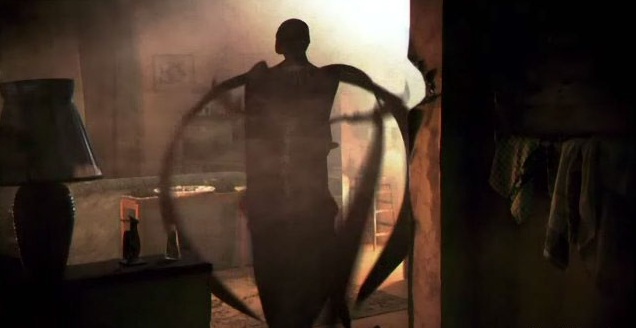
The second picture is of a wingless adult male as it was seen Mimic. You can see the females in the background assuming their mimicry of humans through a rearrangement of their wings and limbs; because the male lacks wings, he cannot mimic the appearance of humans at all. The lighter color of the male is a holdover detail from one of the earlier screenplay drafts, which featured a much different ending from the final cut.


The third picture is of the lone winged adult male from Mimic 2 (2001). This same design was used again in Mimic 3 (2003). While each Mimic film utilized CGI effects and life-sized puppets for the Judas Breed, the sequels also used actors in costume for tight, close-up shots. Because the sequels were produced on a much lower budget than the first film, I'm assuming that it was cheaper in some scenes to put an actor into a Judas Breed costume than to build a highly-detailed animatronic puppet. To better accommodate the actors in the suits, the Judas Breed was redesigned with a larger thorax, larger eyes, and different mandibles. So far, BlackCoatl has not produced a drawing of the winged male's appearance after his last metamorphosis at the end of Mimic 2.


A photo of a Judas Breed head from Mimic 2
(photo courtesy of the YourProps site).


A Judas Breed insect after its final metamorphosis in Mimic 2.


Click here to see all of BlackCoatl's work on DeviantART, which includes depictions of monsters from other movies such as Gremlins, Hellraiser and Pumpkinhead. The Mimic pictures can be found in the gallery folder named "Mutants", which includes pictures of other insect and arachnid horrors from movies such as Mansquito (2005) and the remakes of The Fly (1986) and Earth vs. the Spider (2001). Click here to read more about del Toro’s creation of the Judas Breed on the Monster Legacy site.


Don’t Be Afraid of the Dark and The Gate: Tiny Terrors Times Two

0 comments


Way back in August 2010, I posted some thoughts about Guillermo del Toro’s then-unreleased remake of Don’t Be Afraid of the Dark, a TV movie from 1973 that’s become a cult classic among horror fans. I had an open mind about what the end product would be like based on del Toro’s previous work, although I had some reservations based on de Toro’s decisions to make the movie a “dark fairy tale” and changing the main character from an adult woman named Sally (Kim Darby) who is in a failing marriage to a little girl named Sally (Bailee Madison) who is visiting her divorced father and his new girlfriend. Unfortunately, my misgivings were right: I just saw del Toro’s remake, which he co-wrote and produced, and his changes to the original story only hindered its overall effectiveness as a horror movie. Even Troy Nixey’s capable direction couldn’t turn this remake into something that improves upon its low-budget predecessor.

Yet as I was thinking about how I’d review the Don’t Be Afraid of the Dark remake, I found myself remembering about another movie that pit kids against pint-sized monsters: The Gate, a film from 1986 that was directed by Tibor Takács. The Gate certified its place in movie trivia by outperforming Ishtar, one of the most notorious big-budget flops in American movie history, but it’s also a great example of how to tell a dark fairy tale that’s worth watching. Read on for my comparison, with some minor spoilers.

To be sure, the original version of Don’t Be Afraid of the Dark isn’t one of the best horror films ever made. What made it memorable, though, is that it was made by talented people who understood the significant limitations with which they were faced--especially in terms of a meager production budget and the TV movie format--and successfully applied their skills within those limits. In doing so, the movie not only kept the appearance of the monsters to a minimum, but it also kept the details behind the monsters’ origin as vague as possible.

On the basis of what you see in the movie, you can piece together that the monsters were probably summoned from another hell-like dimension through some kind of dark magic and then couldn’t (or wouldn't) be sent away, although none of the characters say as much. You hear the monsters much more than you see them, and what they say amongst themselves indicate just how sadistic and obsessive they really are. By keeping the monsters vague--their origins, their capabilities, and their intentions--the movie maintains eerie mood of tense uncertainty. Adding to the tension is how the presence of the monsters accentuates the growing rift between Sally and her husband Alex (Jim Hutton), all the way to the film’s grim, creepy conclusion.


By changing the nature of the monsters and the age of the main character, del Toro winds up putting more limitations on his remake than the mandatory ones faced by his predecessors. In the remake, it is explained that the monsters are some kind of creatures from ancient folklore who may have some connection to the Tooth Fairy legend, but that explanation sets up many inconsistencies within the narrative that are more frustrating than scary. For example, these creatures are said to crave children’s teeth every hundred years, but the end of the movie suggests that they’re just as content to go another hundred years without any children’s teeth at all (?). While I can imagine del Toro thinking that strained relationship between the child Sally and her divorced father would have the same dramatic effect as the original’s adult Sally and her career-driven husband, that plot thread quickly diminishes into the cliché of parental characters who refuse to believe their children when they see ghosts, monsters, and other improbable frights.

To accommodate del Toro’s changes yet still justify keeping both the title Don’t Be Afraid of the Dark and its PG-13 rating, the remake restrains itself frequently so that it doesn’t become as horrifying and vicious as it could be. In doing so, the characters--both human and inhuman--become dumber than their TV movie counterparts. The monsters appear to be as adept with tools as they were in the original, but they also announce their presence to Sally many times, they attack her in ways that don’t really hurt her, and they ignore the tactic of stealth enough so that even the clueless adults realize what’s happening by the film’s climax. Then again, adults aren’t that much smarter: Even after they accept the danger that Sally is facing, they still are willing to leave her alone in her room. Finally, I don’t care how bad the divorce of Sally’s parents was, she still shouldn’t be talking to strangers--especially strangers who are locked behind a tiny metal door in the basement of a long deserted mansion.

It should be noted that in an interview with Cineaste magazine about Don’t Be Afraid of the Dark, del Toro stated, “I love the Welsh author Arthur Machen and his idea that fairy lore comes from a dark place, that it’s derived from little, pre-human creatures who are really, really nasty vermin but are magical in a way, living as they do for hundreds of years. His books are what compelled me to do this.” (Machen is even mentioned by name in one scene of the remake.) With such intentions in mind, I can only wonder: Why doesn’t del Toro make a completely new movie based on the works of Machen, instead of trying to insert a Machen-inspired story thread into a remake of a TV movie that gained its cult classic status without such a thread in the first place?


In contrast to del Toro’s remake is The Gate. The Gate is about a young boy named Glen (Stephen Dorff) who notices that the hole left behind by the tree that was removed from his backyard is starting to exhibit unusual features. While his parents are away and his is left in the care of his sister Al (Christa Denton), Glen and his friend Terry (Louis Tripp) discover that the hole is actually a gateway to a nightmarish dimension populated by Lovecraftian horrors that are determined to take back the world, and the gate is slowly opening....

Like Don’t Be Afraid of the Dark, The Gate is rated PG-13; unlike Dark, director Takács and his crew had a better understanding of how to tell a spooky, kid-centric story than del Toro and Nixey. In particular, The Gate is told from the perspective of its three adolescent leads, and the few of adult characters that are in the movie only appear for a few minutes. By approaching its horrors from a more innocent, wide-eyed perspective, the movie lets the vivid imaginations of its adolescent protagonists--not the overuse of expensive special effects--set the tone of unease. This works better in establishing a dark fairy tale setting, as opposed to literally placing monstrous folklore characters into a story that's largely populated by adults. Then again, The Gate uses its own kind of folklore: in particular, the 80s era belief of some that heavy metal music is a deliberate recruiting tool for Satan worship. The movie's running gag is how Glen and Terry regularly consult the liner notes from a Canadian heavy metal album for information about demons, magical incantations, and inter-dimensional portals. (Blame Canada, indeed!)

The Gate’s loose and relaxed rules about the monsters that emerge from the hole in Glen’s backyard appropriately match the story’s setting and characters. There seems to be no limit to what can emerge out of the hole: a rotting zombie, shape-shifters, forces of levitation, telephone-melting possessions, and even a gigantic, multi-limbed demon all come out of the hole. (In that aspect, this movie feels like what one of Lucio Fulci’s “Gates of Hell” movies would’ve been like if he decided to make one with kids as the main characters.) Yet what this film is most known for is its horde of pint-sized demonic minions that terrorize Glen, Terry and Al. What the minions lack in intellect they more than make up for number and determination, and the forced perspective effects techniques that were used to bring the foot-tall freaks to life are much more impressive than the CGI-created monsters in Don’t Be Afraid of the Dark.


When looking at The Gate and the remake of Don’t Be Afraid of the Dark, I can only conclude that the imaginative application of low-budget practical effects to a simple yet solid script create a much more memorable film than the erroneous application of big-budget effects and sets to an overcomplicated and underwhelming script. Even though I admire del Toro’s other work and his understanding of the horror genre, his attempt to breathe new creative life into Don’t Be Afraid of the Dark is a frustrating failure that’s best left unseen. The original 1973 movie left plenty of room for improvement (if not direct continuation), but del Toro chose to impose his own ill-fitting vision on an original story instead of exploring and enriching the strengths that the story already had. I would recommend that horror fans either revisit the original Don’t Be Afraid of the Dark or see The Gate for great examples of how big scares that give kids big nightmares can come in very small, low-budget sizes.


Puss In Boots Review: A Comedic Computer-Generated Cat Caper in 3D

0 comments


When I first heard that DreamWorks was planning a movie spin-off to their Shrek franchise that featured Puss in Boots as the main character, I was somewhat skeptical. After all, Shrek was scraping the bottom of the barrel of fairy tale satire by the end of its four-movie run, so I couldn't imagine that there'd be much left for a stand-alone Puss in Boots movie. Thankfully, I was proven wrong: Puss in Boots is a fun, goofy adventure that's fit for audiences of all ages.

Puss in Boots follows the adventures of its titular character (voiced by Antonio Banderas) as he partners with mastermind Humpty "Alexander" Dumpty (Zach Galifianakis) and feline thief extraordinaire Kitty Softpaws (Salma Hayek) for a big score: the fabled golden egg-laying goose from a particular giant-dwelling castle in the clouds.

Puss in Boots isn't as cheeky as the Shrek movies, and that ultimately works in its favor. Instead of saturating the script with pop culture references and taking repeated jabs at Disney's interpretations of classic fairy tales--and at Disney itself--Puss in Boots milks most of its humor from the inherent absurdity of fairy tales, action-adventure movies, anthropomorphized animals and eggs, and its own warped interpretations of fairy tale characters. (The versions of Jack and Jill that appear in this movie have to be seen to be believed.) Overall, the movie looks and feels like a Sergio Leone-esque Spaghetti Western set in an off-kilter fairy tale world and it works wonderfully. Hayao Miyazaki fans will also find themselves having brief flashbacks to Castle in the Sky, particularly during the unexpectedly touching resolution to one of the key character's narrative arcs.

The voice acting is solid across the board, but a lion's share of the film's charm lies with Banderas' portrayal of Puss. Banderas clearly has a blast playing this character, and I envy the production team that got to watch him record his lines.

Of course, adding considerably to my viewing pleasure was how I saw Puss in Boots--in IMAX 3D. I have yet to see a feature-length CGI cartoon in 3D that has disappointed me in its visual quality but Puss in Boots in particular makes ample use of the 3D format, which adds an extra crispness to its many wide-angle vista shots of the desert, its action scenes, and its multi-layered city landscapes.


Oxitec is Remaking Mimic--with Mosquitoes!

0 comments


My, how times have changed. In the 1997 movie Mimic, scientists genetically engineer a breed of insect that's intended to reduce the population of cockroaches in New York City that are spreading a lethal virus. Fast-forward to 2011, and such a premise is no longer science fiction. According to last Sunday's edition of The New York Times:

"Researchers on Sunday reported initial signs of success from the first release into the environment of mosquitoes engineered to pass a lethal gene to their offspring, killing them before they reach adulthood. The results, and other work elsewhere, could herald an age in which genetically modified insects will be used to help control agricultural pests and insect-borne diseases like dengue fever and malaria. ... Authorities in the Florida Keys, which in 2009 experienced its first cases of dengue fever in decades, hope to conduct an open-air test of the modified mosquitoes as early as December, pending approval from the Agriculture Department."

What could possibly go wrong, you ask? Some of the engineered mosquitoes could develop immunity to the lethal gene and pass that resistance to their offspring, which could very well make them harder to kill in the long run. Since this is for a good cause, I would like to see this effort succeed. I'm just hoping that none of these genetically-tampered bugs wind up looking like this guy:


Pictures of Insect Men: A Retrospective Analysis of the Mimic Trilogy

0 comments


This week marks the release of the Mimic director's cut on Blu-ray, which includes all sorts of brand new goodies. I haven't gotten my copy yet, but I will soon. I heard that even though the new cut still doesn't have the ending that Guillermo del Toro wanted, it's closer to his original vision than the theatrical cut. I've also heard that del Toro's commentary track provides a lot interesting details as to how Mimic became less about what he wanted and more about what the producers wanted. (Then again, I don't think that the new director's cut further explores one of Mimic's grimly funny ideas, that a population of giant carnivorous insects could grow under the very nose of America's largest city but as long as the critters stay in the shadows and relegate their carnivorous diet to society's outcasts--the homeless, stray animals, and larger vermin such as rats--no one would really notice.)

Until I can put my two cents in about the new cut, here's a (slightly edited) reprint of an article I wrote that was originally posted on PopPolitics.com back in 2008. It's a retrospective of the entire Mimic trilogy, the original 1997 movie and its two direct-to-DVD sequels. All three movies were loosely inspired by a short story of the same name that was written by Donald A. Wolheim in 1942. This article examined how concepts and issues that are specific to genetic research and their related environmental impacts permeate the Mimic films, thus making them different from their irradiated Atomic Age "Big Bug" predecessors and worthy of unique consideration. Read on ....

For those of you who are not familiar with the Mimic trilogy, here's a summary of each film:

* Mimic (1997): The film begins with children in New York City dying in droves because of Strickler's Disease, a respiratory illness that was found to be transmitted by the common cockroach. To eradicate the disease, entomologist Dr. Susan Tyler (Mira Sorvino) genetically engineers the Judas Breed, an insect species designed to eradicate Strickler's Disease by attracting and killing the roaches, and then dying off when their intended purpose is fulfilled. Three years later, a series bizarre deaths and occurrences lead Tyler to discover that the Judas Breed didn't die after all, but mutated into six-foot tall, sewer-dwelling predators that have the capability to visually 'mimic' their prey: human beings.

* Mimic 2: Hardshell (2001): A lone male Judas Breed relocates a horde of Judas Breed larvae (presumably the offspring of the Judas Breed nest from the first film) into the basement of a run-down NYC school, a school where Remi Panos (Alix Koromzay), Dr. Tyler's assistant from the first film, teaches science classes. During the course of the story, Remi learns that not only is the monster stalking her and killing her potential boyfriends with the intent of making her the queen of his new nest, but that this particular Judas Breed has also gotten much better at mimicking humans.

* Mimic 3: Sentinel (2003): Marvin Montrose (Karl Geary) is the protagonist, a survivor of the Strickler's Disease epidemic in the first film. The illness had left his health in such poor condition that he has been restricted to living with his family in a dilapidated apartment building in the NYC slums. Limited to his room and a hobby of voyeuristic photography, he notices suspicious activity in his building suggesting that a nest of Judas Breed monsters are feeding on his neighbors.


The Mimic films are Big Bug movies, a horror movie sub-genre that is largely regarded as a relic of American 1950s cinema. Insects are the ideal choice for evoking fear in films, because their general appearance--multiple eyes, coarse hairs, and a seemingly endless arrangement of twitching legs, mandibles, antennae, and wings--is enough to make anyone's skin crawl and the Mimic films use those attributes to great effect. However, the plot device of man’s dominance over nature being challenged by oversized animals has been with cinema since its early days, in films such as the silent adaptation of Arthur Conan Doyle's The Lost World (1925) and the early monster classic King Kong (1933).

While other animals have gotten nasty cases of gigantism through reckless science in the sci-fi/horror genre, movies where insects and arachnids become the giants emphasize both the absurdity and the alienating horror of the big beast narrative. The absurdity comes with something so small becoming so impossibly large, while the alienation and horror come from the idea of coming face to face with something so repulsive and inhuman and yet so deeply embedded within the natural world. Indeed, movies where people are attacked by giant insects--particularly as by-products of scientific negligence--could be seen as a statement of how alienated humanity has become from the natural world and its most abundant inhabitants: the insects.

A common plot device for Big Bug movies is that something related to atomic power, either in the form of atomic bomb testing or scientific research involving radiation, causes insects or arachnids to grow to mammoth proportions. Even though atomic power is blamed for gigantism in the Big Bug movies, their most obvious literary predecessor is H.G. Wells' 1904 novel The Food of the Gods and How it Came to Earth, where giant rats, worms and wasps are the result of careless chemical testing on food supplies.


Some have dismissed the Mimic films as just updated versions of the Big Bug movie, particularly Them! (1954), with "genetic tampering" replacing "atomic radiation" as the public phobia du jour[1]. However, a significant difference between the Mimic films and their predecessors and counterparts is the location of the monsters' origin. Where most Big Bug movies feature the monsters originating in some remote location (a desert, a cave, even the arctic) and then later posing a threat to a large human population, the Mimic monsters are purely creatures of the city: it is where they were created, evolved, and reside in all three movies.

The shift in location of the man-made monsters' birthplace in Big Bug movies could be a reflection of the shift in how people view the idea of environmental corruption: modern ecological awareness has led many to see the problem of environmental corruption as something happening within one's own living environment. The 20th century saw a number of health hazards associated with urban living, including asbestos, lead paint, inadequate waste disposal, and vermin such as bed bugs. In fact, the cockroach-spread Strickler's Disease in the Mimic movies is sort of an exaggerated nightmare of research findings that indicate how cockroach allergens contribute to the increase in asthma cases in urban areas.

The internalization of ecological concerns into urban settings is symbolized in the Judas Breed's appearance. Most other Big Bugs are just a species of insect or arachnid made large, either the size of a car or bigger; once these monsters are found by the protagonists, they are hard to miss. In contrast, the Judas Breed can walk among us unnoticed--in dark subway stations, alleys, and slums--due to their human-mimicking ability.


There is something oddly compelling about the Judas Breed's shape-changing: unlike the near-flawless pod clones from the Invasion of the Body Snatchers movies or the various types of humanoid robots from the Terminator series, the Judas Breeds' ability to imitate humans is both limited and clumsy, only effective in shadows or at a distance. The Judas Breeds' appearance when they imitate humans is like when insects imitate twigs, leaves, or other insects. Seeing this natural survival strategy become part of an artificial, urban environment gives it an exotic, alien aura, further emphasizing the theme of humanity's disconnect from nature. The overall effect of the Judas Breed's deception was best described by Roger Ebert in his review of Mimic: "We're instinctively frightened when an entity looks like one thing and suddenly reveals itself as something else. ... As for the insect predators, what they have learned to mimic, and how they do it, provides one of the best payoff shots in the movie."

Then again, the end result of the Judas Breeds' metamorphosis provides a commentary of its own. The insects look like a giant mantis/termite/cockroach crossbreed with various exoskeletal growths that, when shifted around, appear to look like something vaguely human. Their malformed appearance symbolizes the increased media coverage in recent years of the horrible disfigurement of animals that have been subjected to chemical poisoning, resulting in fish and frogs with multiple limbs or hermaphrodite anatomies. It also reflects modern biological experimentation that has allowed scientists in 1997 to grow human ears on the backs of mice and genetic research that incorporated jellyfish DNA into rabbits and pigs, resulting in glow-in-the-dark animals.


As Big Bug movies go, the Mimic movies have much in common with the The Fly (1958), its 1986 remake, and their various sequels when it comes to the narrative and visual themes of insect and human worlds suddenly fusing together in haphazard, grotesque arrangements that are horrifying, preposterous and tragic in equal measures. For example, the title monster of the original Fly movie is somewhat like the Judas Breed, in the sense that both are genetically-spliced, underground-dwelling, human-sized monsters who hide their insect identities behind awkward, makeshift masks. There are parallels between the classic scene in The Fly, when Helene Delambre (Patricia Owens) pulls the hood away from her husband's head only to see the enlarged face of a housefly, and in Mimic, when Dr. Tyler suddenly sees a full-sized Judas Breed insect unwrap itself out of its human disguise for the first time.

The Fly/Mimic connection is more evident in Mimic 2, which is essentially The Fly in reverse: instead of a man becoming more like an insect, Mimic 2 features an insect slowly becoming more like a man. The ending of Mimic 2, when Remi's Judas Breed admirer shows up at her front door to 'date' her, is likewise very similar to the freakish imagery in The Fly movies.


If the Mimic movies have anything in ample supply, it's irony. The most obvious irony is in the creation and development of the Judas Breed themselves: they were created as bugs that could 'fool' real cockroaches for the purpose of killing them, and then they mutated into something that can 'fool' people for a similar predatory purpose. Likewise, with their original intent as a solution to Strickler's Disease, the Judas Breed put a new ironic spin on the term 'superbug', a term coined to describe an infectious bacterium that is antibiotic-resistant.

In each Mimic film, there is an ironic yet parallel connection between the human protagonists and the Judas Breed:

* In Mimic, even though Dr. Tyler saved countless children through her research and her scientific offspring of genetically modified insects have become much more fertile than she intended, she herself is unable to conceive a child with her husband, Dr. Peter Mann (Jeremy Northam). In contrast, her Judas Breed creations reproduce with great success, even though they were intended to die off after they served their original purpose.

* In Mimic 2, Remi cannot find a boyfriend who understands her but nevertheless cannot shake the sexual designs of a male Judas Breed insect--a suitor that Remi understands better than her human suitors because of her background in entomology. This plot of cross-species attraction is an extension of both the Judas Breed's transgenic creation and the fertility/infertility theme from the first movie. Remi's habit of taking photos of her own face when she is dumped is also paralleled in the lone Judas Breed's ability to attach the faces of its victims--the same people who dumped Remi--to its exoskeleton for better mimicry of people.

* In Mimic 3, Marvin survives Strickler's Disease only to become an asthmatic bubble boy stuck in his room, while the very things that ended the Stricker's epidemic are freely roaming the streets and systematically slaughtering Marvin's neighbors[2].

Another recurring irony in the Mimic movies is photography. The films' protagonists use photography to identify the presence of the Judas Breed menace. This theme complements the Judas Breed's capability for deception, that the human eye cannot be trusted to identify such well-hidden threats. However, the characters' reliance on photography to find the monsters also indicates that technology is more adept at noticing environmental problems than humans; in other words, humans are so far removed from the natural world that we need technology to identify when our technology wreaks havoc with nature.


Plot details aside, the pervasive ironies in the Mimic series allows for commentary on some real issues:

Genetic Modification: Even though the Mimic monsters in reviews and plot summaries are referred to as "giant cockroaches", the Judas Breed are a hybrid of cockroaches, preying mantises, and termites; to use real-world terminology, the Judas Breed are genetically modified organisms (GMOs), particularly one of a transgenic variety. The plot device of elaborate, inter-species genetic splicing is supposed to give plausibility to the Judas Breed's later changes in size and shape, as if to say that humanity's tampering with the genetic code of several insect breeds somehow (to use firearms terminology) took the safety off of nature's mandated order of gradual mutation and evolution. The notion that genetic tampering could result in uncontrollable dangers is further emphasized in the first Mimic film when the Judas Breed were supposed to self-terminate shortly after they fulfilled their purpose--thus limiting their environmental impact to only the cockroaches that served as a vector for the propagation of Strickler's Disease--but instead propagated out of control.

Anti-Vaccination Fears: By intertwining the creation and existence of the Judas Breed with Strickler's Disease--as well as making children frequent victims of the giant insects in all three films--bears symbolic similarities to recent efforts by the anti-vaccination movement. In other words, scientific solutions designed to protect children from disease that in turn endangers them is the underlying premise of the both Mimic trilogy and anti-vaccination paranoia. Coincidentally, the MMR (mumps-measles-rubella) vaccine has been accused of promoting autism, while the only child who survives a close encounter with the Judas Breed in the first Mimic film is obviously autistic.

On a deeper level of irony, director Guillermo del Toro uses Christian imagery throughout the first film to argue that scientists "shouldn't play God" in spite of their efforts to fight a child-killing disease[3] (as if the name "Judas Breed" wasn’t enough of a nod to religious themes). In contrast, some people actually use their religious beliefs as a reason to either exempt their children from vaccinations or to justify denying them medical treatment. Del Toro does not specify in his film when science actually should intervene in the natural order to save lives (you'd think he'd be more sympathetic to the Dr. Tyler character for all of the lives she saved as the result of her work[4]), and the parents in the real world who refuse to immunize or give proper medical care to their children for religious reasons have not offered any remedies to when children die as the result of such beliefs.

Urbanization and Species Displacement: While the underclass are usually the victims of the urban-dwelling Judas Breed monsters, many animals have been reported raiding dumpsters in large cities. Some animals normally thought of as wild (such as raccoons and monkeys in India) have become "urban wildlife", animals that are extremely adept at adjusting their behavior to exist in large cities--essentially, the real-world Judas Breeds. The supreme irony that permeates the Mimic trilogy is that the genetically-engineered bugs are much better suited to survive and thrive in filthy, disease-ridden urban environments than the people who built and live in them. In a biological sense, New York City is more of a home to the Judas Breed than its human inhabitants, suggesting that it is humanity that will be displaced from the world of its own making.


Social Class and Technology: Because each of the films takes place in dirty, impoverished, and neglected urban environments, they provide an opportunity for commentary on social class, particularly how poor urban minority communities suffer from disproportionately higher rates of illness due to prolonged exposure to man-made toxins. In the trilogy, there are hints of an allegorical link between the poor and the scientifically-engineered Judas Breed, an allegory that is akin to the Eloi-Morlok relationship in another H.G. Wells' novel, The Time Machine. Where Wells' story portrays the upper and lower classes evolving into different species to the point where the once-exploited now live underground and feed off of the descendants of the exploiters, the Mimic movies show the upper class promising amazing solutions to complex problems, but once the solutions go underground and out of the public eye they ultimately cause more suffering among the underclass. The theme of linking of urban lower class suffering caused by corrupted technology is also found in the cult horror films such as C.H.U.D. and Street Trash.

While the Mimic movies are very inaccurate in their portrayal of how scientific research actually works and what insects are capable of doing in terms of their biology, they nevertheless provide opportunities to examine the larger implications on humanity's relationship with corrupted scientific research and its results. If anything, the relationship between the camouflaged Judas Breed and their human prey are similar to modern problems that stem from science, technology and industry and our relationship to them: they are familiar but indistinguishable shadows against the dimly lit horizon, vague shapes in the periphery that do not make their true forms known until they are standing directly in front of us. If horror films such as the Mimic trilogy can stimulate further discussion on real problems, one can only hope that the most horrifying of technological terrors will remain limited to the silver screen.


FOOTNOTES

1. This is not entirely an inaccurate comparison, because much of the plot of Mimic and its two sequels faithfully follow what film critic Glenn Erickson calls the "generic 50's monster threat movie" template, albeit with some gender switches among the characters: "The menace (revived dinosaur/beast from space/mutated life form/giant insect) first appears in an odd form that leaves baffling clues and various victims dead in mysterious ways. With the aid of a loyal and patient girlfriend type, a young scientist (or scientist wannabe) eventually discovers the real truth of the menace just as it is about to leap to a new level of terror and threaten the whole world. The hero struggles to get official cooperation (martial law/military intervention) and the radical resources (radioactive gun/CO2 fire extinguishers) needed to stem the menace. After some visually exciting mass destruction, quick thinking and plain good luck enable the hero to put things right. With the menace stopped, the fadeout gives us the time to ponder the next step. Are similar threats on the way? Will we be ready?"

2. Mimic 3 has often been thought of as Alfred Hitchcock's "Rear Window" (1954) with giant bugs. However, because the Judas Breed in this sequel succeed in eliminating all of the human obstacles between Marvin and his love interest, Carmen (Rebecca Mader), Mimic 3 also features some similarities to another giant animal movie: the original King Kong. As Danny Peary writes about Kong in his book Guide for the Film Fanatic, "Kong is a manifestation of (Carl) Denham's subconscious. Denham conjures up Kong as a surrogate to battle (Jack) Driscoll for Ann (Darrow)’s love . . . Kong is Denham's female-lusting side--his alter ego." By this rationale, just as Denham's subconscious created Kong to abduct Ann and steal her away from other possible love interests, it could be said that Marvin's subconscious created a nest of Judas Breed monsters--symbols of the same health problem that rendered Marvin impotent--to destroy all things standing in the way of him winning Carmen's love.

3. In a message he posted on a fan site on his feelings about his work on Mimic, Del Toro stated: "The movie tries to be Medieval in its vision of the world. It tries to define the fact that we don't know anything about the order of nature or the real dimension of God's plan. It tries to say something about pride."

4. As commented in the Mimic review on the And You Call Yourself a Scientist! Web site, "Having succeeded in establishing Susan (Tyler)’s credentials, however, Mimic proceeds to treat her, in my opinion, most unfairly. Once again, we have a(n) "expert", a "leader in her field", apparently knowing less about the correct applications of her discipline than anyone else in the world. . . . Yes, Susan's work has spawned giant killer cockroaches (hey, happens to the best of us, right?)--but, as the screenplay bewilderingly fails to stress, it has also achieved exactly what it set out to achieve: it has eradicated Strickler's Disease. Something strange happens in the course of this film. The fact that "an entire generation of children" is at risk at the opening of the story; that there have many, many deaths already, and that nothing approaching a cure or a vaccine has been found; that Susan's actions have saved countless thousands, perhaps even millions of lives, ultimately has less resonance than Manny's hysterical cries of, "How could you do this!?" and Leonard’s angry--and flagrantly untrue and unjust--addendum, "Yeah, you tell her, Manny, 'cos she don't give a goddamn!" This is not to say that Susan should not be held accountable for the unseen consequences of her actions, nor indeed that the end justifies the means; but merely that I think that Mimic could have put rather more effort, rather more emphasis, into presenting the case for the defense."