Showing posts with label Mimic. Show all posts

A Deviant Artist Takes a Closer Look at Mimic's Judas Breed Bugs

0 comments


As anyone who follows this blog knows, I'm a huge fan of monster art. In particular, I'm an avid collector of various mediums (books, magazines, toys, and scale miniatures) that provide accurate and detailed representations of certain movie monster designs that I consider to be art. Such designs would include the mechanical shark from Jaws, the biomechanical parasites from Alien, the submersible monster suit from The Creature from the Black Lagoon, and the various stop-motion puppets that Willis O'Brien and Ray Harryhausen used throughout their respective careers in movie special effects. Such an interest becomes an exercise in frustration when I find a movie monster design that I like but I cannot find any pictures or miniatures that provide me with a clear look at the design. Case in point: the Judas Breed insects, the giant GMOs from Guillermo del Toro's Mimic (1997) and its two sequels.

As demonstrated in the behind-the-scenes featurettes that were provided in the recent Blu-ray release of the Mimic director's cut, del Toro and his Mimic crew put a lot of work into the Judas Breed, both in terms of their fictional biology and the effects that were used to bring the creatures to life. Unfortunately, even the high-resolution images provided in the Blu-ray release didn't provide any clear pictures of what a Judas Breed insect looks like in its entirety. On the other hand, the only pictures I can find of the Judas Breed online are either incomplete or murky.

Thankfully, I have just found someone online who not only has a mutual interest in the Judas Breed design, but also has the talent to produce detailed pictures of what del Toro's carnivorous and camouflage-capable critters look like, both in the original movie and in the sequels. The Mexican artist in question goes under the screen name of BlackCoatl, and he added his Judas Breed pictures to his account on the deviantART site a few months ago. Click below to see BlackCoatl's beautiful renderings of the different Judas Breed designs, as well as some additional thoughts about the designs and their changes in the sequels.

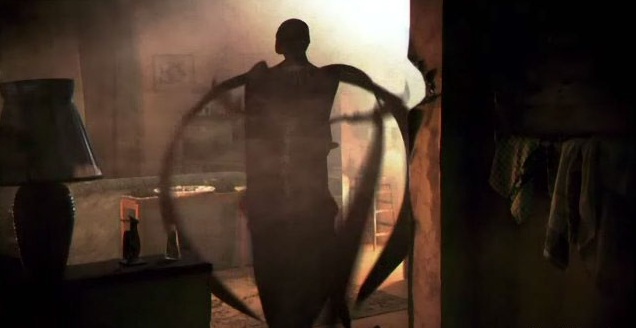
The first picture below is of an adult Judas Breed female as it was seen in Mimic. Not only is this an accurate depiction of the creature's complete design, but it is also reminiscent of the scene in the movie when Dr. Susan Tyler (Mira Sorvino) has her first encounter with the mutated, human-sized version of her creation in a subway station in New York. If you take a close look at the creature's thorax, you will see where the creature's "lungs" are located that provide enough oxygen to sustain its larger size.


The second picture is of a wingless adult male as it was seen Mimic. You can see the females in the background assuming their mimicry of humans through a rearrangement of their wings and limbs; because the male lacks wings, he cannot mimic the appearance of humans at all. The lighter color of the male is a holdover detail from one of the earlier screenplay drafts, which featured a much different ending from the final cut.


The third picture is of the lone winged adult male from Mimic 2 (2001). This same design was used again in Mimic 3 (2003). While each Mimic film utilized CGI effects and life-sized puppets for the Judas Breed, the sequels also used actors in costume for tight, close-up shots. Because the sequels were produced on a much lower budget than the first film, I'm assuming that it was cheaper in some scenes to put an actor into a Judas Breed costume than to build a highly-detailed animatronic puppet. To better accommodate the actors in the suits, the Judas Breed was redesigned with a larger thorax, larger eyes, and different mandibles. So far, BlackCoatl has not produced a drawing of the winged male's appearance after his last metamorphosis at the end of Mimic 2.


A photo of a Judas Breed head from Mimic 2
(photo courtesy of the YourProps site).


A Judas Breed insect after its final metamorphosis in Mimic 2.


Click here to see all of BlackCoatl's work on DeviantART, which includes depictions of monsters from other movies such as Gremlins, Hellraiser and Pumpkinhead. The Mimic pictures can be found in the gallery folder named "Mutants", which includes pictures of other insect and arachnid horrors from movies such as Mansquito (2005) and the remakes of The Fly (1986) and Earth vs. the Spider (2001). Click here to read more about del Toro’s creation of the Judas Breed on the Monster Legacy site.


Oxitec is Remaking Mimic--with Mosquitoes!

0 comments


My, how times have changed. In the 1997 movie Mimic, scientists genetically engineer a breed of insect that's intended to reduce the population of cockroaches in New York City that are spreading a lethal virus. Fast-forward to 2011, and such a premise is no longer science fiction. According to last Sunday's edition of The New York Times:

"Researchers on Sunday reported initial signs of success from the first release into the environment of mosquitoes engineered to pass a lethal gene to their offspring, killing them before they reach adulthood. The results, and other work elsewhere, could herald an age in which genetically modified insects will be used to help control agricultural pests and insect-borne diseases like dengue fever and malaria. ... Authorities in the Florida Keys, which in 2009 experienced its first cases of dengue fever in decades, hope to conduct an open-air test of the modified mosquitoes as early as December, pending approval from the Agriculture Department."

What could possibly go wrong, you ask? Some of the engineered mosquitoes could develop immunity to the lethal gene and pass that resistance to their offspring, which could very well make them harder to kill in the long run. Since this is for a good cause, I would like to see this effort succeed. I'm just hoping that none of these genetically-tampered bugs wind up looking like this guy:


Pictures of Insect Men: A Retrospective Analysis of the Mimic Trilogy

0 comments


This week marks the release of the Mimic director's cut on Blu-ray, which includes all sorts of brand new goodies. I haven't gotten my copy yet, but I will soon. I heard that even though the new cut still doesn't have the ending that Guillermo del Toro wanted, it's closer to his original vision than the theatrical cut. I've also heard that del Toro's commentary track provides a lot interesting details as to how Mimic became less about what he wanted and more about what the producers wanted. (Then again, I don't think that the new director's cut further explores one of Mimic's grimly funny ideas, that a population of giant carnivorous insects could grow under the very nose of America's largest city but as long as the critters stay in the shadows and relegate their carnivorous diet to society's outcasts--the homeless, stray animals, and larger vermin such as rats--no one would really notice.)

Until I can put my two cents in about the new cut, here's a (slightly edited) reprint of an article I wrote that was originally posted on PopPolitics.com back in 2008. It's a retrospective of the entire Mimic trilogy, the original 1997 movie and its two direct-to-DVD sequels. All three movies were loosely inspired by a short story of the same name that was written by Donald A. Wolheim in 1942. This article examined how concepts and issues that are specific to genetic research and their related environmental impacts permeate the Mimic films, thus making them different from their irradiated Atomic Age "Big Bug" predecessors and worthy of unique consideration. Read on ....

For those of you who are not familiar with the Mimic trilogy, here's a summary of each film:

* Mimic (1997): The film begins with children in New York City dying in droves because of Strickler's Disease, a respiratory illness that was found to be transmitted by the common cockroach. To eradicate the disease, entomologist Dr. Susan Tyler (Mira Sorvino) genetically engineers the Judas Breed, an insect species designed to eradicate Strickler's Disease by attracting and killing the roaches, and then dying off when their intended purpose is fulfilled. Three years later, a series bizarre deaths and occurrences lead Tyler to discover that the Judas Breed didn't die after all, but mutated into six-foot tall, sewer-dwelling predators that have the capability to visually 'mimic' their prey: human beings.

* Mimic 2: Hardshell (2001): A lone male Judas Breed relocates a horde of Judas Breed larvae (presumably the offspring of the Judas Breed nest from the first film) into the basement of a run-down NYC school, a school where Remi Panos (Alix Koromzay), Dr. Tyler's assistant from the first film, teaches science classes. During the course of the story, Remi learns that not only is the monster stalking her and killing her potential boyfriends with the intent of making her the queen of his new nest, but that this particular Judas Breed has also gotten much better at mimicking humans.

* Mimic 3: Sentinel (2003): Marvin Montrose (Karl Geary) is the protagonist, a survivor of the Strickler's Disease epidemic in the first film. The illness had left his health in such poor condition that he has been restricted to living with his family in a dilapidated apartment building in the NYC slums. Limited to his room and a hobby of voyeuristic photography, he notices suspicious activity in his building suggesting that a nest of Judas Breed monsters are feeding on his neighbors.


The Mimic films are Big Bug movies, a horror movie sub-genre that is largely regarded as a relic of American 1950s cinema. Insects are the ideal choice for evoking fear in films, because their general appearance--multiple eyes, coarse hairs, and a seemingly endless arrangement of twitching legs, mandibles, antennae, and wings--is enough to make anyone's skin crawl and the Mimic films use those attributes to great effect. However, the plot device of man’s dominance over nature being challenged by oversized animals has been with cinema since its early days, in films such as the silent adaptation of Arthur Conan Doyle's The Lost World (1925) and the early monster classic King Kong (1933).

While other animals have gotten nasty cases of gigantism through reckless science in the sci-fi/horror genre, movies where insects and arachnids become the giants emphasize both the absurdity and the alienating horror of the big beast narrative. The absurdity comes with something so small becoming so impossibly large, while the alienation and horror come from the idea of coming face to face with something so repulsive and inhuman and yet so deeply embedded within the natural world. Indeed, movies where people are attacked by giant insects--particularly as by-products of scientific negligence--could be seen as a statement of how alienated humanity has become from the natural world and its most abundant inhabitants: the insects.

A common plot device for Big Bug movies is that something related to atomic power, either in the form of atomic bomb testing or scientific research involving radiation, causes insects or arachnids to grow to mammoth proportions. Even though atomic power is blamed for gigantism in the Big Bug movies, their most obvious literary predecessor is H.G. Wells' 1904 novel The Food of the Gods and How it Came to Earth, where giant rats, worms and wasps are the result of careless chemical testing on food supplies.


Some have dismissed the Mimic films as just updated versions of the Big Bug movie, particularly Them! (1954), with "genetic tampering" replacing "atomic radiation" as the public phobia du jour[1]. However, a significant difference between the Mimic films and their predecessors and counterparts is the location of the monsters' origin. Where most Big Bug movies feature the monsters originating in some remote location (a desert, a cave, even the arctic) and then later posing a threat to a large human population, the Mimic monsters are purely creatures of the city: it is where they were created, evolved, and reside in all three movies.

The shift in location of the man-made monsters' birthplace in Big Bug movies could be a reflection of the shift in how people view the idea of environmental corruption: modern ecological awareness has led many to see the problem of environmental corruption as something happening within one's own living environment. The 20th century saw a number of health hazards associated with urban living, including asbestos, lead paint, inadequate waste disposal, and vermin such as bed bugs. In fact, the cockroach-spread Strickler's Disease in the Mimic movies is sort of an exaggerated nightmare of research findings that indicate how cockroach allergens contribute to the increase in asthma cases in urban areas.

The internalization of ecological concerns into urban settings is symbolized in the Judas Breed's appearance. Most other Big Bugs are just a species of insect or arachnid made large, either the size of a car or bigger; once these monsters are found by the protagonists, they are hard to miss. In contrast, the Judas Breed can walk among us unnoticed--in dark subway stations, alleys, and slums--due to their human-mimicking ability.


There is something oddly compelling about the Judas Breed's shape-changing: unlike the near-flawless pod clones from the Invasion of the Body Snatchers movies or the various types of humanoid robots from the Terminator series, the Judas Breeds' ability to imitate humans is both limited and clumsy, only effective in shadows or at a distance. The Judas Breeds' appearance when they imitate humans is like when insects imitate twigs, leaves, or other insects. Seeing this natural survival strategy become part of an artificial, urban environment gives it an exotic, alien aura, further emphasizing the theme of humanity's disconnect from nature. The overall effect of the Judas Breed's deception was best described by Roger Ebert in his review of Mimic: "We're instinctively frightened when an entity looks like one thing and suddenly reveals itself as something else. ... As for the insect predators, what they have learned to mimic, and how they do it, provides one of the best payoff shots in the movie."

Then again, the end result of the Judas Breeds' metamorphosis provides a commentary of its own. The insects look like a giant mantis/termite/cockroach crossbreed with various exoskeletal growths that, when shifted around, appear to look like something vaguely human. Their malformed appearance symbolizes the increased media coverage in recent years of the horrible disfigurement of animals that have been subjected to chemical poisoning, resulting in fish and frogs with multiple limbs or hermaphrodite anatomies. It also reflects modern biological experimentation that has allowed scientists in 1997 to grow human ears on the backs of mice and genetic research that incorporated jellyfish DNA into rabbits and pigs, resulting in glow-in-the-dark animals.


As Big Bug movies go, the Mimic movies have much in common with the The Fly (1958), its 1986 remake, and their various sequels when it comes to the narrative and visual themes of insect and human worlds suddenly fusing together in haphazard, grotesque arrangements that are horrifying, preposterous and tragic in equal measures. For example, the title monster of the original Fly movie is somewhat like the Judas Breed, in the sense that both are genetically-spliced, underground-dwelling, human-sized monsters who hide their insect identities behind awkward, makeshift masks. There are parallels between the classic scene in The Fly, when Helene Delambre (Patricia Owens) pulls the hood away from her husband's head only to see the enlarged face of a housefly, and in Mimic, when Dr. Tyler suddenly sees a full-sized Judas Breed insect unwrap itself out of its human disguise for the first time.

The Fly/Mimic connection is more evident in Mimic 2, which is essentially The Fly in reverse: instead of a man becoming more like an insect, Mimic 2 features an insect slowly becoming more like a man. The ending of Mimic 2, when Remi's Judas Breed admirer shows up at her front door to 'date' her, is likewise very similar to the freakish imagery in The Fly movies.


If the Mimic movies have anything in ample supply, it's irony. The most obvious irony is in the creation and development of the Judas Breed themselves: they were created as bugs that could 'fool' real cockroaches for the purpose of killing them, and then they mutated into something that can 'fool' people for a similar predatory purpose. Likewise, with their original intent as a solution to Strickler's Disease, the Judas Breed put a new ironic spin on the term 'superbug', a term coined to describe an infectious bacterium that is antibiotic-resistant.

In each Mimic film, there is an ironic yet parallel connection between the human protagonists and the Judas Breed:

* In Mimic, even though Dr. Tyler saved countless children through her research and her scientific offspring of genetically modified insects have become much more fertile than she intended, she herself is unable to conceive a child with her husband, Dr. Peter Mann (Jeremy Northam). In contrast, her Judas Breed creations reproduce with great success, even though they were intended to die off after they served their original purpose.

* In Mimic 2, Remi cannot find a boyfriend who understands her but nevertheless cannot shake the sexual designs of a male Judas Breed insect--a suitor that Remi understands better than her human suitors because of her background in entomology. This plot of cross-species attraction is an extension of both the Judas Breed's transgenic creation and the fertility/infertility theme from the first movie. Remi's habit of taking photos of her own face when she is dumped is also paralleled in the lone Judas Breed's ability to attach the faces of its victims--the same people who dumped Remi--to its exoskeleton for better mimicry of people.

* In Mimic 3, Marvin survives Strickler's Disease only to become an asthmatic bubble boy stuck in his room, while the very things that ended the Stricker's epidemic are freely roaming the streets and systematically slaughtering Marvin's neighbors[2].

Another recurring irony in the Mimic movies is photography. The films' protagonists use photography to identify the presence of the Judas Breed menace. This theme complements the Judas Breed's capability for deception, that the human eye cannot be trusted to identify such well-hidden threats. However, the characters' reliance on photography to find the monsters also indicates that technology is more adept at noticing environmental problems than humans; in other words, humans are so far removed from the natural world that we need technology to identify when our technology wreaks havoc with nature.


Plot details aside, the pervasive ironies in the Mimic series allows for commentary on some real issues:

Genetic Modification: Even though the Mimic monsters in reviews and plot summaries are referred to as "giant cockroaches", the Judas Breed are a hybrid of cockroaches, preying mantises, and termites; to use real-world terminology, the Judas Breed are genetically modified organisms (GMOs), particularly one of a transgenic variety. The plot device of elaborate, inter-species genetic splicing is supposed to give plausibility to the Judas Breed's later changes in size and shape, as if to say that humanity's tampering with the genetic code of several insect breeds somehow (to use firearms terminology) took the safety off of nature's mandated order of gradual mutation and evolution. The notion that genetic tampering could result in uncontrollable dangers is further emphasized in the first Mimic film when the Judas Breed were supposed to self-terminate shortly after they fulfilled their purpose--thus limiting their environmental impact to only the cockroaches that served as a vector for the propagation of Strickler's Disease--but instead propagated out of control.

Anti-Vaccination Fears: By intertwining the creation and existence of the Judas Breed with Strickler's Disease--as well as making children frequent victims of the giant insects in all three films--bears symbolic similarities to recent efforts by the anti-vaccination movement. In other words, scientific solutions designed to protect children from disease that in turn endangers them is the underlying premise of the both Mimic trilogy and anti-vaccination paranoia. Coincidentally, the MMR (mumps-measles-rubella) vaccine has been accused of promoting autism, while the only child who survives a close encounter with the Judas Breed in the first Mimic film is obviously autistic.

On a deeper level of irony, director Guillermo del Toro uses Christian imagery throughout the first film to argue that scientists "shouldn't play God" in spite of their efforts to fight a child-killing disease[3] (as if the name "Judas Breed" wasn’t enough of a nod to religious themes). In contrast, some people actually use their religious beliefs as a reason to either exempt their children from vaccinations or to justify denying them medical treatment. Del Toro does not specify in his film when science actually should intervene in the natural order to save lives (you'd think he'd be more sympathetic to the Dr. Tyler character for all of the lives she saved as the result of her work[4]), and the parents in the real world who refuse to immunize or give proper medical care to their children for religious reasons have not offered any remedies to when children die as the result of such beliefs.

Urbanization and Species Displacement: While the underclass are usually the victims of the urban-dwelling Judas Breed monsters, many animals have been reported raiding dumpsters in large cities. Some animals normally thought of as wild (such as raccoons and monkeys in India) have become "urban wildlife", animals that are extremely adept at adjusting their behavior to exist in large cities--essentially, the real-world Judas Breeds. The supreme irony that permeates the Mimic trilogy is that the genetically-engineered bugs are much better suited to survive and thrive in filthy, disease-ridden urban environments than the people who built and live in them. In a biological sense, New York City is more of a home to the Judas Breed than its human inhabitants, suggesting that it is humanity that will be displaced from the world of its own making.


Social Class and Technology: Because each of the films takes place in dirty, impoverished, and neglected urban environments, they provide an opportunity for commentary on social class, particularly how poor urban minority communities suffer from disproportionately higher rates of illness due to prolonged exposure to man-made toxins. In the trilogy, there are hints of an allegorical link between the poor and the scientifically-engineered Judas Breed, an allegory that is akin to the Eloi-Morlok relationship in another H.G. Wells' novel, The Time Machine. Where Wells' story portrays the upper and lower classes evolving into different species to the point where the once-exploited now live underground and feed off of the descendants of the exploiters, the Mimic movies show the upper class promising amazing solutions to complex problems, but once the solutions go underground and out of the public eye they ultimately cause more suffering among the underclass. The theme of linking of urban lower class suffering caused by corrupted technology is also found in the cult horror films such as C.H.U.D. and Street Trash.

While the Mimic movies are very inaccurate in their portrayal of how scientific research actually works and what insects are capable of doing in terms of their biology, they nevertheless provide opportunities to examine the larger implications on humanity's relationship with corrupted scientific research and its results. If anything, the relationship between the camouflaged Judas Breed and their human prey are similar to modern problems that stem from science, technology and industry and our relationship to them: they are familiar but indistinguishable shadows against the dimly lit horizon, vague shapes in the periphery that do not make their true forms known until they are standing directly in front of us. If horror films such as the Mimic trilogy can stimulate further discussion on real problems, one can only hope that the most horrifying of technological terrors will remain limited to the silver screen.


FOOTNOTES

1. This is not entirely an inaccurate comparison, because much of the plot of Mimic and its two sequels faithfully follow what film critic Glenn Erickson calls the "generic 50's monster threat movie" template, albeit with some gender switches among the characters: "The menace (revived dinosaur/beast from space/mutated life form/giant insect) first appears in an odd form that leaves baffling clues and various victims dead in mysterious ways. With the aid of a loyal and patient girlfriend type, a young scientist (or scientist wannabe) eventually discovers the real truth of the menace just as it is about to leap to a new level of terror and threaten the whole world. The hero struggles to get official cooperation (martial law/military intervention) and the radical resources (radioactive gun/CO2 fire extinguishers) needed to stem the menace. After some visually exciting mass destruction, quick thinking and plain good luck enable the hero to put things right. With the menace stopped, the fadeout gives us the time to ponder the next step. Are similar threats on the way? Will we be ready?"

2. Mimic 3 has often been thought of as Alfred Hitchcock's "Rear Window" (1954) with giant bugs. However, because the Judas Breed in this sequel succeed in eliminating all of the human obstacles between Marvin and his love interest, Carmen (Rebecca Mader), Mimic 3 also features some similarities to another giant animal movie: the original King Kong. As Danny Peary writes about Kong in his book Guide for the Film Fanatic, "Kong is a manifestation of (Carl) Denham's subconscious. Denham conjures up Kong as a surrogate to battle (Jack) Driscoll for Ann (Darrow)’s love . . . Kong is Denham's female-lusting side--his alter ego." By this rationale, just as Denham's subconscious created Kong to abduct Ann and steal her away from other possible love interests, it could be said that Marvin's subconscious created a nest of Judas Breed monsters--symbols of the same health problem that rendered Marvin impotent--to destroy all things standing in the way of him winning Carmen's love.

3. In a message he posted on a fan site on his feelings about his work on Mimic, Del Toro stated: "The movie tries to be Medieval in its vision of the world. It tries to define the fact that we don't know anything about the order of nature or the real dimension of God's plan. It tries to say something about pride."

4. As commented in the Mimic review on the And You Call Yourself a Scientist! Web site, "Having succeeded in establishing Susan (Tyler)’s credentials, however, Mimic proceeds to treat her, in my opinion, most unfairly. Once again, we have a(n) "expert", a "leader in her field", apparently knowing less about the correct applications of her discipline than anyone else in the world. . . . Yes, Susan's work has spawned giant killer cockroaches (hey, happens to the best of us, right?)--but, as the screenplay bewilderingly fails to stress, it has also achieved exactly what it set out to achieve: it has eradicated Strickler's Disease. Something strange happens in the course of this film. The fact that "an entire generation of children" is at risk at the opening of the story; that there have many, many deaths already, and that nothing approaching a cure or a vaccine has been found; that Susan's actions have saved countless thousands, perhaps even millions of lives, ultimately has less resonance than Manny's hysterical cries of, "How could you do this!?" and Leonard’s angry--and flagrantly untrue and unjust--addendum, "Yeah, you tell her, Manny, 'cos she don't give a goddamn!" This is not to say that Susan should not be held accountable for the unseen consequences of her actions, nor indeed that the end justifies the means; but merely that I think that Mimic could have put rather more effort, rather more emphasis, into presenting the case for the defense."

Mimic: The Director's Cut Blu-Ray Arrives in September

0 comments

Attention all big bug movie lovers! Guillermo del Toro's cut of Mimic, his first Hollywood-produced movie, will be released on Blu-ray on September 27.


I've heard that del Toro ran into quite a few creative conflicts with Miramax Films while he was directing Mimic and rumors have been circulating for years that there was some footage from the cutting room floor still out there waiting to be seen. Presumably, this Blu-ray will incorporate the cut footage back into the movie so we can finally see del Toro's official version of Mimic. Read on for more details, as well as some thoughts regarding the additions to this big bug classic.

According to the press release from Lionsgate, the new Blu-ray of Mimic will include the following features:
  • Video prologue with director Guillermo del Toro
  • Audio commentary with director/co-writer Guillermo Del Toro
  • "Reclaiming Mimic" featurette
  • "A Leap In Evolution: The Creatures of Mimic" featurette
  • "Back Into The Tunnels: Shooting Mimic" featurette
  • Deleted scenes
  • Storyboard animatics
  • Gag reel
Mimic is one of my favorite big bug films, so getting more background information about this movie from del Toro himself is going to be a real treat. (The previous releases of Mimic, both on DVD and Blu-ray, had no special features at all.) However, I've also heard that the new release will only feature seven minutes of added footage, which makes me wonder just how much different this director's cut will be from the studio's cut.

I'm hoping that this new cut will include the original ending that was in the early drafts of the script, an ending that was VERY different from what was released in the theaters (click here to read the original ending). I don't think that this ending will be part of the director's cut, but I could be wrong. It would also be nice if this Blu-ray would include a copy of Donald A. Wollheim's original short story "Mimic", the story upon which the film is based, but it looks like die-hard Mimic fans will still have to hunt that one down themselves. In case you're interested, you can read my review and analysis of the entire Mimic trilogy here.

Now, if only NECA would release a figure of the mutant Judas Breed bug....


Attack of the Giant Lawn Ornament, Part 2: Revenge of Survivor!

0 comments


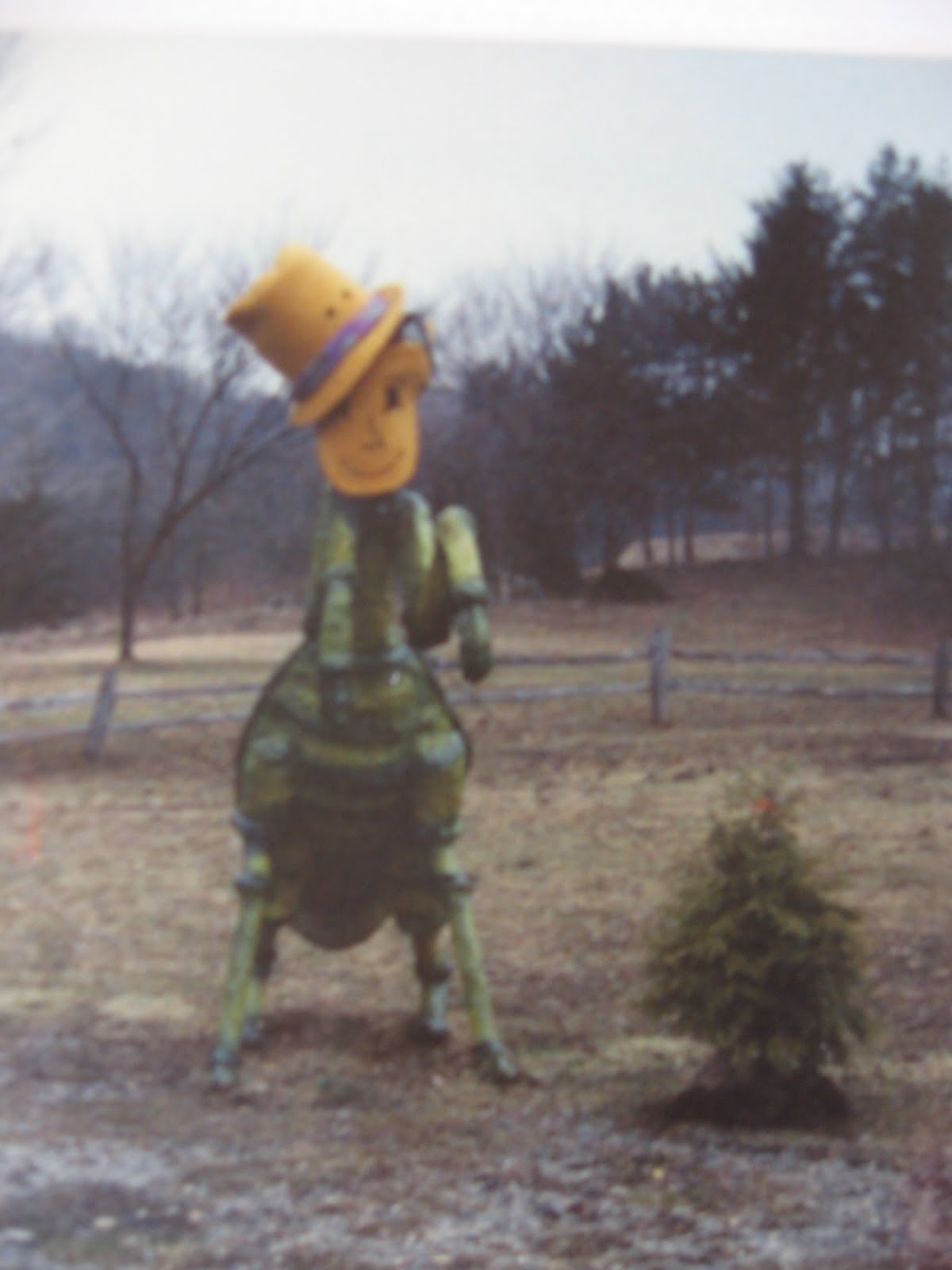
When we last left the big bug lawn ornament in Stoystown, PA, I posted a bunch of pictures on this blog to give you a clear picture of what this 9 foot tall fiberglass mantis looks like. Since then, I've been able to speak directly to the bug's owners at the Second Time Around shop, and they provided plenty of extra information to me about this unique display:

  • The big bug's official name is "Survivor", which was selected as part of a fundraising contest for Easter Seals.
  • Before arriving at Second Time Around, Survivor's previous owner was the proprietor of the Roof Garden Gift Shop in Boswell, PA, which burned down in 1984. The owner purchased Survivor somewhere in Virginia in 1964, along with a companion piece: a large brontosaurus, which is now located in Altoona, PA. (Imagine what kind of spectacular monster movie that would be--Giant Bronto vs. Mega-Mantis!)
  • The owners of Second Time Around regularly dress up Survivor for various events and holidays, such as Halloween and Christmas. 
  • Over the years, Survivor has been shot, vandalized, and stolen--a pretty tough life for a giant insect predator. As the pic above demonstrates, Survivor is no stranger to dismemberment.
Click the link below to see more pictures and articles about Survivor, courtesy of Second Time Around.


Is this a pic of Survivor dressed up, or a never-before-seen production photo of
an early Judas Breed design for Mimic? You be the judge.

So many food choices, so little time.


Write of the Living Dead

0 comments


It's official: I'm now a published author. Centipede Press has published a large book of essays about Night of the Living Dead as part of their "Studies in the Horror Film" series of books and my essay, "Cannibalizing Consumers", is in it. You can read more about the book here.

"Cannibalizing Consumers" was originally part of a series of essays that was included in a 40th anniversary retrospective of Night of the Living Dead on the PopMatters site back in 2008, and it was picked up to be part of the book. If you are so inclined, you can read my original essay here. I'm giddy that my first shot at recognition in an academic publication happens to revolve around the genre-defining film that introduced the world to unstoppable, epidemic, undead cannibalism. Then again, this is isn't just an article publication for me: 1) It's an article published in a series of books about studying horror films, 2) it's an article largely devoted to Night of the Living Dead, and 3) it's an article where I was also able to spend some time discussing Invasion of the Body Snatchers. That's triple nerd score for me!

In case you're interested in reading more of my written works, which are nerd-devotion-thinly-disguised-as-academic-thinking, check out these articles: